AUTHOR: Saad | Fitness Flora / LAST UPDATED: June 2026
Most people searching for a calisthenics program end up with a random YouTube video, a Pinterest board full of disconnected exercises, or a generic PDF with no context, no progressions, and no plan. That stops here.
This guide gives you a complete, structured calisthenics training program PDF you can download for free and start following today. No gym membership. No equipment list running into hundreds of pounds. Just your bodyweight, a clear plan, and eight weeks to build real, functional strength.
Whether you train in a local park, a spare bedroom, or a studio flat in the UK, this program works. I have spent over six years coaching clients through fat loss and strength training using bodyweight methods. The structure in this guide is the same one I use with beginners from day one.
The free calisthenics workout plan PDF is available at the bottom of this page. Read through the full guide first — understanding the why behind each section will make the difference between finishing the eight weeks and giving up by week three.
What Is Calisthenics?
Calisthenics is a form of strength training with calisthenics movements that use your own bodyweight as resistance. Push-ups, pull-ups, dips, squats, and planks are the foundation. No barbells. No machines. No monthly gym fees.
The word comes from the Greek kalos (beauty) and sthenos (strength). That combination is exactly what the training delivers. You build genuine, full body functional strength — the kind that transfers to real life, not just a mirror.
Calisthenics differs from gym training in one critical way. Your body moves through space rather than moving a load through space. That distinction means better coordination, greater joint stability, and significantly lower injury risk. For beginners starting their fitness journey in the UK, it is one of the most accessible and effective entry points into strength training that exists.
Benefits of Calisthenics
Train anywhere, any time. A park bench, a doorframe pull-up bar, or a living room floor is all you need. For anyone in the UK dealing with gym costs that have risen sharply over the past few years, this matters.
Full body calisthenics workout sessions train strength and mobility simultaneously. Every compound movement — the push-up, the pull-up, the squat — demands active flexibility and joint control alongside raw force output. You never have to add a separate stretching routine to fix imbalances created by machine-based training.
Calisthenics for weight loss is genuinely effective because of excess post-exercise oxygen consumption (EPOC). Circuit-style bodyweight training keeps your metabolic rate elevated for hours after the session ends. You burn calories during the workout and continue burning at an elevated rate during recovery.
The training scales to every fitness level. A beginner works with knee push-ups and assisted chin-ups. An advanced practitioner works toward the planche and the one-arm pull-up. The same principles apply at every stage — progressive overload, consistency, and patience.
Joints respond better to bodyweight loading than to heavy barbell work. Tendons and connective tissue strengthen progressively alongside the muscles. This is a significant advantage for anyone with a history of joint discomfort or returning to training after time off.
Core strength calisthenics is built into every movement rather than isolated in a separate abs circuit. A proper push-up demands full core engagement throughout. A pull-up is as much a core exercise as it is an upper-body pull. Your midsection gets trained every session without a single crunch.
Overview of the Calisthenics Training Program PDF
The free calisthenics workout plan PDF covers eight full weeks of structured training. Here is exactly what is inside before you download it.
Duration: 8 weeks
Frequency: 3 to 4 sessions per week
Who it is for: Complete beginners through to early intermediates
What is included: Full warm-up protocol, two training day templates (Day A and Day B), sets and reps for every exercise, a progression guide, rest day structure, and a nutrition overview.
The program is built around two core training days. Day A targets upper body push and pull movements alongside core. Day B targets lower body and core. These alternate across the week with built-in rest days to ensure recovery.
The PDF is formatted to print clearly or read on any device. Every exercise includes a beginner modification so you are never stuck on a move you cannot yet perform.
This is the calisthenics training program PDF I wish had existed when I started coaching. No filler. No unnecessary complexity. Just a clean, honest eight-week plan that works.
Getting Started with Calisthenics
Calisthenics for Beginners
The single biggest mistake beginners make is skipping the foundation. Someone watches a bar calisthenics video, tries a muscle-up in week one, strains their shoulder, and never trains again. The pattern is predictable and entirely avoidable.
Calisthenics for beginners works best when the first four weeks focus exclusively on mastering the foundational movement patterns. Push, pull, squat, hinge, and brace. Everything advanced is built on these five patterns. Master them first.
The starting exercises are not glamorous. Knee push-ups, negative chin-ups (jumping to the bar and lowering slowly), bodyweight squats, glute bridges, and dead bug core holds. These are not easy for someone who has never trained. They are exactly the right place to start.
Form matters more than reps at this stage. A single clean chin-up with full range of motion is worth more than ten half-reps swinging from momentum. I have seen this distinction make or break a beginner’s first eight weeks more times than I can count.
Essential Equipment
The program requires almost nothing. A pull-up bar is the one meaningful addition — available in most UK sports shops or online for £15 to £25. A doorframe model requires no permanent installation and stores away easily.
Optional but useful: a set of gymnastic rings (£30 to £50) and a yoga mat. Every other exercise in the program uses furniture you already own — a chair for step-ups, a floor for everything else.
Do not let equipment become a reason to delay starting. Day B of this program requires nothing at all.
Setting Realistic Goals
Four weeks in: you will push-up with cleaner form, hold a plank for longer, and feel your pull-up negatives getting easier. You will likely notice improved posture and better awareness of how your body moves.
Eight weeks in: meaningful strength gains across all major movement patterns. If your diet is in order, visible fat loss. Possibly your first full chin-up from a dead hang.
In six years of coaching, the clients who set process goals — “I will complete every scheduled session this week” — consistently outperform those chasing outcome goals like “I want to lose a stone in eight weeks.” Set the process. The outcome follows.
The Full Body Calisthenics Workout
Designing Your Workout Plan
Full body calisthenics workout sessions three times per week outperform body-part splits for beginners. The reason is frequency. Squatting three times per week builds the squat faster than squatting once per week. The nervous system adapts through repetition, and beginners are almost entirely neurological learners in the first eight weeks.
The two-day alternating structure — Day A and Day B — balances pushing, pulling, and lower-body volume across the week without overlapping recovery demands. You never train the same pattern on consecutive days.
Core Strength Calisthenics Exercises
Core training in calisthenics is integrated, not isolated. Every session contains direct core work, but every other exercise also demands core engagement to execute correctly.
The six core exercises in this program:
Hollow Body Hold — lie on your back, press your lower back into the floor, raise your legs and shoulders simultaneously. Hold the position. This is the foundation of almost every advanced calisthenics skill.
Plank Variations — forearm plank and side plank. The key is alignment from heel to crown. No sagging hips, no elevated backside.
Hanging Knee Raises — dead hang from the bar, raise both knees to hip height with control. Lower slowly. The lowering phase is where the core work happens.
L-Sit — floor or bar variation. Hips and legs elevated, arms locked. A brutally effective hip flexor and abdominal drill that takes weeks to build.
Dead Bug — lie on your back, arms vertical, knees bent at ninety degrees. Lower alternating arm and opposite leg toward the floor while maintaining full lower-back contact. Slow and controlled.
V-Ups — from a flat back position, simultaneously raise straight legs and arms to meet at the top. Beginner modification: tuck knees rather than keeping legs straight.
Sample Full Body Calisthenics Workout
DAY A — Upper Body Push and Pull + Core
Exercise | Sets | Reps | Rest
Push-Ups (or Knee Push-Ups) | 3 | 10–15 | 60 seconds
Negative Chin-Ups | 3 | 5–8 | 90 seconds
Pike Push-Ups | 3 | 8–12 | 60 seconds
Doorframe Rows (or Ring Rows) | 3 | 10–15 | 60 seconds
Hollow Body Hold | 3 | 20–30 seconds | 45 seconds
DAY B — Lower Body + Core
Exercise | Sets | Reps | Rest
Bodyweight Squats | 3 | 15–20 | 60 seconds
Glute Bridges | 3 | 15–20 | 45 seconds
Reverse Lunges | 3 | 10 reps per leg | 60 seconds
Step-Ups (chair or bottom stair) | 3 | 10 reps per leg | 60 seconds
Dead Bug | 3 | 8 reps per side | 45 seconds
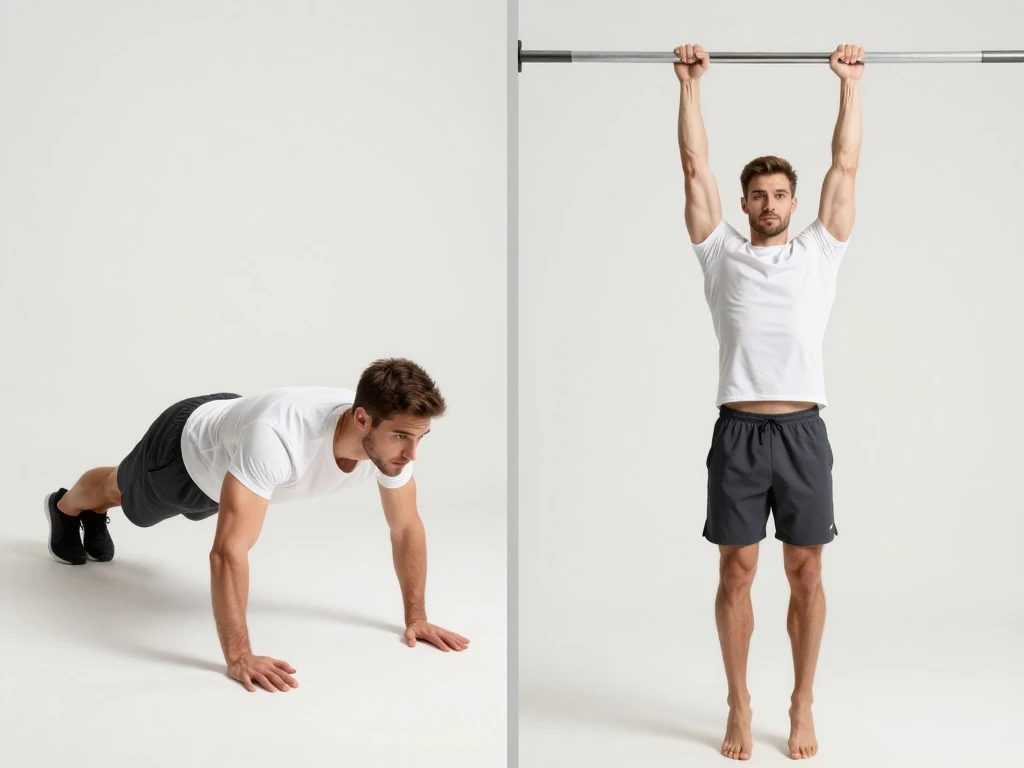
Both sessions begin with a five-minute warm-up: jumping jacks, arm circles, hip rotations, bodyweight squats, and shoulder rolls. Do not skip the warm-up.
Calisthenics Workout Schedule
Weekly Training Breakdown
The eight-week calisthenics workout schedule is divided into two phases.
Phase One (Weeks 1 to 4) — Foundation. Three sessions per week. Volume and intensity are moderate. The goal is movement quality and building the habit.
Phase Two (Weeks 5 to 8) — Build. Three to four sessions per week. Volume increases and exercise progressions are introduced.
WEEKS 1 TO 2 — SAMPLE WEEK
Day | Session
Monday | Day A — Full Body Upper + Core
Tuesday | Rest
Wednesday | Day B — Lower Body + Core
Thursday | Rest
Friday | Day A — Full Body Upper + Core
Saturday | Active Recovery
Sunday | Rest
WEEKS 3 TO 4
Add one set to each exercise. Aim to reach the top of every rep range before Week 5.
WEEKS 5 TO 6
Introduce progressions (see the progression section below). Add a fourth session if recovery allows.
WEEKS 7 TO 8
Push for maximum clean reps in each exercise. Track your numbers. Compare Week 8 to Week 1.
Incorporating Rest Days
Rest days are not empty days. They are the days your muscles rebuild, your connective tissue consolidates, and your nervous system recovers from the demands of training.
Active recovery on scheduled rest days means a twenty to thirty minute walk, light stretching, or a short mobility session. In the UK, this is as simple as walking to a local park and back. Low intensity, no strain, genuine physiological benefit.
Skipping rest days when training is going well is one of the most common mistakes I see. The adaptation does not happen during the session. It happens in the forty-eight hours after it.
Progression and Advancement
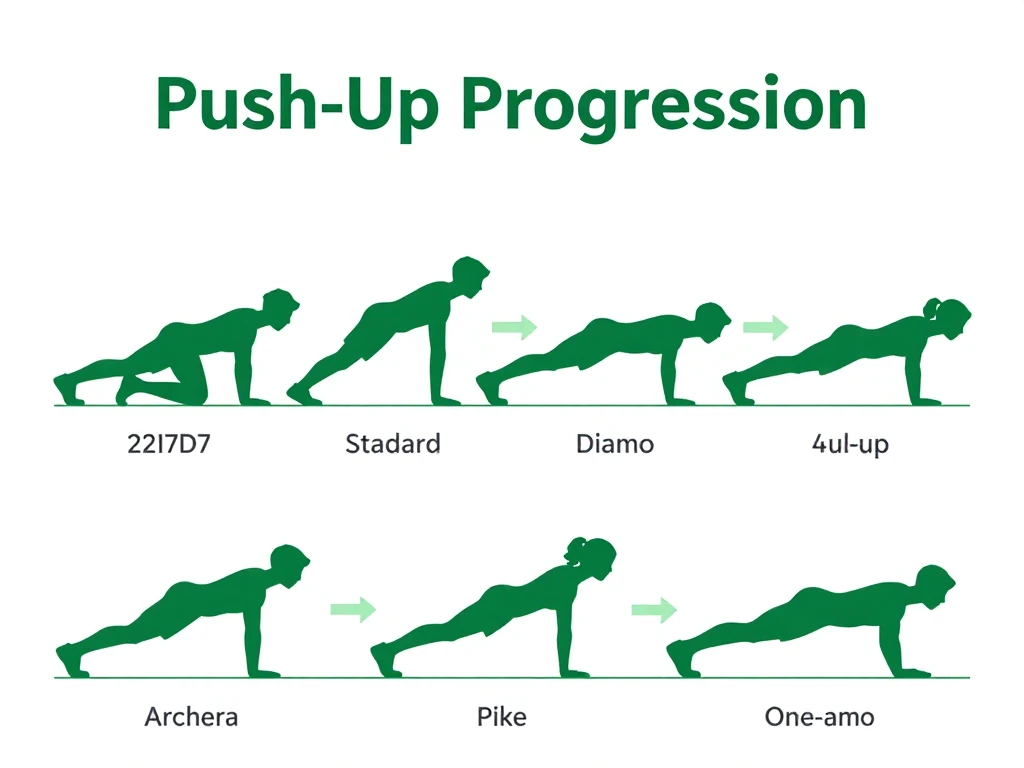
Calisthenics progressions are what separate structured training from random exercise. A progression is a ladder of movements, ordered from easiest to hardest, that you climb as your strength improves. This is the core mechanism by which calisthenics delivers progressive overload without adding external weight.
The rule is simple. When you can complete three clean sets at the top of your rep range — with full control, full range of motion, and no form breakdown — you advance to the next progression.
PUSH-UP PROGRESSION LADDER
Knee Push-Up → Standard Push-Up → Diamond Push-Up → Archer Push-Up → Pike Push-Up → Pseudo Planche Push-Up
PULL-UP PROGRESSION LADDER
Dead Hang → Scapular Pull → Negative Chin-Up → Assisted Pull-Up → Full Chin-Up → Standard Pull-Up → Wide Grip Pull-Up → L-Sit Pull-Up
SQUAT PROGRESSION LADDER
Bodyweight Squat → Bulgarian Split Squat → Skater Squat → Assisted Pistol Squat → Full Pistol Squat
Each of these ladders is included in the downloadable PDF with rep targets and form cues at every stage.
Deload weeks are built into the program at Week 4 and Week 8. During a deload, reduce your training volume by forty percent. Same exercises, same schedule, significantly fewer sets and reps. Your body uses this week to consolidate the gains from the preceding three weeks. Do not skip it under the belief that more training always means more progress.

Nutrition for Calisthenics Training
Calisthenics Nutrition Guide
Training without addressing nutrition is like filling a car with the wrong fuel. The engine runs, but never the way it should. This calisthenics nutrition guide covers what matters without drowning you in complexity.
Protein is the priority. Muscle repair and growth require adequate amino acid availability. The International Society of Sports Nutrition (ISSN) recommends 1.6 to 2.2 grams of protein per kilogram of bodyweight per day for those in active training. For a 75kg individual, that is 120 to 165 grams of protein daily.
Carbohydrates fuel your sessions. Complex carbohydrates — oats, sweet potato, brown rice, wholegrain bread — provide sustained energy for training and replenish muscle glycogen between sessions. Do not eliminate carbohydrates to lose weight faster. Reduce overall calories, not entire macronutrient groups.
Fats support hormonal function. Healthy fats from eggs, olive oil, avocado, and oily fish are not optional extras. They are structural requirements for hormone production, including the testosterone needed to build and maintain muscle.
Caloric targets depend on your goal. For muscle gain, aim for a modest surplus of 200 to 300 kcal above your maintenance level. For fat loss, a deficit of 300 to 500 kcal below maintenance is effective without compromising recovery. Use the NHS BMI and calorie estimation tools as a starting reference point for UK-specific guidance.

Best Foods for Weight Loss and Muscle Gain
For calisthenics for weight loss and muscle building simultaneously, prioritise foods that are high in protein and relatively low in calories. In the UK, the most accessible options are eggs, Greek yogurt, tinned tuna, chicken breast, cottage cheese, lentils, and oats. These foods are widely available, affordable, and carry no nutritional gimmick — just dense, useful macronutrients.
Meal timing is less important than total daily intake. Eating protein spread across three to four meals per day is marginally more effective for muscle protein synthesis than consuming it all in one sitting, but the difference is small. Hit your daily protein target first and adjust timing later.
Hydration and Recovery
Aim for two to three litres of water per day, adjusted upward on training days and during warmer months. Dehydration of even two percent of body mass reduces physical performance measurably.
Sleep is the most powerful recovery tool available. Seven to nine hours per night is the range within which muscle protein synthesis, hormonal recovery, and central nervous system repair all function optimally. Prioritising sleep over late-night screen time will do more for your training results than any supplement.
Foam rolling and light mobility work for ten minutes after each session reduces muscle soreness and maintains the joint range of motion needed to execute calisthenics progressions correctly.
Download Your Free Calisthenics Training Program PDF
The free calisthenics training program PDF includes everything covered in this guide, formatted for easy printing or on-screen use.
Inside the PDF:
— 8-week training schedule (Phase One and Phase Two)
— Day A and Day B workout templates with sets, reps, and rest periods
— Exercise descriptions with form cues and beginner modifications
— Full progression ladders for push-ups, pull-ups, and squats
— Deload week instructions
— Nutrition overview with protein targets and food examples
>>>>>>>>>DOWNLOAD HERE<<<<<<<<<
This is the calisthenics workout plan PDF. No spam. No upsell. A complete eight-week program built for beginners and early intermediates who are ready to get to work.
Conclusion
Consistency beats perfection every time. The best calisthenics program is not the one with the most exercises or the most complex progressions — it is the one you actually follow, session after session, for eight weeks straight.
Download the PDF. Complete Day A this week. Come back next session and do it again.
If you found this useful, explore the full range of training guides on Fitness Flora — including our 28-day walking challenge, push pull legs workout routine, and high protein low calorie meal plans. Everything you need to build a sustainable fitness habit is here, and it is all free.
FAQ
Q: What is the best calisthenics program for beginners?
A: A program that trains three days per week, builds on foundational movements including push-ups, pull-ups, squats, and planks, and applies progressive overload over eight weeks is ideal for beginners. FitnessFlora’s free calisthenics training program PDF follows this exact structure.
Q: Can I download a free calisthenics training program as a PDF?
A: Yes. FitnessFlora offers a free 8-week calisthenics workout plan PDF that includes a weekly training schedule, exercise progressions, form cues, and a nutrition overview. Download it free at the bottom of this page.
Q: How many days a week should a beginner do calisthenics?
A: Beginners should train three days per week with at least one full rest day between sessions. This frequency allows muscles and connective tissue to recover fully, which is where adaptation and strength gains actually occur.
Q: Can calisthenics help with weight loss?
A: Yes. Calisthenics for weight loss is effective because compound bodyweight movements burn significant calories per session and create an EPOC effect that keeps metabolic rate elevated for hours after training. Combined with a moderate calorie deficit, it produces consistent fat loss results.
Q: What equipment do I need to start calisthenics?
A: Very little. A doorframe pull-up bar (around £15 to £25 in the UK) and a yoga mat are sufficient for the full program. Most beginner exercises in Day B require no equipment at all.
Q: What are calisthenics progressions?
A: Calisthenics progressions are structured exercise ladders that move from easier to harder variations as your strength improves. For example: knee push-up → standard push-up → archer push-up → one-arm push-up. Progressions are how calisthenics delivers progressive overload without adding external weight.
Q: Is calisthenics effective for building muscle?
A: Yes. Strength training with calisthenics builds muscle effectively when progressive overload is applied consistently. Research shows that bodyweight training produces comparable hypertrophy to free weight training at equivalent levels of effort and volume.
Q: How long before I see results from calisthenics?
A: Most beginners notice improved movement quality, posture, and endurance within two to three weeks. Visible strength gains and changes in body composition typically appear between weeks four and eight, depending on training consistency and nutrition.