By Saad | Fitness Flora | Updated 2026 | Fat Loss & Nutrition Coach | 6+ Years Experience
Walk into any gym and you’ll find two types of people: those who sprint through 25 minutes and leave, and those who’ve been there so long they’re practically staff. Both are convinced they’re doing it right.
So — how long should a gym session be, really?
The answer isn’t a single number. It shifts depending on what you’re training for, how experienced you are, and what your week looks like. But there is a clear, evidence-backed range that works for most people — and in this guide, I’ll break it down by goal, experience level, and workout type.
Whether you’re lifting weights, doing cardio, or trying to squeeze a session into a packed schedule, you’ll leave with a practical answer that actually fits your life.
Defining Optimal Gym Session Length
General Recommendations
Let’s start with the headline figure most coaches — including myself — give as a starting point: 45 to 60 minutes per session covers the majority of fitness goals for most people.
This isn’t arbitrary. It aligns with NHS physical activity guidelines for adults aged 19 to 64, which recommend at least 150 minutes of moderate-intensity activity per week or 75 minutes of vigorous-intensity activity. Spread across four to five days, that works out to roughly 30 to 45 minutes daily — and once you factor in warm-up, main work, and a cool-down, 45 to 60 minutes is the natural landing zone.
Here’s a practical breakdown by experience level:
| Experience Level | Recommended Session Length |
|---|---|
| Beginner | 30–45 minutes |
| Intermediate | 45–60 minutes |
| Advanced | 60–90 minutes |
Beginners benefit from shorter sessions that build the habit without destroying the body. Intermediate trainees can handle more variety. Advanced lifters working higher volumes may push toward 90 minutes — but rarely need to go beyond that for general fitness or hypertrophy goals.
The key principle: session length should match your goal and recovery capacity — not your ego.
Factors Influencing Session Length
The question “how long should a gym session be” doesn’t have one answer because too many variables shape it. Here are the main ones:
Your training goal. Fat loss, muscle building, cardiovascular health, and athletic performance all require different approaches to volume and intensity — which directly affects time.
Your experience level. Beginners stimulate progress with far less volume than advanced trainees. More sets, heavier loads, and complex programming naturally extend session length as you progress.
Workout type. Strength training involves significant rest between heavy sets (2 to 5 minutes), which extends sessions. HIIT and circuit training compress the same stimulus into much shorter windows.
Rest periods. This is the most underrated variable. Rest time alone can add or subtract 20 minutes from a session:
- Strength focus: 2–5 minutes between sets
- Hypertrophy: 60–90 seconds
- Muscular endurance: 20–60 seconds
Life and schedule. A 45-minute session you actually show up for beats a 90-minute plan you skip. Real life is a legitimate training variable.
How Long Should a Gym Session Be for Cardio Workouts?
Effective Cardio Workout Length
Cardio duration is directly tied to intensity — the harder you work, the less time you need. That’s the simple rule that guides everything here.
The NHS recommends at least 150 minutes of moderate intensity cardio per week (brisk walking, cycling, swimming at a comfortable pace) or 75 minutes of vigorous intensity activity (running, hill cycling, aerobics classes). In practical terms, that breaks down to:
- Moderate cardio: 30 minutes, five days per week
- Vigorous cardio: 25 minutes, three days per week
- Or any combination of both that reaches the weekly target
For general health and heart function, this is enough. For fat loss, bumping moderate cardio sessions to 40 to 45 minutes, or adding a second vigorous session per week, accelerates progress when paired with a calorie deficit.
So when asking how long should a gym session be for cardio, the practical answer is 30 to 45 minutes for most people — enough to meet health targets and support body composition without running yourself into the ground.
High-Intensity Interval Training (HIIT)
If time is your biggest constraint, HIIT is the most efficient tool in the gym.
HIIT alternates between short bursts of maximum effort and brief recovery periods. The NHS classifies it as “very vigorous” activity — which means even a 20-minute session counts significantly toward your weekly target.
Research has found that just 40 minutes of HIIT twice per week can meaningfully improve body composition, metabolic rate, and cardiovascular function. The mechanism is the afterburn effect (EPOC — Excess Post-Exercise Oxygen Consumption), which keeps your body burning calories at an elevated rate for hours after the session ends.
For HIIT specifically, 20 to 40 minutes is the optimal range. Beyond 40 minutes, intensity typically drops and you’re essentially just doing steady-state cardio with a HIIT label on it.
Important note for beginners: start at 20 minutes and build up. Jumping straight into a 40-minute HIIT session with no base fitness is a fast route to injury or excessive soreness.

How Long Should a Gym Session Be for Weightlifting?
Weightlifting Session Length
Strength training is where session length varies the most — and where the most confusion lives.
A well-structured weightlifting session featuring 7 to 9 exercises typically runs 45 to 75 minutes, including warm-up and cool-down. That range holds for most intermediate lifters. Beginners can get solid results in 40 to 45 minutes. Advanced lifters working with higher volumes and heavier compound lifts may push toward 75 to 90 minutes.
The research on session length for strength is clear: you don’t need to be in the gym for two hours to build muscle. A 2020 study found meaningful strength improvements from a single set of 6 to 12 reps per exercise, though multiple sets produce superior hypertrophy outcomes. In practice, 3 to 5 sets per major exercise, across 6 to 8 movements, falls comfortably within a 60-minute window.
So how long should a gym session be for weightlifting?
- Beginners: 40–45 minutes
- Intermediate: 50–65 minutes
- Advanced: 65–90 minutes (with purpose — not padding)
Structure a typical session like this:
- Warm-up: 8–10 minutes
- Compound movements (squats, deadlifts, press, rows): 25–35 minutes
- Isolation work: 10–15 minutes
- Cool-down/mobility: 5–10 minutes
That’s a complete, well-rounded session in under an hour for most people.

Tips for Maximising Weightlifting Efficiency
More time in the gym doesn’t automatically mean more results. Here’s how to make every minute count:
Use supersets. Pairing a push exercise with a pull — bench press followed immediately by a dumbbell row — cuts rest time and keeps training density high. A full session can be completed in under 45 minutes using this method.
Implement progressive overload consistently. Adding small amounts of weight or reps each week drives adaptation. Without it, session length is irrelevant — you’re just spinning wheels.
Match rest periods to your goal. If you’re training for strength, take your full 3 to 5 minutes between heavy sets. Don’t rush it. If you’re training for size or conditioning, keep rest tighter at 60 to 90 seconds.
Log your sessions. Tracking sets, reps, and weights removes the mental overhead of “what should I do next?” — keeping sessions focused and efficient.
Train compound movements first. Hit squats, deadlifts, presses, and rows at the start of the session when energy is highest. Save isolation work for the tail end.
What Is the 3-2-1 Rule in the Gym?
The 3-2-1 rule is a structured weekly training framework that breaks down as: 3 days of strength training, 2 days of cardio, 1 day of mobility or flexibility work.
It’s designed to create balance across the three key pillars of fitness — strength, cardiovascular health, and movement quality — within a 6-day training week that still allows one full rest day.
Some coaches also apply the 3-2-1 structure within a single session: 3 compound lifts, 2 isolation exercises, 1 core or conditioning finisher. This keeps sessions focused and prevents the common mistake of doing too much of one thing and not enough of another.
In terms of session length, the 3-2-1 framework typically produces sessions of 50 to 60 minutes — exactly the range supported by research for most fitness goals.
Is 2 Hours in the Gym Too Much?
For the vast majority of people — yes.
After approximately 60 to 75 minutes of hard training, cortisol levels (your primary stress hormone) rise meaningfully, and the anabolic hormone response begins to taper. This doesn’t mean the session becomes useless after an hour, but it does mean the return on additional time invested starts declining.
There are legitimate exceptions: endurance athletes building aerobic base, advanced bodybuilders running high-frequency splits, or sport-specific conditioning programmes. But for general fitness, fat loss, or muscle building, 90 minutes is the realistic upper limit — and most goals are achieved well within 60 minutes.
If your sessions regularly stretch to 2 hours, ask yourself honestly: are rest periods too long? Is there excessive social time between sets? Is the programme overly bloated with exercises that don’t serve your goals?
Tighten the structure first. In most cases, better results follow.
Is 40 Minutes in the Gym Enough?
Yes — and for many people, especially beginners or those returning after a break, 40 minutes is the ideal starting point.
A 40-minute session can look like this:
- 5-minute warm-up
- 30 minutes of focused training (4 to 5 exercises, 3 sets each)
- 5-minute cool-down
That’s a complete training stimulus. For HIIT, 40 minutes is more than sufficient. For strength training beginners, 40 minutes delivers solid stimulus without excessive fatigue. For cardio, 40 minutes at moderate intensity comfortably meets the NHS daily movement recommendation.
When asking how long should a gym session be for someone just getting started — 40 minutes done consistently is better than 90 minutes done sporadically. Habit and adherence are the most powerful training variables for beginners.

Does Gym Training Improve Heart Health?
Unequivocally, yes.
The NHS states that regular physical activity — including gym-based training — reduces the risk of heart disease, stroke, type 2 diabetes, and certain cancers. Even exercising just once or twice a week produces measurable cardiovascular benefit.
Aerobic training strengthens the heart muscle, lowers resting heart rate, improves blood pressure, and positively influences cholesterol levels. Resistance training contributes to heart health too, particularly through improvements in insulin sensitivity and blood pressure regulation.
Adults who meet the NHS recommendation of 150 minutes of moderate activity per week see significantly reduced cardiovascular risk compared to those who don’t. The gym — used consistently — is one of the most effective tools available for long-term heart health, regardless of session length.
Is Gymming 3 Times a Week Enough?
For most people working toward general fitness, fat loss, or muscle building — absolutely.
Research consistently shows that training frequency of 2 to 3 sessions per week produces substantial improvements in both strength and body composition. Three well-structured sessions of 45 to 60 minutes each provides adequate stimulus, leaves room for recovery, and is sustainable for the long term.
The common reasons people aren’t seeing progress on 3 sessions per week have very little to do with frequency:
- Programme quality: Are sessions structured around progressive overload?
- Effort: Is there genuine challenge in each session?
- Nutrition: Is the diet aligned with the goal?
Three times per week, done right, works. Adding a fourth session on a poor programme with inadequate recovery is unlikely to help.
What Muscle Is Hardest to Grow?
Individual genetics play a significant role here, but certain muscles are consistently flagged as stubborn across the fitness community:
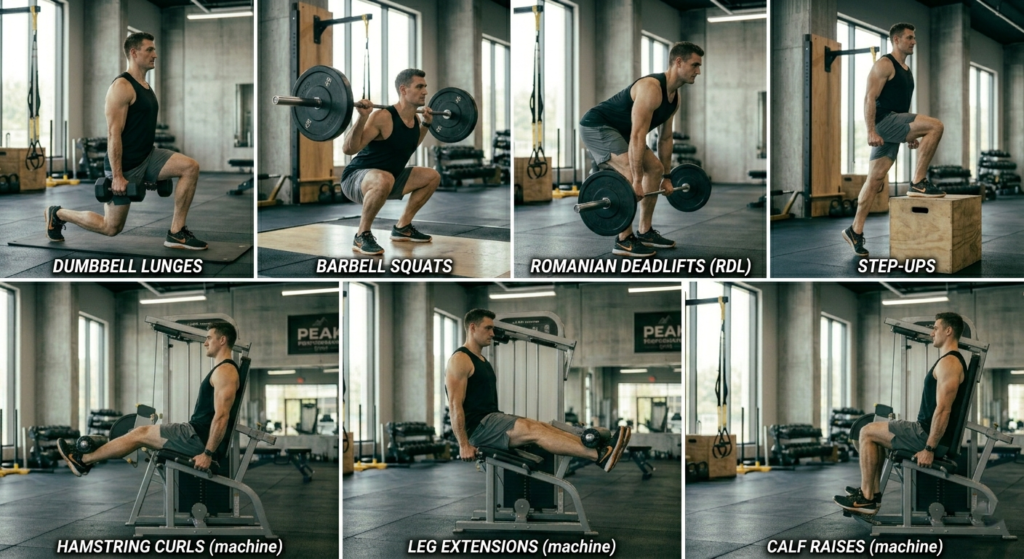
Calves. They endure constant low-level stimulus from daily walking, which means they’re already partially adapted. They respond to high volume, high frequency, and a full range of motion — but slowly.
Hamstrings. Most gym programmes are quad-dominant (squats, leg press, lunges), leaving the hamstrings undertrained. Romanian deadlifts and leg curls need to be prioritised deliberately.
Rear deltoids. Pressing movements don’t reach them. Face pulls, reverse flyes, and band pull-aparts are essential — and most people skip them.
Forearms. Small muscles with dense connective tissue, rarely trained directly.
The most effective strategies for stubborn muscles: train them first in the session when energy is highest, increase frequency to twice per week, and apply progressive overload consistently rather than just adding random sets.
Community Insights: What Reddit Says About Gym Session Length
Online fitness communities — particularly natural bodybuilding and fitness — are worth paying attention to because they represent real-world training experience, not just textbook theory.
The consistent consensus across these communities on how long should a gym session be: 45 to 60 minutes is the most widely cited sweet spot, with experienced lifters frequently warning against sessions stretching beyond 90 minutes without a specific, structured reason.
Common themes from community discussions:
- Beginners almost always err toward too many exercises, not too few
- The quality of a session matters far more than its length
- Rest days and recovery are consistently undervalued by newer trainees
- Warm-up and cool-down are non-negotiable components of a session — not extras
The community also pushes back hard against the idea that longer automatically means more productive. A focused 50-minute session with progressive overload, proper rest periods, and genuine effort consistently outperforms an unfocused 90-minute gym visit.

Common Misconceptions — Debunked
“More time in the gym equals more results.” This is the most pervasive myth in fitness. Volume and progressive overload drive adaptation — not the clock. Once sufficient stimulus has been applied, additional time produces diminishing returns at best and overtraining at worst.
“Short sessions don’t count.” A 30-minute HIIT session or a focused 40-minute strength circuit can produce superior results to an unfocused 90-minute gym session. Duration without intention is just time spent standing around.
“You need to train for hours to lose weight.” Fat loss is primarily a calorie equation. Exercise supports it — but session length is far less important than dietary consistency. Three 45-minute sessions per week, combined with appropriate nutrition, will outperform six 90-minute sessions with no dietary strategy.
Conclusion
Recap: Gym Session Length by Goal
How long should a gym session be? Here’s the definitive, goal-specific breakdown:
| Goal | Optimal Session Length |
|---|---|
| General fitness | 30–45 minutes |
| Fat loss (cardio focus) | 30–45 minutes |
| HIIT | 20–40 minutes |
| Strength training | 45–60 minutes |
| Muscle building (hypertrophy) | 50–75 minutes |
| Beginner (any goal) | 30–45 minutes |
| Advanced lifter | Up to 90 minutes |
Final Thoughts
After six years of coaching clients through fat loss and strength training, the pattern is consistent: the people who get the best results aren’t the ones who train the longest — they’re the ones who train with intention, recover properly, and show up consistently.
If you’re still unsure exactly how long your sessions should be, start at 45 minutes. Track your progress for four weeks. If you’re recovering well, making strength gains, and feeling energised — you’ve found your baseline. Adjust from there based on real feedback from your body, not arbitrary time targets.
The gym should fit your life and serve your goals. Not the other way around.
Saad is the founder of Fitness Flora and a certified fat loss and nutrition coach with over six years of experience. All content on Fitness Flora is written from direct coaching practice and aligned with current NHS guidelines and peer-reviewed research.
Frequently Asked Questions
How long should a gym session be for beginners? 30 to 45 minutes is the ideal starting range. It builds the habit, provides sufficient training stimulus, and avoids the excessive fatigue that drives beginners to quit in the first month.
What is the 3-2-1 rule in the gym? Three strength sessions, two cardio sessions, and one mobility or flexibility session per week — a balanced weekly framework that typically produces 50 to 60-minute individual sessions.
Is 2 hours in the gym too much? For most people, yes. Beyond 75 to 90 minutes, cortisol rises and the quality of effort typically drops. Most fitness goals are achieved well within 60 minutes of structured training.
Is 40 minutes in the gym enough? Absolutely. A focused 40-minute session meets NHS daily activity guidelines, works well for beginners, and is highly effective for HIIT and full-body strength circuits.
Does gym training improve heart health? Yes. Regular gym training reduces the risk of heart disease, stroke, and type 2 diabetes. Even one to two sessions per week produces measurable cardiovascular benefit according to NHS guidelines.
Is gymming 3 times a week enough? Yes — for most goals, three well-structured sessions of 45 to 60 minutes per week is sufficient. Programme quality and nutrition matter far more than adding extra sessions.
What muscle is hardest to grow? Calves, hamstrings, rear deltoids, and forearms are most commonly cited as stubborn. They respond best to dedicated training, higher frequency, and consistent progressive overload.