AUTHOR: Saad | Fitness Flora LAST UPDATED: June 2026
A 10-minute cardio workout is one of the most effective fat burning workouts at home — requiring zero equipment, zero gym access, and less time than a coffee break.
The method is simple: perform 5 cardio exercises for beginners and beyond at high intensity, alternating 40 seconds of effort with 20 seconds of rest, repeated for 2 rounds.
A 2019 meta-analysis in the British Journal of Sports Medicine confirmed that short cardio workouts performed at high intensity produce 28.5% greater fat loss than longer moderate sessions — in significantly less time.
The best part? A home cardio workout with no equipment does not stop burning fat when you stop moving. The afterburn effect keeps your metabolism elevated for up to 24 hours after every session.
For anyone asking what is the best cardio for fat loss without a gym — this is it.
The Day I Stopped Making Excuses About Time
For the first two years of my fitness journey, I believed a workout had to be at least 45 minutes to be worth anything.
If I only had 20 minutes, I skipped it entirely.
That belief cost me months of progress.
The shift happened when I started tracking my heart rate during different session lengths. A focused 10-minute cardio circuit — jumping jacks, high knees, burpees, mountain climbers — pushed my heart rate to 165–175 bpm and kept it there for the full session.
A 45-minute jog on the treadmill averaged 130 bpm.
The 10-minute session was producing a more intense cardiovascular stimulus in one-fifth of the time.
That was the day I redesigned how I trained — and how I coached every client who came to me saying they were too busy to exercise.
This guide is everything I learned from that shift.
What a Cardio Workout for Fat Burning Actually Is — And Why Most People Do It Wrong
Cardio workouts are physical activities that elevate your heart rate and challenge your cardiovascular system — your heart, lungs, and circulatory system — to work harder than at rest.
But here is what most people get wrong: they think cardio means slow and long.
It does not.
Cardio is defined by heart rate response, not duration. A 10-minute session that keeps your heart rate above 75% of its maximum is more cardiovascular effective than a 40-minute walk that keeps it at 50%.
The three cardio intensity zones:
| Zone | Heart Rate % | How It Feels | Best For |
|---|---|---|---|
| Zone 1 — Light | 50–60% | Comfortable, easy conversation | Active recovery, daily movement |
| Zone 2 — Moderate | 60–70% | Can talk but slightly breathless | Endurance, general health |
| Zone 3 — High | 75–90% | Difficult to speak in full sentences | Fat burning, cardiovascular fitness |
The 10-minute cardio workout in this guide operates primarily in Zone 3 — where fat burning and cardiovascular adaptation happen fastest.
What Research Says About 10-Minute Cardio Workouts and Fat Loss
Let the data make the case before we get into the exercises.
A 2019 meta-analysis in the British Journal of Sports Medicine — covering 36 studies and over 1,000 participants — found that high-intensity interval cardio produced 28.5% greater reductions in total absolute fat mass compared to moderate-intensity continuous cardio, despite requiring significantly less time per session.
A 2014 study published in PLOS ONE found that a 10-minute workout containing just one minute of all-out effort produced comparable cardiovascular adaptations to 45 minutes of moderate steady-state exercise over a 12-week period.
A 2017 study in the Journal of Sports Science and Medicine found that a 20-minute high-intensity cardio session elevated resting metabolic rate for up to 24 hours post-exercise — a phenomenon called EPOC (Excess Post-Exercise Oxygen Consumption), or the afterburn effect.
In plain terms: the 10-minute cardio workout you are about to read works not just during the 10 minutes you are doing it — but for the entire day that follows.
10-Minute Cardio Workout vs 30-Minute Jog — Which Burns More Fat?
This is the question I get asked most frequently. Here is the honest, data-backed answer.
| Factor | 10-Min High-Intensity Cardio | 30-Min Steady Jog |
|---|---|---|
| Calories burned during session | 100–150 | 200–280 |
| EPOC afterburn (post-session) | Up to 24 hours | 1–2 hours |
| Total calorie burn (session + afterburn) | 200–350 | 220–300 |
| Fat loss effectiveness | Very high | Moderate |
| Cardiovascular improvement | High | Moderate |
| Muscle preservation | Excellent | Poor (long sessions) |
| Time commitment | 10 minutes | 30+ minutes |
| Equipment needed | None | Treadmill or outdoor space |
| Suitable for beginners | Yes (with modifications) | Yes |
| Boredom risk | Low | High |
My honest opinion: For fat loss in minimum time, a 10-minute high-intensity cardio session wins on total impact — not just on the clock. The afterburn effect means you continue burning fat for hours after you finish. A 30-minute jog stops burning the moment you stop moving.
The 6 Best Cardio Exercises for Fat Burning at Home
These six exercises form the foundation of every 10-minute cardio programme I build for clients. They require zero equipment, can be done in a 2m × 2m space, and produce the highest cardiovascular and caloric response of any bodyweight movements.
Exercise 1 — Jumping Jacks
Muscles worked: Full body — legs, shoulders, cardiovascular system Calorie burn: ~8 calories per minute Difficulty: Beginner
Jumping jacks are the perfect opening exercise — they elevate heart rate within 15 seconds, warm up every joint in the body simultaneously, and require zero skill to perform.
Step-by-step:
- Stand tall with feet together and arms at your sides
- Jump and simultaneously spread feet to just wider than shoulder-width
- As feet land, raise both arms overhead until they nearly touch
- Jump again and return feet together while lowering arms
- Land softly — absorb the impact through your knees, not your heels
- Maintain a steady, controlled rhythm throughout
Beginner modification: Step side to side instead of jumping — same arm movement, zero joint impact. Build up to the jump version over 1–2 weeks.
Target: 25–35 reps in 40 seconds (intermediate)
Saad’s coaching note: Count your reps in the first session and write it down. Nothing tracks progress more clearly than watching that number climb from 25 to 40 over six weeks.
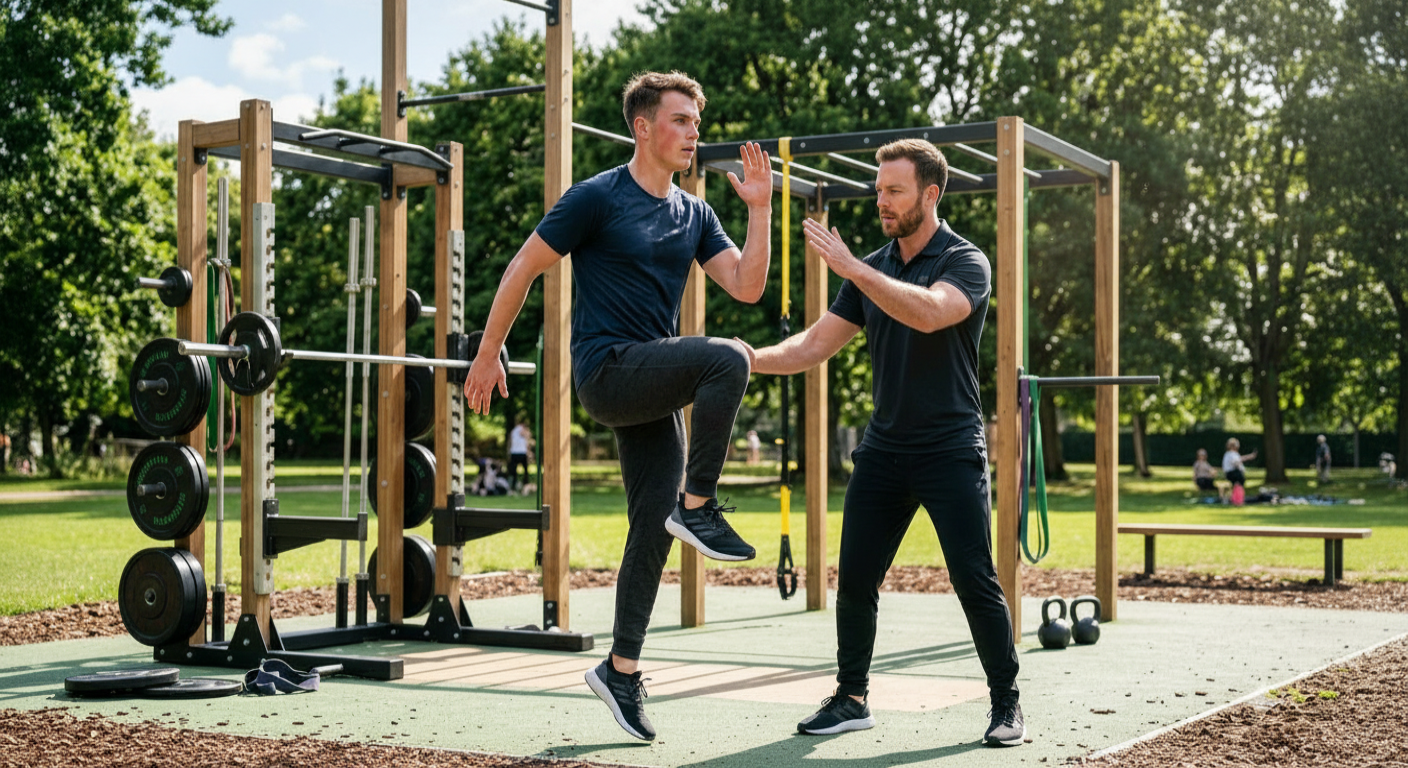
Exercise 2 — High Knees
Muscles worked: Hip flexors, quads, core, cardiovascular system Calorie burn: ~10 calories per minute Difficulty: Beginner–Intermediate
High knees simulate running without moving forward — making them the perfect indoor cardio spike. They also actively engage the core, making them more productive than standard running for abdominal conditioning.
Step-by-step:
- Stand tall with feet hip-width apart
- Drive your right knee upward toward your chest as high as possible
- As it descends, immediately drive the left knee up
- Pump your arms in opposition — right arm forward with left knee
- Stay on the balls of your feet throughout — never flat-footed
- Move at the fastest pace you can sustain with good form
Beginner modification: Marching on the spot with exaggerated knee lifts. Focus on height first, speed second.
Target: 40–50 reps (alternating legs) in 40 seconds (intermediate)
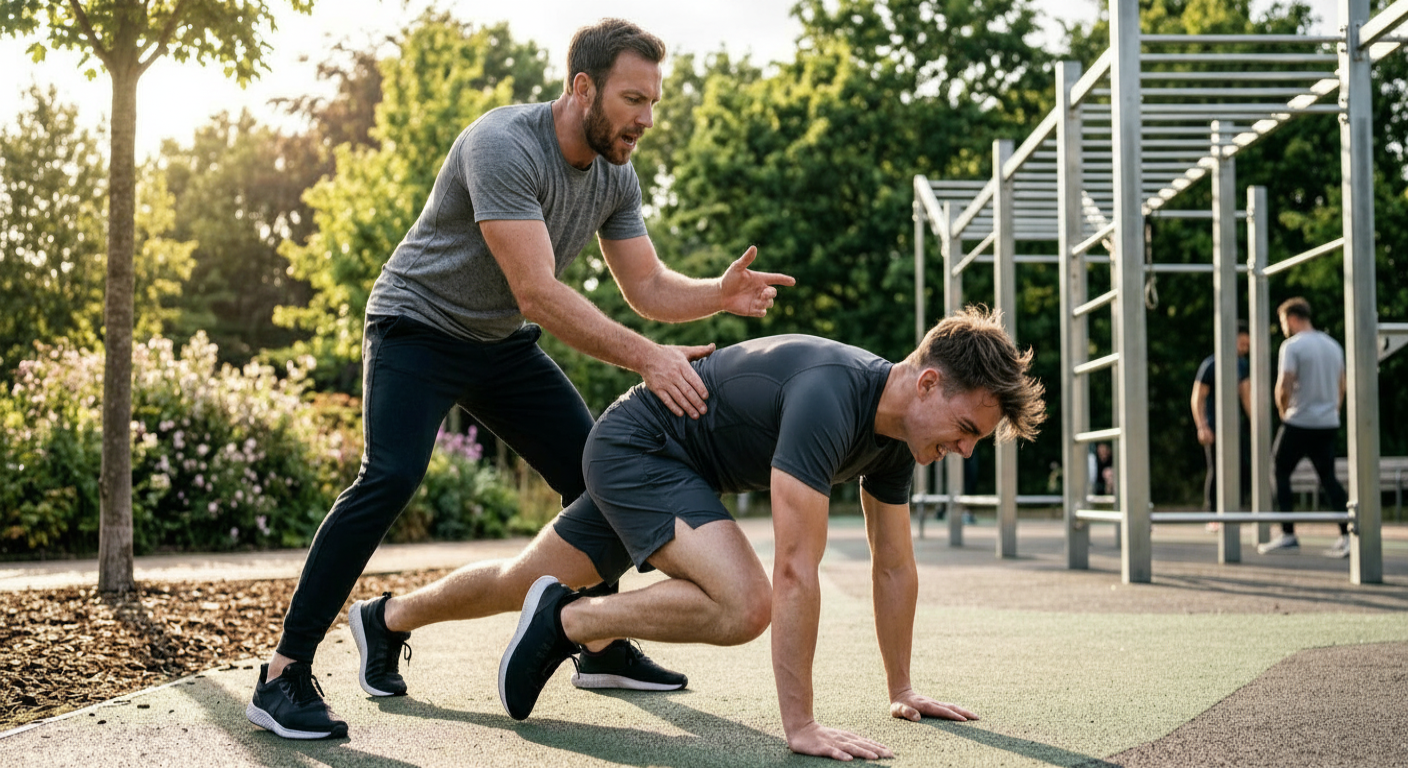
Exercise 3 — Mountain Climbers
Muscles worked: Core, hip flexors, chest, shoulders, cardiovascular system Calorie burn: ~11 calories per minute Difficulty: Beginner–Intermediate
Mountain climbers are a moving plank — they build core strength and cardiovascular fitness simultaneously. In a 10-minute circuit, they serve as both a core exercise and a heart rate maintainer between heavier movements.
Step-by-step:
- Start in a high plank — hands directly under shoulders, body in a rigid straight line
- Drive your right knee toward your chest as fast as possible
- Return it and immediately drive your left knee forward
- Keep your hips level throughout — they should not rise or sag
- Maintain the rigid plank in your upper body — shoulders stay over wrists
- Move at a controlled but challenging pace
Beginner modification: Slow mountain climbers — 2 seconds per knee drive. Same benefit, more control. Build speed over 2–3 weeks.
Target: 30–40 reps (alternating legs) in 40 seconds (intermediate)
Exercise 4 — Squat Jumps
Muscles worked: Quads, glutes, hamstrings, calves, cardiovascular system Calorie burn: ~12 calories per minute Difficulty: Intermediate
Squat jumps are the highest-calorie-burning exercise in this routine. They train the largest muscle groups in the body explosively — which is why they produce such a dramatic heart rate spike within the first 5 reps.
Step-by-step:
- Stand with feet shoulder-width apart, toes turned out slightly
- Lower into a squat until thighs are parallel to the floor
- Explode upward into a jump — drive through the heels
- Reach arms overhead at the peak of the jump
- Land softly with knees slightly bent — absorb the impact
- Immediately sink back into the next squat without pausing
Beginner modification: Regular bodyweight squat with a calf raise at the top. No jumping until landing mechanics feel natural and controlled.
Target: 15–20 reps in 40 seconds (intermediate)
Exercise 5 — Burpees
Muscles worked: Full body — chest, shoulders, triceps, quads, glutes, core, cardiovascular system Calorie burn: ~13–14 calories per minute (ACE research, 2014) Difficulty: Intermediate
Burpees are the single most calorie-efficient bodyweight exercise in existence. A 2014 American Council on Exercise study confirmed they burn 13–14 calories per minute at moderate pace — more than almost any other bodyweight movement.
They are also the most hated exercise in this list. That is not a coincidence.
Step-by-step:
- Stand with feet shoulder-width apart
- Drop hands to the floor and jump feet back into a plank position
- Perform one full push-up — chest touches the floor
- Jump feet forward toward your hands
- Explode upward into a jump, arms overhead
- Land softly with knees slightly bent
- Immediately drop back down for the next rep
Beginner modification: Step feet back one at a time instead of jumping. Remove the push-up. Remove the jump at the top. Build each component separately over 2–3 weeks before combining them.
Target: 10–14 reps in 40 seconds (intermediate)
Exercise 6 — Skipping (Jump Rope)
Muscles worked: Calves, shoulders, cardiovascular system, coordination Calorie burn: ~12–15 calories per minute Difficulty: Beginner (with practice)
Skipping is optional in this routine — it requires a jump rope and slightly more space — but it is one of the most effective fat-burning cardio tools available. Professional boxers have used it for decades for precisely this reason.
Step-by-step:
- Hold one handle in each hand with rope behind your feet
- Swing the rope forward overhead in a controlled arc
- Jump with both feet together just as the rope reaches your feet
- Land on the balls of your feet — never flat-footed
- Keep jumps small — just enough clearance for the rope
- Maintain a steady rhythm — consistency matters more than speed
Beginner modification: Practice the jump rhythm without the rope first. Once the timing feels natural, add the rope.
Target: 60–80 revolutions in 40 seconds (intermediate)
The Complete 10-Minute Cardio Workout Plan
How it works:
- 5 exercises × 40 seconds work / 20 seconds rest
- 2 rounds = exactly 10 minutes
- No equipment needed
- Space required: 2m × 2m
Beginner Version (10 Minutes)
Format: 30 seconds work / 30 seconds rest × 2 rounds
| Exercise | Work | Rest |
|---|---|---|
| Jumping Jacks | 30 sec | 30 sec |
| High Knees (marching) | 30 sec | 30 sec |
| Slow Mountain Climbers | 30 sec | 30 sec |
| Bodyweight Squat | 30 sec | 30 sec |
| Step-Out Burpee | 30 sec | 30 sec |
Rest between rounds: 90 seconds Estimated calorie burn: 70–100
Intermediate Version (10 Minutes)
Format: 40 seconds work / 20 seconds rest × 2 rounds
| Exercise | Work | Rest |
|---|---|---|
| Jumping Jacks | 40 sec | 20 sec |
| High Knees | 40 sec | 20 sec |
| Mountain Climbers | 40 sec | 20 sec |
| Squat Jumps | 40 sec | 20 sec |
| Burpees | 40 sec | 20 sec |
Rest between rounds: 60 seconds Estimated calorie burn: 120–160
Advanced Version (10 Minutes — Tabata Format)
Format: 20 seconds all-out / 10 seconds rest × 8 rounds per exercise
| Exercise | Rounds | Format |
|---|---|---|
| Burpees | 4 min | 20 sec on / 10 sec off |
| Squat Jumps | 3 min | 20 sec on / 10 sec off |
| Mountain Climbers | 3 min | 20 sec on / 10 sec off |
Estimated calorie burn: 150–200+
Warning: The advanced Tabata format is genuinely brutal. If you have not trained consistently for at least 4 weeks, start with the beginner or intermediate version.
The Weekly Cardio Plan That Actually Works
Most beginner weekly cardio plans fail because they ignore recovery. Here is the plan I use with clients that balances intensity and rest correctly.
| Day | Session | Duration |
|---|---|---|
| Monday | Intermediate cardio workout | 10 min |
| Tuesday | Light walking | 20–30 min |
| Wednesday | Intermediate cardio workout | 10 min |
| Thursday | Rest or gentle stretching | — |
| Friday | Intermediate cardio workout | 10 min |
| Saturday | Outdoor activity — jog, cycle, swim | 20–30 min |
| Sunday | Full rest | — |
Total structured cardio per week: 30 minutes Total movement per week: ~90 minutes
This plan is deliberately conservative. Three structured sessions per week with active recovery days consistently outperforms five or six sessions with inadequate recovery — because the body adapts during rest, not during training.
Real-World Case Study: Zara’s 8-Week Result
Zara was 29, a primary school teacher, and had never followed a structured exercise programme in her adult life.
She came to me with one goal: lose the 8 kg she had gained during a stressful year at work.
She had 10 minutes available every morning before school, three days per week. That was her entire training window.
I gave her the intermediate 10-minute cardio workout above — Monday, Wednesday, Friday — and asked her to walk for 20 minutes on the other days.
I did not change her diet beyond one instruction: eat 100g of protein per day.
Her 8-week results:
- Body weight: 74 kg → 70.3 kg (−3.7 kg)
- Waist measurement: 86 cm → 80 cm (−6 cm)
- Resting heart rate: 79 → 69 bpm
- Burpees in 40 seconds (week 1 → week 8): 6 → 13
- Self-reported energy (1–10): 3 → 8
Her comment at week 8: “I genuinely thought 10 minutes couldn’t do anything. I was completely wrong. I feel fitter than I did at 22.”
Zara’s results are not exceptional. They are what consistently happens when a sedentary person applies three 10-minute sessions per week with genuine intensity for eight weeks.
The Fat Loss Cardio Framework — 4 Principles I Use With Every Client
After six years of coaching cardio for fat loss, these four principles separate clients who transform their bodies from those who stay stuck.
Principle 1 — Intensity Beats Duration A 10-minute session at 80% maximum heart rate burns more total fat than a 30-minute session at 50%. Stop watching the clock and start monitoring how hard you are working.
Principle 2 — Consistency Beats Perfection Three imperfect 10-minute sessions per week will always outperform one perfect 45-minute session. The body adapts to frequency — not to occasional heroic efforts.
Principle 3 — Cardio Without Diet Is a Treadmill You cannot out-run a poor diet. A 10-minute cardio session burns approximately 120–150 calories. One chocolate bar replaces that in seconds. Cardio accelerates fat loss — diet is what creates it.
Principle 4 — Progress the Workout, Not Just the Habit Once the intermediate workout feels manageable, reduce rest to 15 seconds, add a third round, or switch to the Tabata format. If the workout doesn’t challenge you, it isn’t changing you.

5 Tips to Maximise Fat Burning From 10-Minute Cardio
Tip 1 — Train fasted in the morning (optional but effective) Morning fasted cardio — training before breakfast — forces the body to draw on fat stores rather than recently consumed glucose. A 2017 study in the British Journal of Nutrition found that fasted exercise burned 20% more fat than fed exercise. This is not mandatory but is a simple optimisation for people who train in the morning.
Tip 2 — Never skip the warm-up Two minutes of light movement — marching on the spot, arm circles, hip rotations — before every session reduces injury risk and improves performance. Cold muscles and cold joints do not perform at full capacity.
Tip 3 — Stay hydrated throughout Even mild dehydration (1–2% of body weight) reduces cardiovascular performance significantly. Drink 500ml of water 30 minutes before your session and keep water nearby throughout.
Tip 4 — Use an interval timer app Tabata Timer and Interval Timer (both free on iOS and Android) handle all timing automatically. You focus entirely on the work. No watching the clock, no losing count, no interruptions.
Tip 5 — Cool down for 3 minutes after every session Walking on the spot and performing light static stretches for 3 minutes after your session reduces next-day soreness, brings your heart rate down safely, and signals to your nervous system that the training stress is over. Never skip the cool-down on a high-intensity session.
Common Cardio Mistakes That Kill Fat Loss Results
Mistake 1: Working at low intensity and calling it cardio If you can comfortably scroll your phone while doing the workout, you are not in a fat-burning zone. The work intervals in this programme should feel genuinely challenging — speaking in full sentences should be difficult by the second half of each interval.
Mistake 2: Doing cardio every day without rest Daily high-intensity cardio elevates cortisol chronically, disrupts sleep, increases injury risk, and paradoxically slows fat loss. Three sessions per week with recovery days consistently outperforms daily training.
Mistake 3: Relying on cardio alone for fat loss Cardio burns calories during the session. Strength training builds muscle that burns calories permanently. The most effective fat loss approach combines both — 3 cardio sessions and 2 strength sessions per week.
Mistake 4: Ignoring protein intake Cardio burns both fat and muscle tissue. Without adequate protein intake (1.6g per kg of bodyweight daily), you risk losing the muscle you have — which lowers your resting metabolic rate and makes future fat loss harder.
Mistake 5: Changing the routine every week Your body needs consistent stimulus to adapt. Changing exercises every session prevents the adaptation that produces results. Follow the same programme for 4 weeks before modifying anything.
About the Author
Saad
I am a fitness and fat loss coach with over 6 years of hands-on experience helping everyday people burn fat, build fitness, and stay consistent — without spending hours in the gym. I founded Fitness Flora to provide practical, research-backed workout guidance for people with busy lives and real schedules. My coaching philosophy: intensity and consistency matter infinitely more than duration and complexity.
Conclusion
Ten minutes.
That is all it takes — if those ten minutes are genuinely intense, consistently repeated, and supported by a basic approach to nutrition.
The cardio workout in this guide has produced real results for real people with genuinely busy lives. Zara lost 3.7 kg and 6 cm from her waist in 8 weeks training 30 minutes per week total. Not because the programme was complicated — but because she showed up three times a week and worked hard for ten minutes each time.
Start with the beginner version today.
Progress to intermediate at week 3.
Track your reps every session.
The results will come.
Related Articles:
- 10-Minute Workout at Home – No Equipment Needed
- Time-Efficient HIIT Home Workout Strategies
- 13 Best Full Body Exercises for Strength
- Gym Workouts: The Ultimate Guide to Better Fitness
Frequently Asked Questions
Q: Is 10 minutes of cardio enough to lose fat?
Yes — if performed at sufficient intensity. Research consistently shows that 10 minutes of high-intensity cardio produces meaningful fat loss and cardiovascular improvement when done 3–5 times per week. The key variable is intensity, not duration. A casual 10-minute walk will not produce the same result as a focused 10-minute circuit at 80% maximum heart rate.
Q: How many calories does a 10-minute cardio workout burn?
A 10-minute high-intensity cardio workout burns approximately 100–150 calories during the session for a 70 kg person. However, the EPOC afterburn effect means your body continues burning additional calories at an elevated rate for up to 24 hours afterward — bringing the total burn to 200–350 calories from a single 10-minute session.
Q: Can I do 10-minute cardio every day?
You can do low-intensity cardio (walking, light cycling) daily. High-intensity cardio workouts like the one in this guide require 48 hours of recovery between sessions. Limit to 3–4 high-intensity sessions per week and use remaining days for light activity or rest.
Q: Does cardio burn belly fat specifically?
No exercise burns fat from a specific body part — this is called “spot reduction” and research has consistently shown it does not work. Cardio burns total body fat, and your genetics determine where fat is lost first. However, consistent cardio combined with a calorie deficit will reduce belly fat over time as part of overall fat loss.
Q: Should I do cardio before or after strength training?
After strength training — always. Weight training requires your central nervous system and glycogen stores to be at full capacity. Cardio before weights depletes both, reducing the quality of your strength session significantly. Exception: 2–3 minutes of light cardio as a warm-up is fine before any session.
Q: What is the best cardio exercise for fat burning at home?
Burpees produce the highest calorie burn of any bodyweight exercise at approximately 13–14 calories per minute. However, the most effective fat-burning workout combines multiple exercises — as in the 10-minute circuit in this guide — because variety prevents adaptation and keeps the cardiovascular demand high throughout.
Q: How long before I see results from 10-minute cardio?
Most people notice improved energy and reduced breathlessness within 1–2 weeks. Visible fat loss typically becomes apparent at 3–4 weeks with consistent training and adequate diet. Significant body composition change is usually visible at 6–8 weeks. Results depend heavily on diet — cardio accelerates fat loss, but diet creates it.
Q: Is cardio or strength training better for fat loss?
Both — but for different reasons. Cardio burns calories during the session. Strength training builds muscle that raises your resting metabolic rate permanently. Research consistently shows the combination of both produces superior fat loss results compared to either alone. Start with 3 cardio sessions and add 2 strength sessions per week as your fitness improves.
Q: Do I need to warm up before a 10-minute cardio workout?
Yes — always. Two minutes of light dynamic movement before a high-intensity session significantly reduces injury risk and improves performance. Jumping straight into burpees and squat jumps with cold muscles is how ankle and knee injuries happen.
Q: What should I eat after a cardio workout?
Within 60 minutes of finishing, eat a meal or snack containing 20–30g of protein and some carbohydrates — for example, Greek yoghurt with a banana, eggs on toast, or a protein shake with fruit. This replenishes glycogen stores and initiates muscle repair.