10-Minute Workout at Home – Easy & No Equipment Needed
AUTHOR: Saad | Fitness Flora LAST UPDATED: June 2026
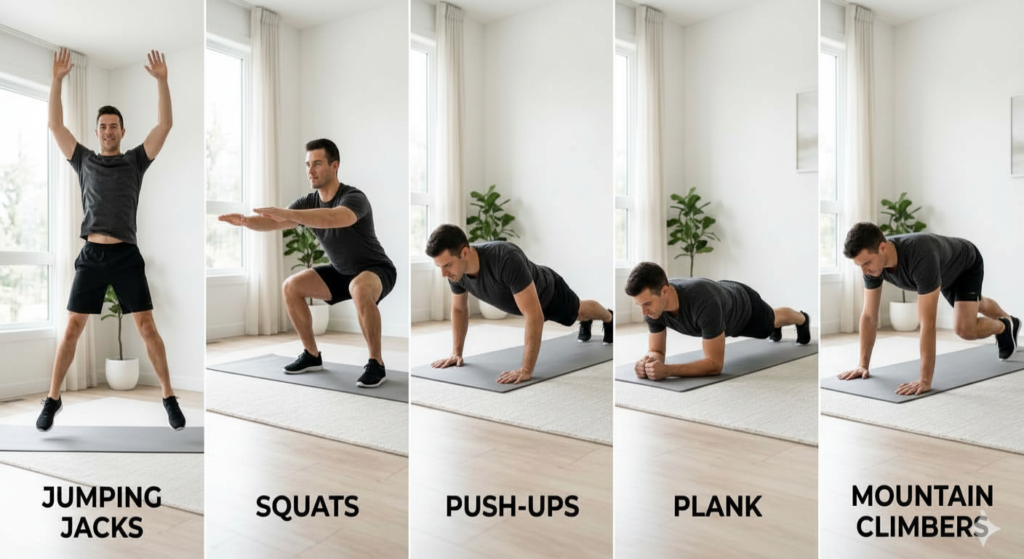
A 10-minute home workout consists of 5 bodyweight exercises — jumping jacks, squats, push-ups, plank hold, and mountain climbers — each performed for 40 seconds with 20 seconds rest, repeated for 2 rounds. No equipment is needed. Research from the American College of Sports Medicine confirms that short, high-intensity 10-minute sessions can meaningfully improve cardiovascular fitness and calorie burn when performed consistently 4–5 times per week. For beginners, this is the most practical way to build the habit of daily exercise without gym access, cost, or scheduling pressure.
What the Science Says About Short Workouts
Let’s address the obvious question: can 10 minutes actually do anything?
The answer, backed by research, is yes — with one condition: intensity matters.
A 2014 study published in PLOS ONE found that a 10-minute workout containing one minute of all-out effort produced comparable cardiovascular adaptations to 45 minutes of moderate steady-state cardio. The key was that the short session had to be genuinely challenging.
A 2019 review in the British Journal of Sports Medicine concluded that even small amounts of vigorous physical activity — as little as 10 minutes per day — were associated with significant reductions in all-cause mortality risk.
In practical terms: 10 minutes done with real effort, 4–5 days per week, beats 45 minutes done half-heartedly once a week. Every time.
Who This Workout Is For
This routine was designed specifically for:
- Complete beginners who have never followed a structured workout programme
- Busy professionals with unpredictable schedules
- Parents with limited solo time during the day
- Students with no gym access or budget
- Anyone returning to fitness after a long break
If you can already do 20+ push-ups and run 5km without stopping, this routine will feel too easy. That’s fine — use it as a warm-up before a longer session, or check out the Full Body Strength Programme instead.
The Day I Realised 10 Minutes Was Enough
Three years into coaching, I had a client named Farrukh — a 41-year-old project manager with two kids, a 90-minute daily commute, and a genuine desire to get fit. He’d tried gym memberships twice. Both times, life got in the way by week three.
When he came to me, he said, “Saad, I genuinely cannot give you more than 10 minutes a day. Is that even worth doing?”
I told him to try it for 30 days and track how he felt — not how he looked.
By day 30, his resting heart rate had dropped from 78 to 71 bpm. He’d lost 2.3 kg. More importantly, he hadn’t missed a single day. The streak itself became motivating.
That’s the power of a 10-minute home workout. It isn’t a compromise — it’s a gateway. And for most people who are completely sedentary, it produces real, measurable results faster than you’d expect.
The 10-Minute Home Workout Routine
How it works:
- 5 exercises × 40 seconds work / 20 seconds rest
- 2 rounds = exactly 10 minutes
- No equipment — bodyweight only
- Space needed — 2m × 2m floor space
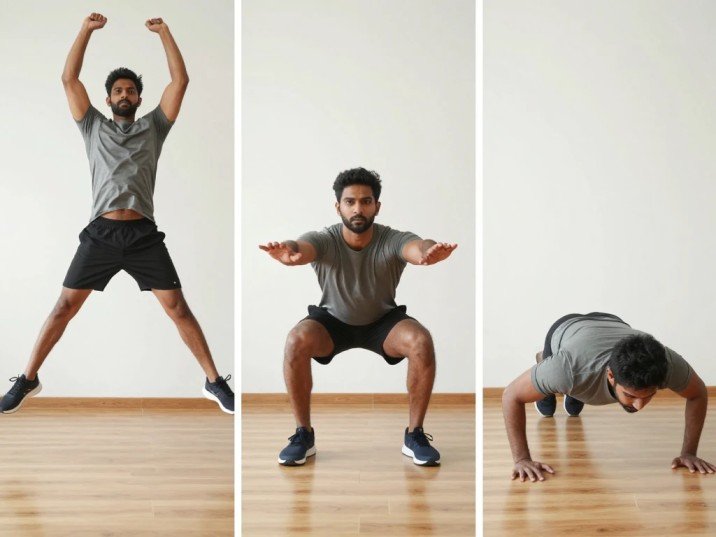
Exercise 1 — Jumping Jacks
Duration: 40 seconds | Rest: 20 seconds Muscles: Full body, cardiovascular system Difficulty: Beginner
Jumping jacks elevate your heart rate within the first 10 seconds, warming up your joints and preparing your body for the exercises ahead. They’re also the easiest entry point for anyone who hasn’t exercised in months.
Step-by-step:
- Stand tall with feet together and arms at your sides
- Jump and simultaneously spread your feet to just wider than shoulder-width
- As your feet land, raise both arms overhead until they almost touch
- Jump again and return to the starting position
- Land softly — don’t slam your heels into the floor
- Maintain a steady rhythm throughout
Beginner modification: Step side to side instead of jumping. Same arm movement, zero impact on the joints.
Common mistake: Letting your arms flop rather than driving them up actively. Engage your shoulders — this increases the calorie burn significantly.
Saad’s tip: Count your reps during the first session. Most beginners hit 25–35 in 40 seconds. Write it down. Watch that number climb over the coming weeks.
Exercise 2 — Bodyweight Squats
Duration: 40 seconds | Rest: 20 seconds Muscles: Quads, glutes, hamstrings, core Difficulty: Beginner
The squat is the most fundamental human movement pattern. We squat to sit, to pick things up, to get in and out of a car. Training it directly makes everyday life easier — and that’s a benefit most people feel within 2 weeks.
Step-by-step:
- Stand with feet shoulder-width apart, toes pointed out 15–30 degrees
- Hold your arms straight out in front for balance (or cross them at your chest)
- Brace your core — imagine someone is about to push you from behind
- Push your knees out in the direction of your toes as you descend
- Lower until your thighs are parallel to the floor (or as low as your mobility allows)
- Drive through your heels to stand back up
- Squeeze your glutes at the top for one second before the next rep
Beginner modification: Squat to a chair or bed — sit down and stand up. This removes the fear of “falling” and builds confidence in the movement pattern.
Common mistake: Letting the heels rise off the floor. If this happens, your ankles lack mobility. Fix it by placing a folded towel under your heels temporarily while you work on ankle flexibility.
Exercise 3 — Push-Ups
Duration: 40 seconds | Rest: 20 seconds Muscles: Chest, shoulders, triceps, core Difficulty: Beginner–Intermediate
Push-ups are one of the most complete upper-body exercises available without equipment. When performed correctly — with a rigid body and full range of motion — they build genuine pressing strength that transfers to real-world tasks.
Step-by-step:
- Place hands slightly wider than shoulder-width apart, fingers pointing forward
- Form a rigid plank from head to heels — squeeze your glutes and brace your core
- Elbows should travel at roughly 45 degrees from your body (not flared at 90 degrees)
- Lower your chest to within 2–3 cm of the floor
- Pause briefly at the bottom
- Press explosively back to the starting position
Beginner modification: Drop to your knees. Keep everything else identical — rigid torso, full range of motion, controlled speed. Knee push-ups are a legitimate progression tool, not a shortcut.
Progression ladder:
- Week 1–2: Knee push-ups
- Week 3–4: Standard push-ups (even if only 3–4 per set)
- Week 5+: Slow descent push-ups (3 seconds down)
Common mistake: Sagging hips or piking the hips upward. Both mean your core isn’t braced. Hold a 20-second plank before each push-up set to activate the core first.
Exercise 4 — Plank Hold
Duration: 40 seconds | Rest: 20 seconds Muscles: Core (transverse abdominis, obliques), glutes, shoulders Difficulty: Beginner
The plank is not a passive rest. A correctly performed plank is one of the most intense core exercises available — every muscle in your body is working simultaneously to maintain rigidity.
Step-by-step:
- Rest on your forearms with elbows directly under your shoulders
- Squeeze your glutes — this is the single most important cue
- Tuck your pelvis slightly to flatten your lower back
- Pull your navel gently toward your spine
- Keep your neck neutral — look at a spot on the floor about 30 cm in front of your hands
- Breathe steadily — don’t hold your breath
- Hold without any sagging at the hips or piking upward
Beginner modification: Start with a 20-second hold. If you can’t make 40 seconds without form breaking down, rest for 5 seconds and resume — never compromise the position to hit the time target.
Common mistake I see constantly: People looking up or forward. This puts the neck into hyperextension and shifts tension away from the core. Eyes down, always.
Exercise 5 — Mountain Climbers
Duration: 40 seconds | Rest: 20 seconds Muscles: Core, hip flexors, shoulders, quads, cardiovascular system Difficulty: Beginner–Intermediate
Mountain climbers are the perfect finisher for this circuit — they combine a moving plank with a cardio spike, bringing your heart rate to its peak at the end of each round. They also burn more calories per second than any other exercise in this routine.
Step-by-step:
- Start in a high plank position — hands under shoulders, arms straight, body rigid
- Drive your right knee toward your chest as far as you can
- Return it and immediately drive your left knee forward
- Keep your hips level throughout — don’t let them rise or sag
- Maintain the plank position in your upper body — shoulders over wrists
- Move at a controlled but challenging pace
Beginner modification: Slow mountain climbers — take 2 seconds per knee drive. This keeps the heart rate elevated while giving you more control over form.
Common mistake: Letting the hips rise into the air with each knee drive. This turns a full-body exercise into a hip-flexor stretch. Keep the hips down and the core engaged throughout.
Complete Workout Structure at a Glance
| Round | Exercise | Work | Rest |
|---|---|---|---|
| 1 | Jumping Jacks | 40 sec | 20 sec |
| 1 | Bodyweight Squats | 40 sec | 20 sec |
| 1 | Push-Ups | 40 sec | 20 sec |
| 1 | Plank Hold | 40 sec | 20 sec |
| 1 | Mountain Climbers | 40 sec | 20 sec |
| — | Rest between rounds | — | 60 sec |
| 2 | Jumping Jacks | 40 sec | 20 sec |
| 2 | Bodyweight Squats | 40 sec | 20 sec |
| 2 | Push-Ups | 40 sec | 20 sec |
| 2 | Plank Hold | 40 sec | 20 sec |
| 2 | Mountain Climbers | 40 sec | 20 sec |
Total time: 10 minutes
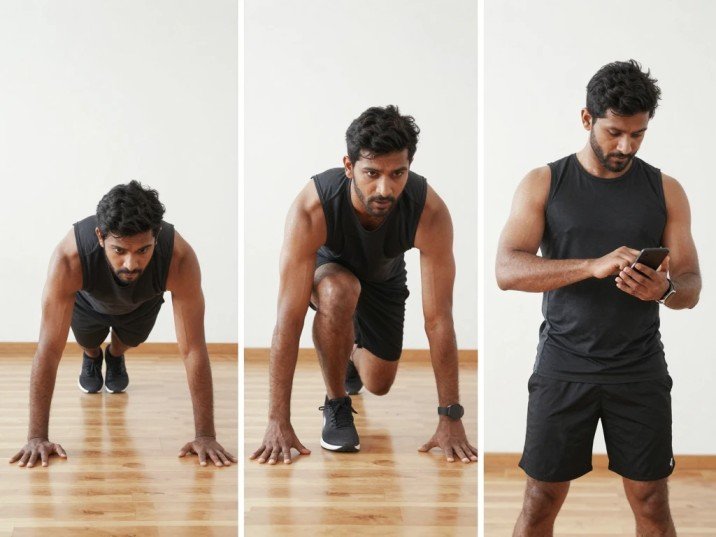
Use a free interval timer app (Tabata Timer or Interval Timer on iOS/Android) to track your work and rest periods without watching the clock.
Tips to Maximise Results From 10 Minutes
1. Warm up for 2 minutes before you start Walk on the spot, do 10 arm circles in each direction, and perform 5 slow bodyweight squats. Cold muscles tear. Two minutes of preparation prevents injury and improves performance.
2. Push your intensity during the 40-second work periods A 10-minute workout only delivers results proportional to the effort you put in. If you can hold a conversation during mountain climbers, you’re not working hard enough. By the end of each exercise, you should feel like stopping.
3. Track your reps Write down how many reps you complete for each exercise in each session. This creates accountability and makes progressive overload visible. Seeing your squat count go from 12 to 19 in three weeks is the most motivating data you’ll ever see.
4. Be consistent before you try to be perfect Doing this workout 5 days a week for 4 weeks at moderate effort will produce far better results than doing it perfectly twice a week. Frequency beats intensity at this stage of training.
5. Pair it with protein Exercise tears muscle tissue. Protein repairs and builds it. Aim for at least 20–30g of protein within 60–90 minutes of finishing your workout. Eggs, Greek yoghurt, cottage cheese, or a protein shake all work.
4-Week Progression Plan
Don’t do the same workout forever. Here’s how to progress week by week:
| Week | Modification | Goal |
|---|---|---|
| Week 1 | Beginner versions of all exercises, 2 rounds | Build the habit, establish form |
| Week 2 | Standard versions, 2 rounds | Increase reps per exercise |
| Week 3 | Standard versions, 3 rounds (15 min) | Build endurance |
| Week 4 | Faster pace, 3 rounds, reduce rest to 15 sec | Increase intensity |
After week 4, you’ll be ready to progress to a longer routine. The Full Body Strength Programme is the natural next step.
Real-World Case Study: Farrukh’s 30-Day Result
I mentioned Farrukh at the start of this article. Here are his actual numbers after 30 days of this exact routine:
- Sessions completed: 28 out of 30 (missed 2 due to travel)
- Resting heart rate: 78 → 71 bpm
- Weight: 87.4 kg → 85.1 kg (−2.3 kg)
- Push-ups in 40 seconds: 8 → 17
- Squats in 40 seconds: 12 → 22
- Self-reported energy level (1–10): 4 → 7
He didn’t change his diet during this period. He didn’t add any additional exercise. He simply did this 10-minute routine consistently.
His comment at the end of week 4: “I feel like a different person. I didn’t expect anything to change in 30 days but everything has.”
Farrukh’s case isn’t exceptional. It’s typical of what happens when a sedentary person begins any form of consistent exercise. The first 30 days produce the most dramatic improvements — because the baseline is low and the body responds rapidly to a new stimulus.
10-Minute Workout vs. 45-Minute Gym Session — Is There a Real Difference?
| Factor | 10-Min Home Workout | 45-Min Gym Session |
|---|---|---|
| Calories burned | ~80–120 | ~300–450 |
| Muscle building potential | Moderate (beginner) | High |
| Cardiovascular benefit | Good | Very good |
| Consistency rate (real world) | High | Low |
| Cost | Free | £30–60/month |
| Time including travel | 10 minutes | 60–90 minutes |
| Equipment needed | None | Yes |
| Suitable for complete beginners | Yes | Depends |
The honest answer: A 45-minute gym session will produce faster and greater results — if you actually go. For most people, the gym session wins on paper and loses in practice. A 10-minute home workout you do 5 days a week will outperform a gym membership you use twice a month.
How Fast Will You See Results?
Here’s a realistic timeline based on consistent daily effort:
Days 1–5: Muscle soreness (DOMS). You’ll feel the squats in your quads and the push-ups in your chest. This is normal and indicates the muscles are being stimulated.
Week 1–2: Better sleep quality, more energy in the morning, improved mood. These are the first adaptations — neurological and hormonal, not yet structural.
Week 2–3: Noticeably more reps per exercise. What felt like maximum effort at week 1 now feels manageable. Stamina is building.
Week 3–4: Visible changes begin — slightly leaner, posture improves, clothes fit differently. Friends may start commenting.
Week 5–8: Significant strength and endurance improvements. At this point you’ll likely need to progress beyond this routine to keep seeing results.
Common Mistakes to Avoid
Skipping the warm-up Two minutes of light movement before this workout makes a significant difference to performance and injury risk. Never skip it.
Racing through exercises with poor form Speed is worthless without control. A slow, controlled squat does more than a fast, sloppy one every single time.
Inconsistency followed by overcompensation Missing three days then trying to do 5 rounds to “catch up” is how injuries happen. If you miss a day, simply resume the next day with the regular programme.
Expecting results without dietary support Exercise is 30–40% of the equation. You cannot out-train a diet built on processed food and excess calories. Focus on protein, vegetables, and whole foods alongside this routine.
Stopping at week 4 because it feels too easy When it stops being challenging, it stops producing results. Progress to 3 rounds, reduce rest periods, or add a second 10-minute session in the evening.
About the Author
I am a fitness and fat loss coach with over 6 years of experience helping everyday people build sustainable fitness habits. I founded Fitness Flora to provide practical, research-backed workout and nutrition guidance for people who don’t have hours to spend in the gym. My coaching philosophy centres on one principle: consistency in simple things beats perfection in complicated ones.
Conclusion
A 10-minute home workout is not a compromise. It is a decision to show up every day, build a consistent habit, and let compounding do its work.
The five exercises in this routine — jumping jacks, squats, push-ups, plank, and mountain climbers — cover every major movement pattern, require zero equipment, and take less time than scrolling social media.
Start today. Track your reps. Come back tomorrow.
The results will follow.
Related Articles:
- 13 Best Full Body Exercises for Strength
- 10 Bodyweight Back Exercises to Build a Strong Back at Home
- Full Body Workout Routine for Women
Frequently Asked Questions
Q: Is 10 minutes of exercise a day actually enough?
For a complete beginner, yes — 10 minutes of consistent, intense effort will produce real improvements in fitness, energy, and body composition. The research is clear that some exercise is dramatically better than none. That said, as you get fitter, you’ll need to increase duration or intensity to keep progressing.
Q: Can I do this workout every day?
Yes — this routine is low enough in intensity that daily practice is safe for most people. However, if you feel genuinely fatigued or sore, take a rest day. Recovery is part of the process.
Q: Will this workout help me lose weight?
It will contribute to weight loss, particularly in the early weeks. For meaningful fat loss, you’ll need to combine it with a calorie-controlled diet. A 10-minute workout burns approximately 80–120 calories — useful, but diet remains the dominant factor in fat loss.
Q: What if I can’t do a full push-up?
Start with knee push-ups. There is no shame in this — it is a legitimate training tool used by professional coaches. Progress from there as your strength builds.
Q: Is this safe for older adults?
Generally yes, with modifications. Replace jumping jacks with marching on the spot to reduce joint impact. Use a chair for squat support if needed. If you have any pre-existing joint or cardiovascular conditions, check with your doctor before starting.
Q: Do I need to warm up before a 10-minute workout?
Yes — 2 minutes of light movement (marching, arm circles, gentle squats) is enough. Skipping the warm-up on a short, intense session significantly increases injury risk.
Q: What should I eat before this workout?
If training in the morning, a small snack (banana, a few dates, or a slice of toast) 20–30 minutes before is enough. If training later in the day, you’ll have eaten previously and no additional pre-workout food is needed.
Q: When should I progress beyond this routine? When you can complete all 2 rounds with perfect form and feel like you could do a third round comfortably — it’s time to progress. Add a third round, reduce rest periods, or move to a longer full-body programme.
Q: Can I build muscle with this workout? For complete beginners, yes — any resistance training stimulus will produce muscle growth in the early stages. After 4–6 weeks, muscle building will plateau without adding external resistance (dumbbells, bands). This routine is primarily a foundation builder and habit installer.
Q: What’s the best time of day to do this workout? The best time is whichever time you will actually do it. Research shows morning workouts have a slight advantage for consistency (fewer scheduling conflicts as the day goes on), but the physiological benefits are the same regardless of timing.