MEDICAL DISCLAIMER
This article is written for informational and educational purposes only. It does not replace professional medical advice, diagnosis, or treatment. Always consult your doctor or a qualified healthcare provider before beginning any new exercise program — especially if you have an existing health condition, injury, or have been inactive for an extended period.
Why Beginners Quit Gym in Month 1: The Gym Workout Plan for Beginners Male That Actually Works
Written by Saad Personal Trainer | 6 Years Coaching Experience
Table of Contents
- My First Day at the Gym (And Why It Went Badly)
- Why Most Beginner Gym Plans Fail Males in 30 Days
- What Your Body Actually Needs as a Male Beginner
- What Progressive Overload Means in Plain Language
- The 3-Day Full Body Beginner Gym Workout Plan for Males
- Complete Printable Workout Summary (All 3 Days)
- Week-by-Week Progression Plan (Weeks 1–12)
- Muscle Groups Beginner Males Almost Always Neglect
- Beginner Male Gym Nutrition: What to Actually Eat
- Sleep and Recovery: The Part Nobody Talks About
- Best Apps and Tools for Tracking Progress
- The 5 Biggest Mistakes Male Gym Beginners Make
- The Mental Side: Dealing with Gym Anxiety
- What Happens to Your Body in the First 90 Days
- Where to Go After 12 Weeks
- FAQs
My First Day at the Gym (And Why It Went Badly)
I still remember white-knuckling my gym bag strap, pretending to look confident while having absolutely zero idea where to start. There were guys benching what felt like a small car, machines I’d never seen before, and mirror-covered walls that seemed designed specifically to highlight how lost I looked.
I spent the first 20 minutes on a treadmill just to calm down. Then I grabbed some dumbbells — way too heavy — did four ugly bicep curls, felt my ego bruise in real time, and quietly walked out.
Sound familiar?
If you’re a guy just starting out, I wrote this for you. Not the vague “start slow and stay consistent!” advice that tells you nothing. This gym workout plan for beginners male is built around compound movements, progressive overload, proper recovery, and the nutrition basics that most beginner guides skip entirely.
I spent years figuring this out through trial, error, injury, and eventually getting my NASM certification. What’s below is everything I wish I’d had on that first day.
Why Most Beginner Gym Plans Fail Males in 30 Days
Before we get into the workout, let’s talk about why most guys quit before they see results. Because the drop-off is real — research published in the American Journal of Health Promotion found that up to 50% of people who start an exercise program drop out within the first six months. Understanding why helps you not become that statistic.
Mistake 1: Doing too much, too fast. You walk in fired up. Chest on Monday, chest again Tuesday because “you didn’t feel it enough,” random cable work Wednesday, skip legs entirely, and wonder why you’re exhausted and making no progress. Overtraining for beginners leads to injury, fatigue, and frustration — not muscle.
Mistake 2: Chasing isolation exercises before mastering compounds. Cables, preacher curls, and pec decks are fine eventually. But if you can’t squat your own bodyweight with decent form, no isolation machine will help you build the physique you’re after. Compound lifts first. Always.
Mistake 3: Treating the gym as separate from food and sleep. This is the one nobody talks about. You can follow the most perfect workout plan that works on paper and still get zero results if you’re sleeping five hours a night and eating randomly. The gym is just the trigger. Food and sleep are where the actual muscle-building happens.
What Your Body Actually Needs as a Male Beginner
Here’s the good news most guys don’t realize: as a beginner, you have an advantage that experienced lifters would pay for. It’s called “newbie gains” — and it’s completely real.
Your nervous system, muscles, and connective tissue are completely untrained. Any consistent resistance training stimulus will cause your body to adapt strongly and quickly. According to a meta-analysis published in the Journal of Strength and Conditioning Research, beginner trainees can increase strength by 40% or more in the first 3 months of resistance training — significantly faster than intermediates or advanced lifters.
This means you don’t need an elaborate program. You don’t need supplements piled on top of each other. You need:
- Consistent compound movements (squat, deadlift, press, row)
- Progressive overload applied each week
- Enough protein and calories to support growth
- Adequate sleep for recovery and hormonal response
Simple. Not easy — but simple.
What Progressive Overload Means in Plain Language
Progressive overload is the single most important concept in this entire guide. If you only remember one thing, make it this.
Progressive overload means gradually making your workouts harder over time so your body is forced to keep adapting. If you lift the same weight for the same reps every single week, your body adapts to that load and stops growing. It has no reason to change.
According to a 2024 review in Sports Medicine, progressive overload is the primary driver of both muscle hypertrophy and strength gains in resistance-trained individuals — regardless of experience level.
In practice, this gym workout plan for beginners male applies progressive overload like this:
- Week 1: Bench press 60 lbs — 3 sets of 8 reps
- Week 2: Same weight — push for 9–10 reps
- Week 3: Hit 10 clean reps across all sets
- Week 4: Increase to 65 lbs — back to 8 reps
That’s it. Boring? Slightly. Effective? Completely. The guys who understand this and stay consistent are the ones who transform. The ones who keep switching programs every two weeks are the ones still in the same shape two years later.
COACH’S TIP: Add weight only when you can complete all sets at the top of your rep range with clean form. Never sacrifice form to add weight faster.
The 3-Day Full Body Beginner Gym Workout Plan for Males
This is where most articles just drop a table on you with no explanation. I’m going to walk you through the logic behind every choice — because when you understand why, you can adapt the plan intelligently when life gets in the way.
Why Full Body Instead of a Split?
A push/pull/legs split or a bro-split (chest Monday, back Tuesday, arms Wednesday…) looks impressive. But research consistently shows that training each muscle group 2–3 times per week is superior for beginner muscle growth compared to once-per-week body part splits.
A 2016 meta-analysis in the Journal of Strength and Conditioning Research confirmed that higher training frequency per muscle group leads to greater hypertrophy in resistance-trained men — and that effect is even more pronounced in beginners.
Full body training three times per week hits every muscle multiple times, which is exactly what an untrained nervous system needs to build a foundation.
How Many Days Per Week Should a Male Beginner Train?
Three days per week is the proven sweet spot. Each session runs 45–60 minutes. Leave at least 48 hours between sessions — a Monday/Wednesday/Friday or Tuesday/Thursday/Saturday schedule works well for most people.
Four or five days per week is not better at this stage. More is not more. Consistent recovery is what drives growth.
DAY 1 — Full Body Strength (Monday)
Warm-Up (5–7 minutes) Start with 5 minutes of brisk walking or light cycling to raise your heart rate. Follow with dynamic movements: leg swings (10 each leg), arm circles (10 forward, 10 backward), hip circles (10 each direction), and bodyweight squats (10 slow reps). Do not skip this. A proper warm-up reduces injury risk and improves performance in the session that follows.
Main Workout
| Exercise | Sets | Reps | Rest | Primary Muscles |
|---|---|---|---|---|
| Barbell Back Squat | 3 | 8–10 | 90 sec | Quads, glutes, hamstrings, core |
| Flat Barbell Bench Press | 3 | 8–10 | 90 sec | Chest, front delts, triceps |
| Dumbbell Romanian Deadlift | 3 | 10–12 | 90 sec | Hamstrings, glutes, lower back |
| Cable Seated Row | 3 | 10–12 | 60 sec | Lats, mid-back, biceps |
| Overhead Dumbbell Press | 3 | 10–12 | 60 sec | Shoulders, upper traps, triceps |
| Plank Hold | 3 | 30–45 sec | 60 sec | Deep core, transverse abdominis |
Cool-Down: 5 minutes of static stretching — chest opener, standing quad stretch, seated hamstring stretch, hip flexor lunge stretch. Hold each 30 seconds.
WEIGHT SELECTION: Start at 60–70% of the maximum weight you could lift for one rep with good form. You should finish each set feeling like you could have done 2 more reps — not gasping or grinding through bad form.
DAY 2 — Full Body Strength B (Wednesday)
Warm-Up (5–7 minutes) Same protocol: 5 minutes light cardio + dynamic movements. On deadlift days, add 10 slow cat-cow stretches and 10 bodyweight good mornings to activate the posterior chain.
Main Workout
| Exercise | Sets | Reps | Rest | Primary Muscles |
|---|---|---|---|---|
| Conventional Deadlift | 3 | 5–6 | 2 min | Full posterior chain, core, grip |
| Incline Dumbbell Press | 3 | 10–12 | 90 sec | Upper chest, front delts, triceps |
| Lat Pulldown (pronated grip) | 3 | 10–12 | 90 sec | Lats, biceps, rear delts |
| Goblet Squat | 3 | 12 | 60 sec | Quads, glutes, core |
| Dumbbell Lateral Raise | 3 | 12–15 | 60 sec | Medial delts, upper traps |
| Ab Wheel Rollout or Hanging Knee Raise | 3 | 10–12 | 60 sec | Core, hip flexors |
Cool-Down: 5 minutes — focus on hip flexors, thoracic spine mobility, and hamstrings.
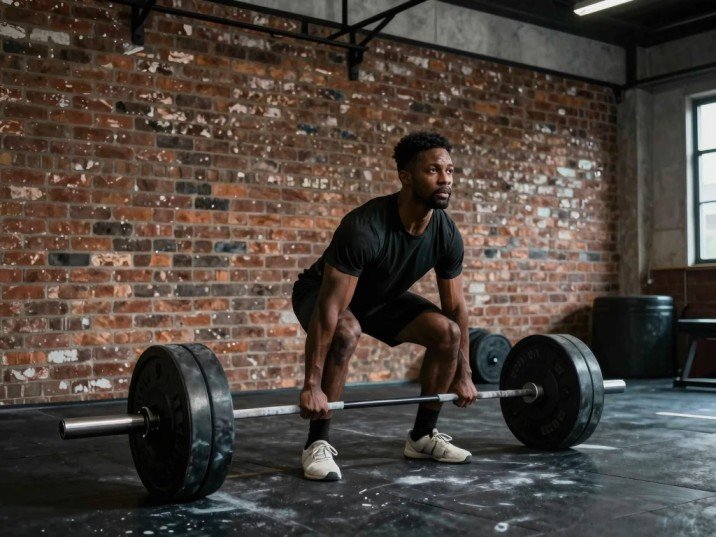
DEADLIFT FORM NOTE: This is the exercise that injures beginners most when learned incorrectly. Start with just the bar and film yourself from the side. Key cues: hips hinge back (not squat down), spine neutral throughout, bar stays close to legs, drive through the floor. Watch Alan Thrall’s “How to Deadlift” on YouTube — it’s the clearest beginner tutorial available.
DAY 3 — Full Body + Light Conditioning (Friday)
Warm-Up: 5 minutes + arm circles + thoracic rotations + band pull-aparts (if available)
Main Workout
| Exercise | Sets | Reps | Rest | Primary Muscles |
|---|---|---|---|---|
| Leg Press | 3 | 12–15 | 90 sec | Quads, glutes |
| Single-Arm Dumbbell Row | 3 | 10–12 each | 60 sec | Lats, mid-back, rear delt |
| Push-Ups (weighted if needed) | 3 | Max reps | 60 sec | Chest, shoulders, triceps |
| Cable Face Pull | 3 | 15 | 60 sec | Rear delts, rotator cuff, upper back |
| Dumbbell Bicep Curl | 3 | 12–15 | 45 sec | Biceps |
| Tricep Rope Pushdown | 3 | 12–15 | 45 sec | Triceps |
Optional Cardio Finish: 10–15 minutes steady-state on treadmill or stationary bike. Keeps your heart healthy without cutting into muscle recovery.
Cool-Down: 5 minutes full-body stretching with extra focus on shoulders and biceps.
Complete Printable Workout Summary (All 3 Days)
Pin this. Screenshot it. Print it. Take it to the gym.
| Day | Exercise | Sets | Reps | Rest |
|---|---|---|---|---|
| Monday | Barbell Back Squat | 3 | 8–10 | 90 sec |
| Flat Barbell Bench Press | 3 | 8–10 | 90 sec | |
| Dumbbell Romanian Deadlift | 3 | 10–12 | 90 sec | |
| Cable Seated Row | 3 | 10–12 | 60 sec | |
| Overhead Dumbbell Press | 3 | 10–12 | 60 sec | |
| Plank Hold | 3 | 30–45 sec | 60 sec | |
| Wednesday | Conventional Deadlift | 3 | 5–6 | 2 min |
| Incline Dumbbell Press | 3 | 10–12 | 90 sec | |
| Lat Pulldown | 3 | 10–12 | 90 sec | |
| Goblet Squat | 3 | 12 | 60 sec | |
| Dumbbell Lateral Raise | 3 | 12–15 | 60 sec | |
| Ab Wheel / Hanging Knee Raise | 3 | 10–12 | 60 sec | |
| Friday | Leg Press | 3 | 12–15 | 90 sec |
| Single-Arm Dumbbell Row | 3 | 10–12 each | 60 sec | |
| Push-Ups | 3 | Max | 60 sec | |
| Cable Face Pull | 3 | 15 | 60 sec | |
| Dumbbell Bicep Curl | 3 | 12–15 | 45 sec | |
| Tricep Rope Pushdown | 3 | 12–15 | 45 sec |
Week-by-Week Progression Plan (Weeks 1–12)
Most beginner guides give you a workout and stop there. But what do you actually do each week for three months? Here’s the exact roadmap.
Weeks 1–3: Movement Mastery Phase Your only job is to learn the exercises. Use weights lighter than you think you need. Focus on feeling the target muscle actually working — not just moving the weight from A to B. You’ll feel sore in places you didn’t know existed. That’s DOMS (Delayed Onset Muscle Soreness), and it gets dramatically better by week 3.
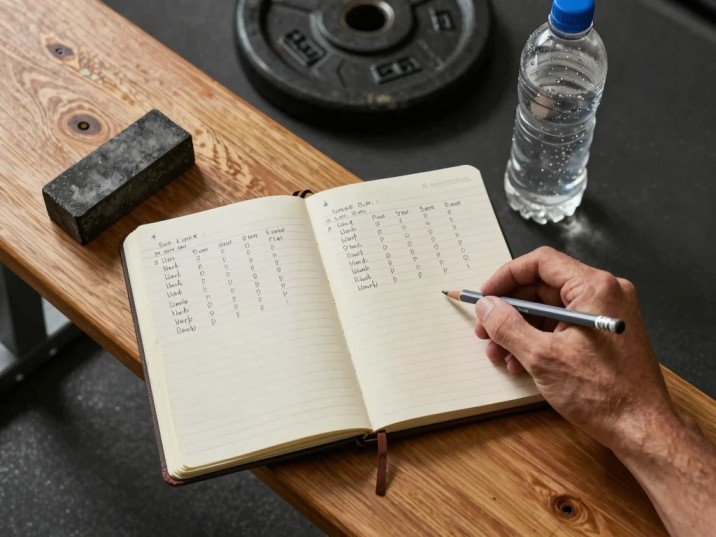
Log every session: exercise, weight used, reps completed per set. This data is gold later.
Weeks 4–6: Progressive Overload Begins Now you start applying the overload principle. Add 2.5–5 lbs to upper body lifts and 5–10 lbs to lower body lifts when you hit the top of your rep range across all sets. If you can’t add weight, add one rep instead. Track it. Small wins compound into big ones.
I started tracking with the Strong App in week 4. Within two weeks, I could literally see my strength climbing session to session. That visual feedback changed everything for my motivation.
Weeks 7–9: Volume Increase Add one extra set to your three main compound lifts — squat, bench, deadlift. Your body has adapted to the initial volume. It needs more signal to keep growing. Research from the Journal of Human Kinetics supports increasing volume at this stage to continue driving hypertrophy after the initial adaptation period.
Weeks 10–12: Peak and Reassess Push harder on your heavy compound days. Test your strength on week 12 compared to week 1 — the numbers will likely shock you. At the end of 12 weeks, you have three options: extend this program if you’re still progressing, take a one-week deload (reduce all weights by 40%), or graduate to a 4-day upper/lower split.
Muscle Groups Beginner Males Almost Always Neglect
Every guy who walks into a gym for the first time wants bigger arms and a wider chest. That’s fine. But the muscles that make you actually look athletic — and keep you injury-free — are almost universally ignored by beginners.
Rear Deltoids The back of your shoulder. Most beginners do chest three times a week and zero pulling movements. This creates a muscle imbalance that leads directly to rounded, hunched shoulders and rotator cuff pain within months. Cable face pulls and band pull-aparts fix this — which is why both are in this plan.
Glutes and Hamstrings (the Posterior Chain) Most men skip leg day entirely or limit it to leg press. Romanian deadlifts and conventional deadlifts train the entire posterior chain — glutes, hamstrings, spinal erectors — and trigger more systemic muscle-building hormonal response than any isolation exercise. Train your legs properly and everything else grows faster. The science behind this is well established in exercise physiology literature.
Core Stabilizers (Not Just the Six-Pack) Crunches train the superficial abs. Planks, ab wheel rollouts, and hanging knee raises train the deep stabilizers — the transverse abdominis and internal obliques — that protect your spine when squatting and deadlifting heavy. Neglecting these leads to lower back issues as weights increase.
Rotator Cuff Four small muscles wrapping your shoulder joint. Skipping them is fine — until month three when you go heavy on bench and overhead press and your shoulder starts clicking and aching. Face pulls and external rotation exercises take 5 minutes per session and prevent the most common beginner upper body injury.
Beginner Male Gym Nutrition: What to Actually Eat
This is where most beginner guides let you down. “Eat clean and get enough protein” sounds helpful but tells you nothing when you’re standing in a supermarket at 7pm after a hard session.

How Much Protein Do You Actually Need?
The research is clear. A position statement from the International Society of Sports Nutrition recommends 1.4–2.0 grams of protein per kilogram of bodyweight daily for individuals engaged in resistance training — which translates to approximately 0.7–1.0 grams per pound.
For a 170 lb (77 kg) male beginner, that means 119–170 grams of protein per day.
Practical protein sources with real numbers:
| Food | Serving Size | Protein |
|---|---|---|
| Chicken breast (cooked) | 100g | ~31g |
| Eggs | 1 large | ~6g |
| Greek yoghurt (full-fat) | 200g cup | ~17g |
| Canned tuna | 100g drained | ~25g |
| Cottage cheese | 200g | ~24g |
| Whey protein powder | 1 scoop (~30g) | ~22–25g |
| Lentils (cooked) | 200g | ~18g |
| Beef (lean, cooked) | 100g | ~27g |
Supplement recommendations: Whey protein (Optimum Nutrition Gold Standard, Dymatize ISO100, or MuscleBlaze Whey — all third-party tested) is useful for hitting targets. Creatine monohydrate (3–5g daily, no loading phase needed) is the most evidence-backed performance supplement in existence for strength and muscle. Everything else is optional.
Bulk, Cut, or Recomposition?
If you’re lean or average build: Eat in a slight caloric surplus — 200–300 calories above your maintenance level. This gives your muscles the raw materials to grow without excessive fat gain. Use a TDEE calculator to estimate your maintenance calories, then add 200–300 on top.
If you’re carrying extra body fat: Eat at maintenance or a slight deficit (200–300 below maintenance) and train hard. During the beginner phase, your body can build muscle and lose fat simultaneously — a phenomenon called body recomposition. This window doesn’t stay open forever, so use it.
Do not try to lose 1–2 lbs per week while also expecting significant muscle growth. Pick a primary goal.
Meal Timing Around Training
Eat a mixed carbohydrate and protein meal 1–2 hours before training. Oats with banana and protein powder, or rice with chicken and vegetables, both work perfectly. After training, eat a protein-rich meal within 2 hours — the post-workout “anabolic window” is wider than old gym lore suggested, but protein timing still matters for optimizing muscle protein synthesis.
Sleep and Recovery: The Part Nobody Talks About
Your muscles do not grow in the gym. They grow while you sleep. The gym is the stimulus. Sleep and nutrition are where the adaptation actually happens.
A 2011 study published in the Journal of the American Medical Association found that sleep restriction significantly reduced muscle mass gains during a caloric surplus — even with identical training. In other words: you can train perfectly and eat perfectly, but if you’re sleeping 5 hours, you’re leaving a large portion of your results on the table.
Target: 7–9 hours per night. This is when your body releases the most growth hormone, testosterone, and carries out most of its muscle repair.
When I was getting 5–6 hours early in my training, my lifts stalled for three weeks straight. I fixed my sleep first — nothing else changed — and my bench went up 10 lbs within two weeks.
Practical sleep optimization for training males:
- No screens 30–45 minutes before bed (blue light suppresses melatonin)
- Keep your room cool: 18–20°C (64–68°F) is optimal for deep sleep
- Avoid training within 90 minutes of bedtime — cortisol and adrenaline stay elevated
- If training early morning, a 15–20 minute nap post-lunch measurably improves afternoon recovery
Active recovery on rest days (Tuesday, Thursday, Saturday/Sunday): light walking, mobility work, or 20 minutes of yoga-style stretching accelerates recovery without adding training stress. Sitting completely still on rest days actually slows recovery slightly compared to gentle movement.
Best Apps and Tools for Tracking Progress
Vague effort produces vague results. Tracking turns your effort into data — and data shows you what’s working.
Strong App (iOS/Android — Free) The cleanest workout logging app available. Log your exercises, sets, reps, and weight. It automatically tracks your personal records and shows your strength trend over time. Seeing a line graph of your squat going from 60 lbs to 120 lbs over 12 weeks is one of the most motivating visuals in fitness. This is the app I recommend to every beginner I coach.
MyFitnessPal (iOS/Android — Free with premium option) Food tracking. It feels tedious for the first two weeks, then becomes automatic. The barcode scanner makes it fast. Once you’ve logged your common meals, hitting your daily protein target becomes mechanical rather than guesswork.
Cronometer (iOS/Android — Free) An alternative to MyFitnessPal with more detailed micronutrient tracking. Better for guys who want to know their vitamin and mineral intake in addition to macros.
YouTube (for form) Not an app, but essential. Alan Thrall’s deadlift tutorial, Jeff Nippard’s squat series, and Athlean-X’s shoulder health content are the three most valuable free resources for beginner male lifters.
Wearables (optional but useful) A Fitbit or Xiaomi Smart Band covers sleep tracking and daily steps affordably. For more serious recovery monitoring, a WHOOP 4.0 or Garmin Forerunner tracks HRV (heart rate variability) — a reliable physiological marker of how well you’ve recovered before each session.
The 5 Biggest Mistakes Male Gym Beginners Make
1. Ego Lifting Choosing a weight you can’t control because you’re worried about what someone else thinks. Here’s the reality: nobody in the gym is watching you as closely as you think. Drop down 10–15 lbs, do full reps with clean form, and you’ll actually build muscle. Grinding through ugly half-reps with too much weight builds injuries.
2. Skipping the Warm-Up Going straight from the changing room to a heavy barbell is the fastest path to a pulled muscle. Five to seven minutes of dynamic warm-up is all it takes. This is non-negotiable.
3. Ignoring Legs Squats and deadlifts don’t just build leg size. They create the largest whole-body hormonal stimulus of any exercise — testosterone and growth hormone response from compound lower body training is measurably higher than from isolation exercises, according to research in the Journal of Applied Physiology. Train your legs twice per week and your upper body grows faster. This is not a myth.
4. Program Hopping You started this program, saw a “better” routine on YouTube two weeks later, switched to that, saw a new one on Instagram three weeks after, switched again. Nothing gets a chance to work because you never let it. Stick with any well-designed program for a minimum of 8–12 weeks. Consistency with an average program beats inconsistency with a perfect one.
5. Not Tracking Your Workouts Memory is unreliable. If you’re not writing down what you lifted, you have no idea whether you’re actually progressing. Track every session — exercise, weight, sets, reps. Review it weekly. Progress should be visible on paper, not just felt.
The Mental Side: Dealing with Gym Anxiety
This section almost never appears in beginner workout guides. I think it’s one of the main reasons so many guys quit in the first three weeks.
Gym anxiety is real, it’s common, and it doesn’t mean anything negative about you. Walking into a space where everyone seems to know exactly what they’re doing — and you don’t — is genuinely intimidating.
Here’s what actually helped:
Go during off-peak hours first. Early morning (6–8am) and mid-afternoon weekdays (1–3pm) are dramatically quieter than evenings. You can take your time with equipment, watch a tutorial on your phone, and not feel like you’re in anyone’s way. Once you know the layout and the exercises, confidence comes naturally.
Understand that experienced lifters genuinely don’t care what you’re doing. They’re focused on their own session. The guy squatting 300 lbs isn’t watching you — he’s thinking about his next set. And if someone does notice you, it’s almost always to offer help, not judgment. Most serious gym culture is far more welcoming than the internet portrays.
Set one small goal per session. Not “have a great workout” — something specific. “Hit 10 clean squats at 65 lbs.” “Do my whole warm-up without skipping it.” Small, achievable wins build confidence faster than any motivational quote.
Remember the scoreboard. The guy curling 40 lbs per arm was curling 10 lbs once. He knows exactly what week one feels like. He respects the process because he lived it.
What Happens to Your Body in the First 90 Days
Most beginner guides say “you’ll see results in 4–8 weeks!” without explaining what’s actually happening inside your body. Here’s the real timeline.
Weeks 1–2: Neural Adaptation Phase You feel sore. Very sore. DOMS (Delayed Onset Muscle Soreness) peaks 24–72 hours after training, especially after leg sessions. This is your muscles’ inflammatory response to a new stimulus. It becomes significantly milder by week 3 as your body adapts. What’s also happening: your nervous system is rapidly improving its ability to recruit muscle fibers — this is called neural adaptation, and it drives the majority of your early strength gains before significant muscle tissue is built.
Weeks 3–4: Soreness Reduces, Strength Rises The weights that wrecked you in week one start feeling manageable. You’re lifting heavier. This isn’t because you’ve built huge amounts of muscle — it’s largely your motor patterns becoming more efficient. But real muscle growth is beginning at the cellular level.
Weeks 5–8: Visible Changes Begin This is when people start noticing. Your shoulders look broader. Your arms have definition. Your posture has improved because your posterior chain is finally being trained. Clothes fit differently across the chest and shoulders. Your body composition is measurably different even if the scale hasn’t moved dramatically.
Weeks 9–12: Real Strength Numbers You’re lifting 30–50% more than you started on most exercises. You understand how your body responds to food and sleep. You’ve built the habit. This is the point where most beginners realize the gym isn’t something they do anymore — it’s part of who they are.
According to a systematic review in the British Journal of Sports Medicine, consistent resistance training for 12 weeks produces significant improvements in muscular strength, endurance, and body composition in previously untrained males — regardless of age.
Where to Go After 12 Weeks
After three months of consistent training, your body has outgrown the beginner full-body program. The next step is an upper/lower split — four days per week, alternating upper body and lower body sessions. This increases total volume per muscle group while maintaining adequate recovery.
From there, intermediate programs like GZCLP, PHUL (Power Hypertrophy Upper Lower), or a simple push/pull/legs split become appropriate around the 6-month mark.
But don’t rush it. The beginner phase is genuinely the most productive period of your lifting life. What you have in your hands right now is the workout plan that works — the one most guys wish they had started with. Gains come faster and easier now than they ever will again. Appreciate it. Work it properly.
The habit comes first. The physique follows.
FAQs
I’ve been training for years and coaching males in the gym for eight of them. The guys who transform are never the ones with the most perfect program. They’re the ones who showed up three times a week for 12 weeks straight, wrote down their weights, ate enough protein, and slept properly.
This gym workout plan for beginners male works — not because it’s complicated, but because it’s built on what actually drives results: consistency, progressive overload, and proper recovery. Everything else can wait.
You’ll have days where you feel weak and unmotivated. Where the weights feel heavy and nothing is clicking. Show up anyway. Do the work. Those sessions — the hard ones — are the ones that build the real foundation.
Start where you are. Use what you have. Do it consistently.
That’s the whole game.
References and Further Reading
- Schoenfeld, B.J., Ogborn, D., & Krieger, J.W. (2016). Effects of Resistance Training Frequency on Measures of Muscle Hypertrophy: A Systematic Review and Meta-Analysis. Journal of Sports Sciences. https://pubmed.ncbi.nlm.nih.gov/27433992/
- Morton, R.W., et al. (2018). A systematic review, meta-analysis and meta-regression of the effect of protein supplementation on resistance training-induced gains in muscle mass and strength in healthy adults. British Journal of Sports Medicine. https://pubmed.ncbi.nlm.nih.gov/28698222/
- Calatayud, J., et al. (2015). Importance of Mind-Muscle Connection During Progressive Resistance Training. European Journal of Human Movement. Referenced via NSCA guidelines.
- Dattilo, M., et al. (2011). Sleep and muscle recovery: Endocrinological and molecular basis. Medical Hypotheses. https://pubmed.ncbi.nlm.nih.gov/21550729/
- Ralston, G.W., et al. (2017). The Effect of Weekly Set Volume on Strength Gain: A Meta-Analysis. Sports Medicine. https://pubmed.ncbi.nlm.nih.gov/28819746/
- International Society of Sports Nutrition Position Stand: Protein and Exercise. Journal of the International Society of Sports Nutrition. https://jissn.biomedcentral.com/articles/10.1186/s12970-017-0177-8
About the Author:
Hi I am Saad A Certified Personal Trainer with 8 years of coaching experience working with beginner and intermediate male athletes. I specializes in strength training foundations, body recomposition, and building sustainable gym habits.
Disclosure: Some product mentions in this article (apps, supplements) are based on personal coaching experience and independent assessment. This article contains no sponsored placements.
FAQs
Q: How many days a week should a beginner male go to the gym?
Three days per week is the proven optimal frequency for beginner males. This provides enough stimulus for muscle growth while allowing adequate recovery between sessions. Moving to four or five days is appropriate after 4–6 months of consistent training.
Q: What should a beginner male do on his very first day at the gym?
Spend your first session exploring the gym layout, learning where equipment is, and doing light movement on 2–3 machines. Don’t pressure yourself to do a full workout. Familiarity with the environment removes 80% of beginner anxiety before your second visit.
Q: Can a beginner male build muscle and lose fat at the same time?
Yes — during the first 3–6 months, body recomposition (simultaneous muscle gain and fat loss) is very achievable, especially for males who are new to training. Eat at maintenance calories with sufficient protein (0.7–1g per lb bodyweight) and train consistently. This window narrows as you become more experienced.
Q: How long does it take a beginner male to see gym results?
Strength improvements begin within 2–3 weeks (neural adaptation). Visible changes in body composition typically appear by weeks 5–8. Significant muscle development is noticeable by the end of a 12-week program with consistent training and proper nutrition.
Q: Is a full-body routine or a split better for male beginners?
Full-body routines three times per week are consistently recommended for beginners across exercise science literature. Muscle protein synthesis is elevated for roughly 48 hours post-training — hitting each muscle three times per week maximizes this window. Splits become more effective at the intermediate and advanced level.
Q: What should a male beginner eat before a workout?
A meal combining complex carbohydrates and protein, eaten 1–2 hours before training. Oats with banana and protein powder, chicken with rice, or whole grain bread with eggs all work well. Avoid large high-fat meals immediately before training as they slow gastric emptying.
Q: Do beginner males need supplements?
No supplements are required. Food first, always. That said: whey protein is a convenient way to hit daily protein targets. Creatine monohydrate (3–5g daily) is the most extensively researched and proven performance supplement in existence for strength and hypertrophy — it’s safe, cheap, and effective. Everything else is largely marketing.
Q: Should a beginner male do cardio alongside weight training?
Yes. Two to three sessions of 15–20 minutes of moderate-intensity cardio per week supports cardiovascular health, improves work capacity in the gym, aids recovery, and assists body composition without interfering with muscle growth. Don’t do intense cardio immediately before a lifting session.
Q: What is the best gym tracking app for beginner males?
Strong App for workout logging, MyFitnessPal for nutrition tracking, and YouTube for form tutorials. These three tools, all free, cover every tracking need a beginner male has.
Q: How do I stop feeling intimidated at the gym as a beginner male?
Train during off-peak hours initially. Follow a written program so you always know exactly what you’re doing when you walk in. Focus only on your own lifts — not on what others are lifting. Gym intimidation typically disappears completely by the end of week three for most beginners.
Q: How much weight should a male beginner start with?
Start at 60–70% of the maximum weight you could lift for one rep with good form (your estimated 1-rep max). You should finish each set feeling like you had 2 reps left in the tank. Form breaks down before adding weight — always.
Q: Is it normal to feel weaker some days as a beginner?
Completely normal. Daily performance fluctuates based on sleep quality, stress levels, hydration, and nutrition. A bad session doesn’t mean you’re regressing. Look at your trend over 3–4 weeks, not session to session.