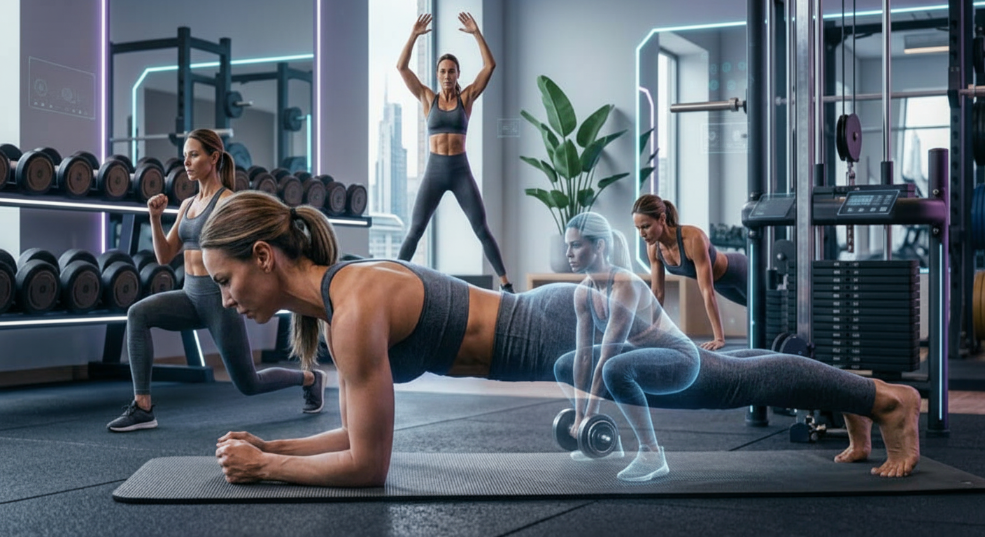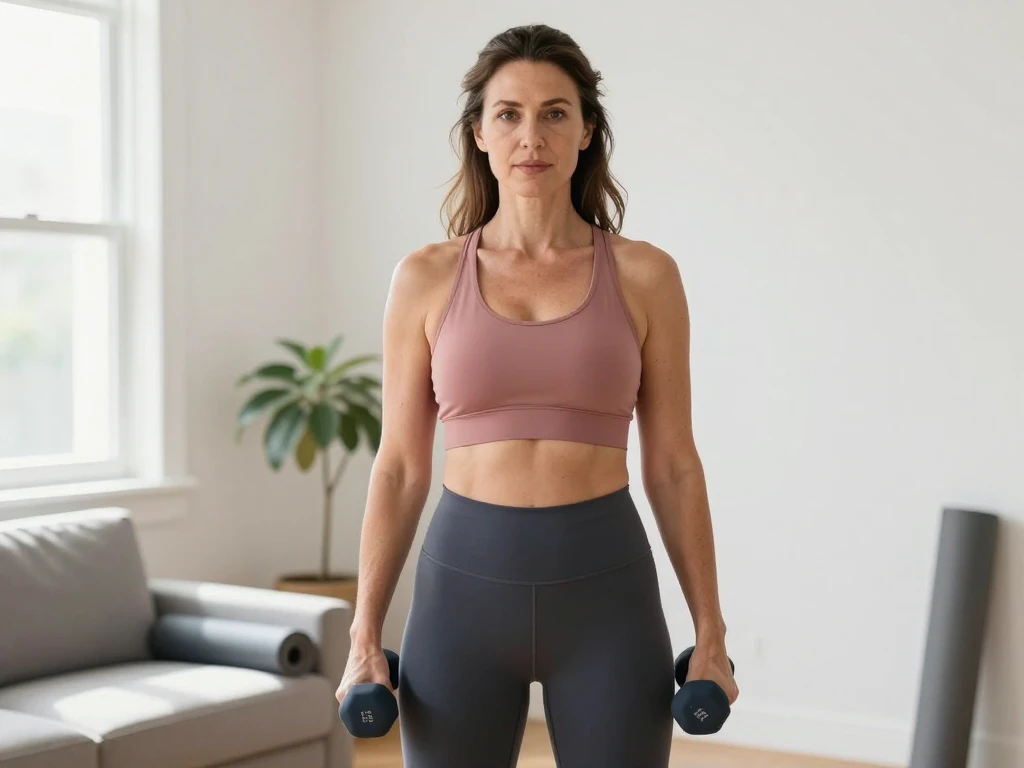
⚠️ Medical Disclaimer: This article is for informational and educational purposes only and does not constitute medical advice. Always consult your doctor or a qualified healthcare provider before beginning any new exercise or nutrition program, especially if you have existing health conditions, joint problems, or hormonal concerns.
Home Workout Plan for Women Over 40: The 4-Week Strength Guide That Actually Works
I turned 43 and cried in a fitting room. Not because the dress didn’t fit — but because I had no idea how my body had changed so much while I was still doing everything I thought was right. Same cardio. Same low-calorie eating. Same YouTube fitness videos from 2015.
My body had shifted. And no one had told me my home workout plan for women over 40 needed to shift with it.
If you’re a woman over 40 searching for a workout plan that fits real life, works with your hormones, and actually delivers results — you are in exactly the right place. This guide covers everything: what’s really happening in your body after 40, the 4-week home workout plan, nutrition, recovery, and the mistakes most women make that quietly kill their progress.
No gym. No expensive equipment. No 5 a.m. boot camps.
Table of Contents
- What’s Really Happening in Your Body After 40
- Why Strength Training Is the Foundation
- The 4-Week Home Workout Plan for Women Over 40
- Weekly Schedule
- Monday: Lower Body Strength Workout
- Wednesday: Upper Body Strength Workout
- Friday: Full Body + Core Workout
- The Cardio Strategy That Works After 40
- The Cortisol Problem Nobody Explains
- Recovery: Why Rest Is Part of the Plan
- Nutrition Basics for Women Over 40 Who Train at Home
- 4-Week Progressive Workout Schedule
- Best Apps and Tools for Home Workouts Over 40
- Common Mistakes Women Over 40 Make With Home Workouts
- Key Takeaways
- Frequently Asked Questions
What’s Really Happening in Your Body After 40 (And Why Your Old Plan Stopped Working)
Before we get into any home workout plan for women over 40, this part matters most. Skipping it is why so many women keep spinning their wheels.
After 40, your body enters a hormonal transition. Estrogen and progesterone begin to decline — a phase called perimenopause — which can start years before your last period, sometimes as early as the late 30s. This shift affects your metabolism, your sleep, your ability to build muscle, and where your body stores fat.
Here is what that means for your fitness, in plain language:
Muscle loss accelerates. Women lose roughly 1% of muscle mass per year after 40. Research confirms that adults lose between 3 and 8 percent of muscle mass per decade after age 30, and the rate worsens as estrogen declines. Less muscle equals a slower resting metabolism — which means the same food and the same cardio routine that worked at 32 will not produce the same results at 42.
Cortisol becomes a bigger problem. When estrogen and progesterone drop, the stress hormone cortisol becomes more dominant. Poor sleep, work stress, and — ironically — long cardio sessions all raise cortisol further. Chronically elevated cortisol promotes abdominal fat storage. This is that stubborn “menopause belly” that seems to appear despite doing everything right.
Your recovery is slower. Connective tissue, joints, and the nervous system all take longer to recover after 40. Training exactly the same as you did in your 30s without adjusting recovery will lead to fatigue, injury, and plateaus.
Your body is not broken. It is asking for a smarter approach.
Why Strength Training Is the Foundation of Any Home Workout Plan for Women Over 40
Here is the single most important shift in any effective workout plan for women over 40: stop chasing sweat and start chasing strength.
Strength training — using dumbbells, resistance bands, or bodyweight — is the most science-backed, most impactful form of exercise for women in their 40s and beyond. The evidence is clear:
- Building lean muscle directly increases your resting metabolic rate, so you burn more calories even at rest
- Resistance exercise improves bone density at a time when estrogen loss accelerates bone thinning
- Strength training improves insulin sensitivity, which reduces blood sugar spikes and fat storage
- It lowers baseline cortisol over time when done consistently and with proper recovery
- The mental health payoff — reduced anxiety, improved mood, real confidence — is well-documented
The biggest myth holding women back from weights: fear of “bulking up.” Women simply do not produce enough testosterone to build large, bulky muscles from regular strength training. What you will build is a leaner, more defined body that functions better at every age.
The 4-Week Home Workout Plan for Women Over 40
This complete at home workout plan for women over 40 requires minimal equipment. You need: a pair of dumbbells (start with 5–10 lbs, or 2.5–5 kg), one resistance band (medium resistance), and a yoga mat or carpeted floor space. Bodyweight-only modifications are included throughout for those just starting out.
Weekly Schedule
| Day | Session | Duration |
|---|---|---|
| Monday | Lower Body Strength | 30–35 min |
| Tuesday | Active Recovery (walk + stretch) | 20 min |
| Wednesday | Upper Body Strength | 30–35 min |
| Thursday | Rest or Yoga / Mobility | 20–25 min |
| Friday | Full Body Strength + Core | 35–40 min |
| Saturday | Low-Intensity Cardio (walk or cycle) | 30 min |
| Sunday | Complete Rest | — |
Why this structure works: Two to three strength sessions per week is the proven sweet spot for women over 40. Enough stimulus to build muscle and rev your metabolism — without the cortisol spike that comes from daily intense training. Rest days are not laziness. They are when your muscles repair and grow.
Monday — Lower Body Home Workout for Women Over 40
Warm-Up (5 minutes): Leg swings front-to-back, hip circles, slow bodyweight squats × 8, ankle rolls.
Workout: 3 rounds, rest 60–90 seconds between sets
1. Goblet Squats — 3 × 12 reps Hold one dumbbell vertically at your chest. Feet shoulder-width apart, toes slightly out. Sit back and down until thighs reach parallel, then drive through your heels to stand. Targets quads, glutes, and core simultaneously — one of the best compound moves for women over 40. Beginner modification: bodyweight squat, no dumbbell.
2. Glute Bridges — 3 × 15 reps Lie on your back, knees bent, feet flat and hip-width apart. Drive through your heels to lift your hips until your body forms a straight line from knees to shoulders. Squeeze at the top for 1 second. Add a dumbbell across your hips to increase resistance. Targets glutes and lower back without stressing knees.
3. Reverse Lunges — 3 × 10 each leg Step backward (not forward) to reduce knee strain. Lower your back knee toward the floor, then push through your front heel to return. Hold dumbbells at your sides. Strengthens quads, glutes, and improves balance.
4. Resistance Band Side Steps — 3 × 15 steps each direction Band just above the knees, slight squat position. Step sideways with control, keeping tension in the band throughout. Activates the hip abductors and outer glutes — muscles that weaken with age and contribute to lower back and knee pain when neglected.
5. Calf Raises — 3 × 20 reps Stand near a wall for balance. Rise onto the balls of both feet, hold for 1 second, lower slowly. Supports bone density in the lower legs and ankle stability.
Cool-Down (5 minutes): Hip flexor stretch × 30 sec each side, quad stretch, figure-4 glute stretch on your back, 5 deep belly breaths.
Wednesday — Upper Body Home Workout for Women Over 40
Warm-Up (5 minutes): Arm circles forward and backward, shoulder rolls, chest-opener stretch, resistance band pull-aparts × 10.
Workout: 3 rounds, rest 60–90 seconds between sets
1. Dumbbell Rows — 3 × 12 each side Place one hand and one knee on a chair for support. Pull the dumbbell from a hanging position up toward your hip, keeping your elbow close to your body. Essential for upper back strength and counteracting the forward hunching posture that develops at a desk.
2. Push-Ups — 3 × 10–12 reps Modified (knees down) is completely valid and effective. Keep your body in a straight line from head to knees. Lower your chest toward the floor, push back up. Builds chest, shoulders, and triceps. Progress marker: when modified feels easy, move to a half-incline, then full push-up.
3. Dumbbell Shoulder Press — 3 × 10 reps Sit or stand, dumbbells at shoulder height, palms facing forward. Press overhead until arms are straight, then lower with control. Strengthens the shoulders, which tend to lose functional strength with age.
4. Bicep Curls — 3 × 12 reps Stand with dumbbells at your sides, palms facing forward. Curl up to shoulder level, lower slowly. The slow lowering (eccentric phase) is where muscle building happens — do not let gravity drop the weight.
5. Tricep Kickbacks — 3 × 12 reps Hinge forward at the hips, upper arm pinned parallel to the floor, extend the forearm backward. Targets the back of the arm — an area of common concern for women over 40.
6. Resistance Band Face Pulls — 3 × 15 reps Anchor a band at roughly face height around a door handle. Pull toward your face with elbows wide and high. One of the most underused but important exercises for shoulder health and posture correction.
Cool-Down (5 minutes): Thread-the-needle stretch, doorway chest opener, seated neck rolls.
Friday — Full Body Strength + Core Home Workout for Women Over 40
Warm-Up (5 minutes): Cat-cow stretches × 10, hip hinges with hands on thighs, light marching in place or jumping jacks × 20.
Workout: 3 rounds, rest 60–90 seconds between sets
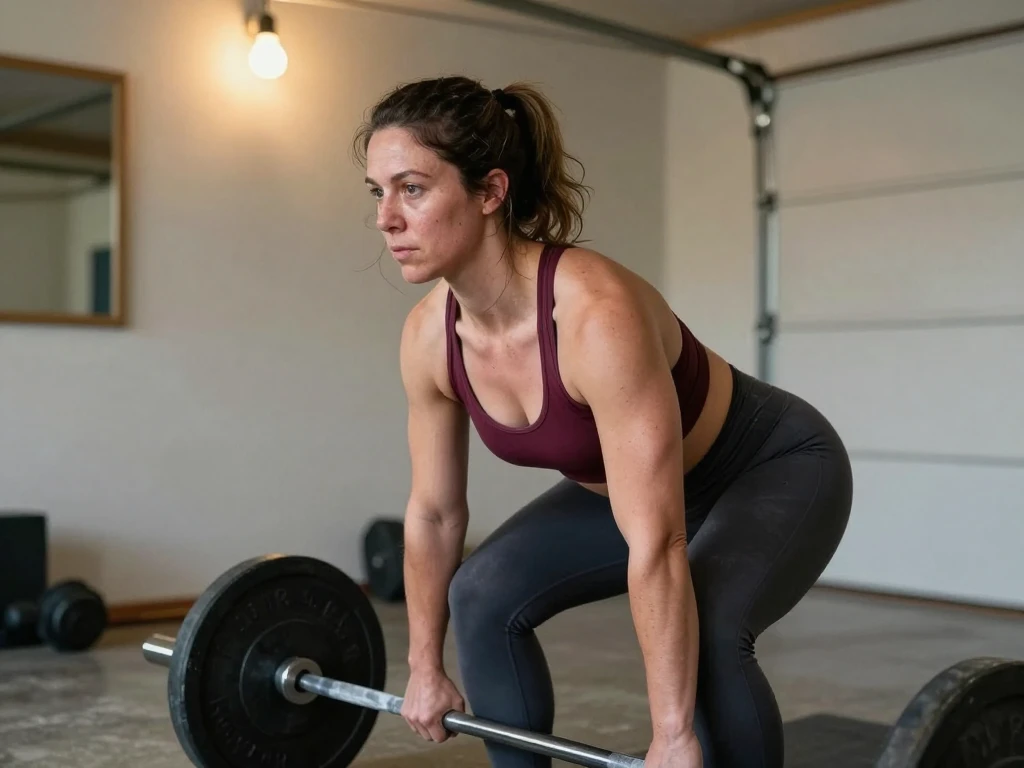
1. Dumbbell Deadlifts — 3 × 10 reps Hold dumbbells in front of your thighs. Hinge at the hips with a soft bend in the knees and a flat back. Lower the dumbbells toward mid-shin, feeling a stretch in the hamstrings, then drive your hips forward to stand. The most functional exercise in this plan — it replicates the movement of picking things up from the floor, protecting your back for life.
2. Floor Press — 3 × 12 reps Lie on your mat, a dumbbell in each hand at chest height. Press upward until arms are straight, then lower slowly. A floor press naturally limits the range of motion in a way that is more shoulder-friendly than a full bench press — great for women with shoulder sensitivity.
3. Sumo Squats — 3 × 12 reps Wide stance, toes pointed out at 45 degrees, hold one heavier dumbbell with both hands. Lower into a squat, keeping your chest up and knees tracking over your toes. Targets inner thighs, glutes, and hip adductors.
4. Plank Hold — 3 × 20–40 seconds Elbows on the mat, forearms flat, body in a straight line from head to heels. Squeeze your core, glutes, and thighs simultaneously. Build up your hold time by 5 seconds each week. Core strength protects the lower back and improves posture.
5. Dead Bug — 3 × 8 each side Lie on your back, arms straight up toward the ceiling, knees bent at 90 degrees in the air. Slowly extend your right arm overhead and your left leg toward the floor simultaneously, keeping your lower back pressed into the mat. Return and alternate sides. The best core exercise for women with lower back sensitivity — it builds deep core stability without spinal compression.
6. Romanian Deadlift — 3 × 12 reps Hold dumbbells in front of your thighs, legs nearly straight. Hinge at the hips and lower the weights down the front of your legs, feeling the hamstrings stretch. Drive hips forward to return upright. Targets the posterior chain — hamstrings and glutes — which is chronically weak in most women.
Cool-Down (5 minutes): Child’s pose × 60 seconds, supine spinal twist each side, seated forward fold.
The Cardio Strategy That Works After 40
Most women over 40 are doing too much cardio. That is not an opinion — it is backed by how cortisol responds to sustained, intense aerobic exercise in a body with declining progesterone.
This does not mean stop moving. It means move smarter.
What actually works for women over 40:
Daily brisk walking is one of your most powerful tools. A 20 to 30-minute walk — especially after a meal — improves insulin sensitivity, lowers baseline cortisol, supports bone density, and improves sleep quality. The Pacer app or a basic step counter on your phone makes this easy to track. Aim for 7,000 to 10,000 steps per day.
Low-intensity steady-state cardio (easy cycling, swimming, light elliptical) once or twice a week is excellent for cardiovascular health without adding hormonal stress. Keep it at a “can hold a conversation” pace.
Sprint interval training (SIT) can be effective in very small doses. If you enjoy it, keep sessions to 15 to 20 minutes maximum, no more than once per week, and always follow with a rest day. A stationary bike works better than running for reducing joint stress during intervals.
The timing matters too. Cortisol is naturally highest in the morning. Pairing high-intensity exercise with already-elevated morning cortisol amplifies the hormonal stress response. Save intense sessions for midday or early afternoon when cortisol is naturally declining.
The Cortisol Problem Nobody Explains to Women Over 40
This is the most important and most overlooked piece of any home workout plan for women over 40.
When you are in perimenopause, progesterone — which naturally counterbalances cortisol — is declining. This means your body is already in a higher-cortisol baseline state than it was in your 30s. Add to that: poor sleep, work pressure, family stress, and a punishing workout schedule, and cortisol stays chronically elevated.
Chronically high cortisol:
- Promotes fat storage specifically around the abdomen
- Breaks down muscle tissue (the opposite of what you want)
- Disrupts sleep quality further
- Increases cravings for sugar and refined carbohydrates
- Suppresses the immune system
The solution is not to stop exercising. It is to choose workouts that build strength without chronically spiking stress hormones. Moderate-intensity strength training, walking, yoga, and Pilates all support or reduce cortisol over time. Long daily HIIT sessions, chronic under-eating, and extreme cardio do the opposite.
Recovery: The Part of Your Home Workout Plan That Most Women Skip
After 40, recovery is not a bonus feature of your workout plan. It is the plan.
Your muscles do not grow during the workout. They grow during the rest that follows — specifically, during deep sleep, when growth hormone is released and muscle protein synthesis occurs. Skipping rest days or sleeping less than 7 hours actively undermines the work you do in every session.
What effective recovery looks like:
Sleep 7 to 8 hours as a non-negotiable. Sleep deprivation raises cortisol, increases hunger hormones (ghrelin), lowers leptin (satiety hormone), slows muscle repair, and impairs every hormone that supports your fitness goals. You genuinely cannot out-train poor sleep.
Walk on rest days. Active recovery — a 20 to 30-minute easy walk — improves circulation, supports lymphatic drainage, reduces next-day muscle soreness, and lowers cortisol without adding training stress.
Space your strength sessions by 48 hours. This is why this plan has strength on Monday, Wednesday, and Friday — never back-to-back.
Hydrate consistently. Aim for at least 8 glasses (2 litres) of water per day, more on training days. Dehydration impairs muscle recovery and amplifies fatigue.
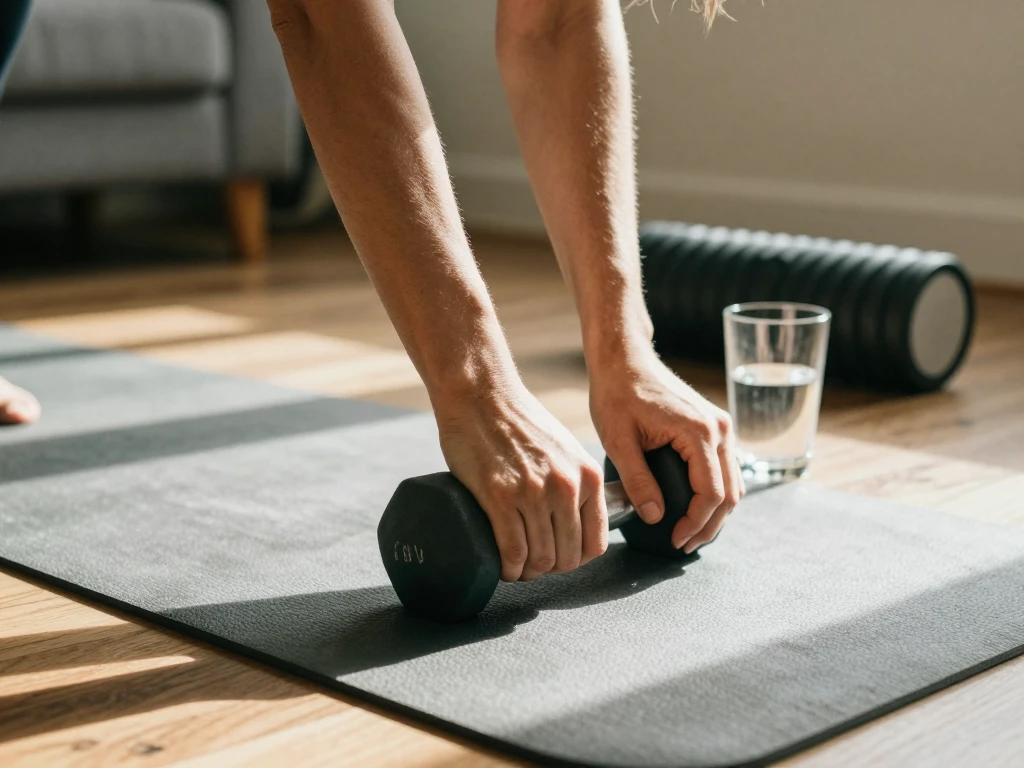
Use a foam roller. Five minutes of rolling out your hamstrings, calves, quads, and upper back after each workout significantly reduces next-day soreness and improves joint mobility over time.
Nutrition Basics That Support a Home Workout Plan for Women Over 40
You do not need a complex diet. But a few principles make or break the results of any exercise plan for women over 40.
Prioritise protein at every meal. Due to anabolic resistance — a reduced efficiency in muscle protein synthesis that increases with age — women over 40 need more dietary protein to stimulate the same muscle-building response as younger women. Aim for 25 to 30 grams of protein per meal, spread evenly across breakfast, lunch, and dinner. Research shows this distribution increases 24-hour muscle protein synthesis by approximately 25% compared to eating the majority of protein at dinner.
Good protein sources: eggs, Greek yogurt, cottage cheese, chicken breast, tinned salmon, lentils, tofu, edamame.
Do not cut calories too aggressively. Under-eating is one of the most common saboteurs for women over 40. Severe calorie restriction raises cortisol, increases muscle breakdown, and slows the metabolic rate further. A moderate deficit of 200 to 300 calories per day supports fat loss while preserving muscle.
Reduce ultra-processed foods and alcohol. Your liver is responsible for processing estrogen. After 40, with hormones in flux, processed foods and regular alcohol consumption place added burden on liver function and worsen hormonal balance.
Eat enough carbohydrates. Carbohydrates are your muscles’ primary fuel source during strength training. Cutting carbs too drastically impairs workout performance, slows recovery, and — once again — raises cortisol.
4-Week Progressive Home Workout Plan Schedule at a Glance
| Week | Sets Per Exercise | Rest Between Sets | Progression Focus |
|---|---|---|---|
| Week 1 | 2 sets | 90 seconds | Learn form, establish habit |
| Week 2 | 3 sets | 75 seconds | Build consistency, add reps |
| Week 3 | 3 sets (heavier weights) | 60 seconds | Progressive overload begins |
| Week 4 | 3–4 sets (heavier or slower tempo) | 60 seconds | Challenge and adapt |
Progressive overload is the most important concept in this plan. It simply means making the workout slightly harder over time — through heavier weights, more reps, slower tempo, or shorter rest. Without progressive overload, your body adapts and stops changing. With it, you keep building strength and reshaping body composition every single week.
Best Apps and Tools for Your Home Workout Plan (Women Over 40)
You do not need a home gym. But a few well-chosen tools make this plan significantly more effective and easier to stay consistent with.
Nike Training Club (NTC) — Free. Hundreds of guided home workouts, including strength and mobility. Filter by “at home” and “no equipment” or “dumbbells only.” Easy to use for beginners.
Fitbod — Paid, with a free trial. Builds personalised strength training plans based on your available equipment and tracks progressive overload automatically. Excellent for structured progression.
Insight Timer — Free. Meditation, breathwork, and sleep tools. Directly useful for managing the cortisol side of fitness for women over 40.
A foam roller ($15–$25) — Roll your hamstrings, quads, calves, and upper back for 5 minutes post-workout. Reduces soreness by up to 30% in next-day recovery studies.
Adjustable dumbbells — If you can invest in one piece of equipment, make it this. A set ranging from 5 to 25 lbs covers every exercise in this plan and eliminates the need to keep buying new weights as you get stronger.
A loop resistance band set — Usually under $15 for a 3-band set. Versatile for glute activation, shoulder health, and adding challenge to bodyweight moves.
Best Weight Loss Percentage Calculator (Free & Fast) — Track your real fat loss progress with the Best Weight Loss Percentage Calculator — free, fast, and accurate in seconds. 100% free
6 Common Mistakes Women Over 40 Make With Home Workouts
1. Too much cardio, not enough strength training. For all the reasons covered above — muscle loss, cortisol, metabolism — this is the single most common and most costly mistake. Cardio has its place, but it cannot replace what strength training does for the female body after 40.
2. Skipping warm-up and cool-down. After 40, joints, tendons, and connective tissue are less forgiving. A 5-minute warm-up dramatically reduces injury risk and improves performance during the session. A cool-down supports recovery and flexibility.
3. Lifting too light for too long. Many women use the same light weights for months out of fear of injury or bulking up. If the last 2 reps of your final set do not feel challenging, the weight is too light. Progressive overload requires you to gradually increase the challenge.
4. Working out intensely every day. More exercise is not automatically more results. Daily intense training without adequate recovery keeps cortisol elevated, breaks down muscle, and eventually causes injury or burnout. Three strength sessions per week with active recovery is more effective than seven punishing sessions.
5. Comparing progress to your 30-year-old body. Your body has changed. That is not failure — it is biology. The goal now is to build a stronger, more functional, more energetic body for your 40s, 50s, and beyond — not to recapture what you looked like at 30.
6. Ignoring sleep. This cannot be overstated. You can execute every workout perfectly and still plateau, gain fat, and feel exhausted if you are sleeping less than 7 hours. Sleep is where every adaptation from your training happens.
What Nobody Tells You When You Turn 40 — And Why It Matters
There is a quiet grief many women feel when they realise their body no longer responds the way it used to. When doing everything “right” no longer produces the results it once did. I felt it. Most women feel it. And most fitness content either pretends it does not exist or just tells you to push harder.
But harder is not the answer after 40. Smarter is.
The women I have seen thrive in their 40s and 50s are not the ones grinding through daily hour-long boot camps on four hours of sleep. They are the ones who lift weights three times a week, walk every day, protect their sleep, eat enough protein, and actually enjoy the process. They are consistent — not compulsive.
A good home workout plan for women over 40 is not about punishing your body into submission. It is about working with your biology instead of against it. Fueling it. Resting it. Challenging it progressively. Respecting it.
That is the plan above. Start with Week 1. Two strength sessions if three feels like too much. Get your sleep. Get your protein. Walk more.
Everything else builds from there.
Key Takeaways
- Women over 40 lose muscle mass and experience hormonal shifts that require a different workout strategy than in their 30s
- Strength training 2–3 times per week is the most important form of exercise for women over 40 — more important than cardio
- Cortisol management is critical: avoid daily high-intensity training, protect sleep, and include recovery days
- Progressive overload — gradually increasing the challenge — is what drives continuous results
- Protein intake of 1.2–1.6 g per kg of body weight daily, spread across meals, is essential for muscle maintenance after 40
- Walking daily is one of the most underrated tools for fat loss, hormonal balance, and recovery for women over 40
- Rest days are not optional — they are when your muscles actually grow and adapt
This article was written from personal experience, real-world fitness practice, and research. It is intended for general informational purposes and does not replace individualised advice from a medical or fitness professional. If you have any existing health conditions, injuries, or concerns, please consult a qualified healthcare provider before beginning this or any other workout program.
Frequently Asked Questions
How many days a week should women over 40 work out at home?
Three to four days is the ideal range — two or three strength training sessions plus one to two days of light cardio such as walking. Always schedule at least one to two complete rest days per week. More sessions without adequate rest increases cortisol and impairs results.
Can a home workout plan for women over 40 help reduce belly fat?
Yes — but the approach matters. Belly fat after 40 is largely hormonal, driven by high cortisol and declining estrogen. Strength training, daily walking, adequate sleep, sufficient protein intake, and cortisol management together address the root causes. Cardio alone rarely solves hormonal belly fat.
Do I need equipment for a home workout plan for women over 40?
Not to start. Bodyweight squats, push-ups, hip hinges, glute bridges, and planks are all effective without any equipment. Adding a pair of dumbbells ($20–$50) and a resistance band ($10–$15) significantly expands your options and accelerates results.
How long before I see results from a home workout plan after 40?
Most women notice improved energy, better sleep, and reduced stiffness within 2 weeks of consistent training. Visible body composition changes — leaner arms, flatter midsection, lifted glutes — typically become noticeable between weeks 6 and 8. Strength gains often come sooner.
Is HIIT good for women over 40?
In small doses, yes. Keep HIIT sessions to 15–20 minutes maximum and limit to once per week. Prioritise recovery the day after. If you notice disrupted sleep, persistent fatigue, increased cravings, or irritability following HIIT sessions, scale back intensity or frequency. These are signs of cortisol overload.
What if I have knee pain or lower back pain?
Reverse lunges (stepping backward) reduce knee stress compared to forward lunges. Glute bridges and dead bugs build lower back strength without spinal compression. Wall squats and seated dumbbell exercises further reduce joint load. When in doubt, consult a physiotherapist for a personalised modification plan.
How much protein should a woman over 40 eat when following a home workout plan?
Aim for 1.2 to 1.6 grams of protein per kilogram of body weight per day, distributed evenly across meals. A 65 kg woman needs roughly 78 to 104 grams of protein daily — not in one sitting, but spread across breakfast, lunch, and dinner for maximum muscle protein synthesis.
Can I do this home workout plan during perimenopause?
Absolutely — in fact, this plan was designed with perimenopause in mind. The focus on strength training over intense cardio, the attention to recovery, the cortisol management strategy, and the protein guidance all directly address the hormonal environment of perimenopause. Always check with your doctor before starting, especially if you have specific health considerations.