
I jogged every morning for 3 months and looked exactly the same
Let me tell you something embarrassing.
Three years ago, I set my alarm for 6 AM every single day. Rain, cold, tired — didn’t matter. I laced up my shoes, ran 30 minutes, came home, made a salad, and felt incredibly proud of myself.
Three months later, I stepped on the scale. Down 1.2 pounds.
My clothes looked identical. My arms were the same. The only thing that had changed was my pain tolerance for waking up early.
Then a friend who had genuinely transformed her body in about four months looked at my routine and said, “You’re burning calories but you’re not building anything. Your body has nothing to show for it.”
She was right. I had been doing almost zero resistance training. No weights, no bodyweight strength work — just running and eating less. My body was burning through whatever it could find for fuel, including the small amount of muscle I had.
The moment I swapped my routine to include a proper full body strength workout three times a week — combined with smarter nutrition — everything changed. Within 8 weeks I had lost visible fat around my stomach and arms, I could see muscle definition I’d never had before, and my energy was better than it had been in years. The scale? It barely moved. But I looked and felt like a completely different person.
That’s what this guide is built around. Not theory from a textbook. Not a generic “do squats and eat protein” post. A real, beginner-friendly approach to the best full body workout for weight loss and muscle gain at the same time — the kind that actually works.
What “losing fat and gaining muscle at the same time” actually means
Before we get into the workout, this part matters a lot — because most people misunderstand what they’re actually chasing.
When people say they want to “lose weight and build muscle at the same time,” what they really want is something called body recomposition. It means changing the composition of your body — more lean muscle, less fat — without necessarily changing the number on the scale much at all.
This is not the same as traditional weight loss, where you lose fat AND muscle simultaneously (which slows your metabolism and often leads to the rebound effect).
Body recomposition means your body is burning stored fat to fuel the energy needed to build and repair muscle tissue. It’s a metabolic two-for-one that most people don’t even know is available to them.
Research published in Frontiers in Endocrinology studied 304 adults ranging from ages 20 to 74 — all placed on a calorie deficit of about 500 calories per day. Diet was kept constant. Exercise was the only variable. The resistance training group lost significantly more fat than the cardio and no-exercise groups AND simultaneously gained an average of 1.8 to 2 pounds of lean muscle. The no-exercise group lost muscle at nearly three times the rate of the strength trainers.
That number is what made me stop second-guessing. strength training is the single most important exercise variable for body recomposition. Cardio helps, diet matters enormously, but resistance work is what tells your body to hold onto — and build — muscle while it burns through fat.
Now here is the piece of this that nobody talks about enough.
Beginners have an almost unfair advantage at this.
When your muscles encounter resistance training for the first time, they respond aggressively. Your body doesn’t need years of progressive training to show results — it responds to the very first few months with what coaches call “newbie gains.” You can build muscle and lose fat simultaneously at a rate that experienced trainees would envy. This window is precious. Use it.
Why a full body workout is the best approach for this goal
You might have heard about “leg day,” “chest day,” “arm day” — splitting your training so each session targets one body part. For advanced bodybuilders training six days a week, that makes sense.
For beginners trying to lose fat and build muscle at the same time? Full body workouts win every time. Here is why.
Full body sessions recruit more total muscle. When you squat, deadlift, press, and row in the same session, you’re using your legs, back, chest, shoulders, arms, and core all at once. More muscle recruitment means more calories burned during the workout AND a higher metabolic demand for hours afterward — something researchers call EPOC (Excess Post-Exercise Oxygen Consumption), or the “afterburn effect.”
Higher training frequency per muscle group. With a full body plan three days a week, each muscle group gets trained three times weekly. With a split routine training five days a week, each muscle group might only get hit once. Research consistently shows that hitting each muscle group at least twice per week is optimal for hypertrophy (muscle growth) in beginners.
It’s sustainable. Missing one session in a split routine means a whole muscle group goes untrained that week. Miss one full body session and you just reschedule it. The flexibility keeps beginners consistent, and consistency is what drives results more than any perfect program.
A 2021 peer-reviewed study confirmed that full body and split routines produce equivalent muscle growth when weekly training volume is matched — but full body sessions burn significantly more calories per session. For body recomposition specifically, that is a clear structural advantage.
The three pillars that make this work
Most fitness articles hand you a workout and send you on your way. That’s not helpful, because the workout alone is only one-third of the equation. Here is what actually drives body recomposition.
Pillar 1 — a moderate calorie deficit, not a crash diet
To lose fat, your body must burn slightly more energy than it consumes. That’s non-negotiable. But the size of that deficit matters enormously.
Cut too aggressively — say, eating 800 to 1,000 calories below your maintenance level — and your body enters a kind of stress state. It starts breaking down muscle tissue for fuel because muscle is energetically expensive to maintain. You lose weight on the scale, but a significant portion of what you lose is muscle. Your metabolism slows. You feel exhausted. And within weeks of stopping the diet, the weight comes back faster than it left.
The sweet spot for body recomposition is a deficit of 200–300 calories below your maintenance level (TDEE). This is small enough that your body preferentially burns fat rather than muscle, and large enough that fat loss actually happens.
To find your TDEE, use a free online calculator. Search “TDEE calculator,” plug in your age, weight, height, gender, and activity level. It gives you a number — that is your maintenance. Subtract 200–300 calories from it. That is your daily target.
For example: if your TDEE is 2,100 calories, aim for 1,800–1,900 calories daily. Not 1,200. Not 1,400. A sensible, sustainable 1,800–1,900.
Pillar 2 — high protein intake
Protein is the building material your muscles use to repair micro-tears caused by strength training. Without adequate protein, even a perfect workout delivers minimal muscle growth.
The research-backed target for body recomposition is 0.8 to 1 gram of protein per pound of bodyweight per day. If you weigh 150 pounds, that’s 120–150 grams of protein daily. If you weigh 130 pounds, aim for 104–130 grams.
That sounds like a lot until you break it down across meals:
- Breakfast: 3 scrambled eggs + 1 cup Greek yogurt = ~35g protein
- Lunch: Grilled chicken breast + quinoa = ~45g protein
- Snack: Cottage cheese + handful of almonds = ~20g protein
- Dinner: Baked salmon + lentils = ~45g protein
That’s roughly 145 grams without trying very hard.
Protein timing matters too. Aim to spread your intake across 3–4 meals rather than trying to eat it all in one or two sittings. Your body can only use so much protein for muscle protein synthesis at once — spreading it evenly throughout the day maximizes the anabolic signal.
Don’t fear carbohydrates. Carbs fuel your strength workouts. Cutting them too drastically drops workout performance, which means less muscle stimulus and slower body recomposition. Eat complex carbs — oats, rice, sweet potato, fruit — especially around your workouts.
Healthy fats are not optional. Some people eliminate all fat in an attempt to create a bigger calorie deficit. This backfires because fat is essential for hormone production — including testosterone, which drives muscle growth and fat metabolism in both men and women. Include avocado, olive oil, nuts, eggs, and fatty fish regularly.
Pillar 3 — progressive overload
This is the principle that separates people who transform their bodies from people who plateau after six weeks.
Progressive overload means making your workout slightly harder over time. This can mean:
- Adding one more rep per set each week
- Using dumbbells that are 2 lbs heavier than last week
- Reducing rest time from 90 seconds to 75 seconds
- Slowing down your tempo (3 seconds lowering, 1 second up)
When your muscles experience the same stimulus repeatedly with no increase in challenge, they adapt and stop growing. Your body is incredibly efficient — it builds exactly enough muscle to handle the demands you place on it, and not one fiber more.
The first time I did goblet squats I used a 10-pound dumbbell and it was genuinely hard. Eight weeks later I was using 30 pounds and it felt manageable. That progression is not accidental — it’s the entire mechanism of muscle growth. Log every workout. Every set, every rep, every weight. Even a simple notes app works. Without a record, you can’t know if you’re progressing.
The best full body workout for weight loss and muscle gain
This is a 3-day-per-week plan designed for beginners and intermediate trainees. Every session is 40–50 minutes. You can do this at home with a pair of dumbbells, or at the gym.
Recommended Schedule: Monday / Wednesday / Friday, or Tuesday / Thursday / Saturday — any 3 non-consecutive days.
Day 1 — full body strength (lower body emphasis)
Warm-Up — 5 Minutes
Do not skip this. Cold muscles tear. A proper warm-up also improves your range of motion and the quality of every rep.
- March in place with high knees — 60 seconds
- Bodyweight hip circles — 30 seconds each direction
- Slow bodyweight squats — 10 reps (pause at the bottom for 2 seconds)
- Leg swings front to back — 10 each leg
- Arm circles — 30 seconds
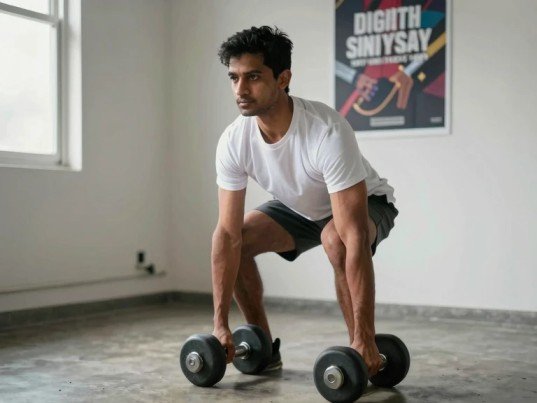
Main Workout — 3 Rounds, 60 Seconds Rest Between Exercises
Exercise 1: Goblet Squat — 4 sets × 10–12 reps
Hold a dumbbell or a full water jug vertically at chest height. Stand feet shoulder-width apart, toes slightly out. Squat down until your thighs are parallel to the floor (or lower), keeping your chest tall and your knees tracking over your toes. Drive through your heels to stand.
The first time I did these with just a 10-pound dumbbell, my legs were shaking by rep 8. That’s not weakness — that’s your muscles being challenged for the first time. By week 4, I genuinely looked forward to these.
This exercise activates your quads, glutes, hamstrings, and core simultaneously — making it one of the most calorie-burning movements you can do without any complex equipment.
Beginner modification: Hold nothing. Do bodyweight squats and focus purely on depth and form. Progression: Add 2–5 lbs every 1–2 weeks.
Exercise 2: Romanian Deadlift — 3 sets × 10–12 reps
Hold dumbbells in front of your thighs, palms facing your body. With a slight bend in your knees, hinge at your hips and push your glutes backward as you lower the weights toward your mid-shins. Keep your back flat — not rounded — the entire time. Squeeze your glutes to drive back to standing.
This exercise changed my posture completely. After six weeks of RDLs, my lower back pain from sitting at a desk all day was nearly gone. The posterior chain — hamstrings, glutes, lower back — is almost universally weak in beginners, and this targets all of it.
Beginner modification: Use very light dumbbells or a single dumbbell held with both hands. Focus entirely on the hip hinge movement pattern before adding weight.
Exercise 3: Reverse Lunge — 3 sets × 10 reps each leg
Stand with feet together. Step one foot backward and lower your back knee toward the floor without letting it slam down. Your front shin should stay vertical. Push through your front heel to return to standing.
Reverse lunges are safer on the knees than forward lunges and equally effective at targeting the quads and glutes. Do all 10 reps on one leg before switching.
Exercise 4: Dumbbell Row — 3 sets × 12 reps each arm
Place your right hand and right knee on a sturdy bench or chair for support. Hold a dumbbell in your left hand, arm hanging straight down. Pull the dumbbell toward your left hip, driving your elbow behind you. Lower with control. Complete all reps, then switch sides.
Most beginners ignore their back entirely. This is a huge mistake. A strong back improves your posture, protects your spine, and makes every other exercise feel better. Once I started rowing consistently, my push-ups got stronger within two weeks — the pulling and pushing muscles work together.
Exercise 5: Plank Hold — 3 sets × 30–45 seconds
Forearms on the floor, body in a straight line from head to heel. Don’t let your hips sag or pike up. Breathe normally.
As you get stronger, increase hold time by 5 seconds each week.
Cool-Down — 5 Minutes
- Standing quad stretch — 40 seconds each leg
- Seated hamstring stretch — 45 seconds
- Pigeon pose (or figure-4 glute stretch) — 45 seconds each side
- Child’s pose — 1 minute
Day 2 — full body strength (upper body emphasis)

Warm-Up — 5 Minutes
- Shoulder rolls — 30 seconds forward, 30 seconds back
- Cat-cow spinal stretch — 10 reps
- Push-up to downward dog — 5 reps
- Wrist circles — 30 seconds
- Light arm swings across the body — 30 seconds
Main Workout — 3 Rounds
Exercise 1: Push-Ups — 4 sets × 8–15 reps
Hands slightly wider than shoulder-width, body in a straight line. Lower slowly — 3 full seconds on the way down — then press up. This slow tempo increases muscle tension and makes even modified push-ups genuinely effective.
When I started, I could do exactly 5 full push-ups before my chest gave out. I used knee push-ups for the rest of the set, and I wasn’t embarrassed about it. Four weeks later I could do 12 full push-ups. Eight weeks later, 20. If the modification gets you consistent, the modification is the right choice.
Beginner modification: Knee push-ups with 3-second lowering tempo. Progression: Elevate feet on a chair for decline push-ups.
Exercise 2: Dumbbell Shoulder Press — 3 sets × 10–12 reps
Sit on a chair or stand with dumbbells at ear height, elbows at 90 degrees. Press straight overhead until arms are fully extended (don’t lock elbows aggressively). Lower with control.
Keep your core braced — avoid arching your lower back to compensate for pressing heavy.
Exercise 3: Dumbbell Bicep Curl — 3 sets × 12–15 reps
Stand with dumbbells at your sides, palms facing forward. Curl both dumbbells up toward your shoulders without swinging your elbows forward. Lower slowly — 3 seconds down.
Slow lowering (the eccentric phase) is where a significant amount of muscle damage — and therefore growth — happens. Don’t rush it.
Exercise 4: Tricep Overhead Extension — 3 sets × 12 reps
Hold one dumbbell with both hands above your head. Lower it behind your head by bending your elbows, keeping your upper arms still. Press back up. Triceps make up roughly two-thirds of your upper arm — training them directly gives you visible arm definition faster than curls alone.
Exercise 5: Superman Hold — 3 sets × 10 reps, 2-second hold at top
Lie face down on the floor, arms extended in front of you. Simultaneously lift your arms, chest, and legs off the floor. Hold for 2 seconds. Lower with control.
This felt embarrassing to do at first because I was barely lifting off the floor. But by week 6, my lower back strength had improved enough that my Romanian deadlifts jumped significantly. The posterior chain is all connected — these little exercises have outsized effects.
Exercise 6: Bicycle Crunches — 3 sets × 20 reps (10 each side)
Lie on your back, hands lightly behind your head. Bring one knee toward your chest while rotating your opposite elbow toward it. Do not pull on your neck. The rotation should come from your obliques, not momentum.
Cool-Down — 5 Minutes
- Doorway chest stretch — 30 seconds
- Overhead tricep stretch — 30 seconds each arm
- Child’s pose — 1 minute
- Neck side stretch — 30 seconds each side
Day 3 — metabolic full body HIIT + strength combo
This session is the fat-burning engine of the whole plan.
By combining strength movements with cardio-style intervals, you create a metabolic demand that burns significant calories during the session AND keeps your metabolism elevated for 12–24 hours afterward through EPOC. This is what people mean when they talk about “burning fat while you sleep.”

Structure: 40 seconds work / 20 seconds rest. Complete 4 rounds. Rest 2 minutes between rounds.
Round structure:
Movement 1: Squat to Press Hold dumbbells at shoulder height. Squat down, then as you stand, press the dumbbells overhead. Return them to shoulders as you squat again. This combines lower and upper body into one continuous movement — extremely calorie-intensive.
Movement 2: Push-Up to Renegade Row Do one push-up. At the top, row your right dumbbell to your hip. Lower it. Do another push-up. Row your left dumbbell. That’s one rep. This combination builds chest, triceps, shoulders, and back simultaneously.
Movement 3: Reverse Lunge with Bicep Curl Step back into a reverse lunge. As you lower, curl both dumbbells up. Stand, lower the weights. Switch legs. Coordination, lower body strength, and arm work combined.
Movement 4: Mountain Climbers High plank position. Drive knees to chest alternately as fast as you can control with good form. This is your cardio burst — heart rate spikes, core gets hammered.
Movement 5: Dumbbell Deadlift Standard deadlift with dumbbells. Control the lowering phase — 3 seconds down. This brings in your hamstrings, glutes, and back after the intensity of mountain climbers.
Movement 6: Burpee (or Step-Back Burpee for Low Impact) From standing, drop to a plank, do a push-up (optional), step or jump back to your feet, then jump or step up. This is the finisher — total body, high intensity, and absolutely effective for burning calories even after the session ends.
The first time I did this Day 3 session I was completely gassed after two rounds. I sat on my floor for two minutes and seriously considered quitting. I did the third round anyway. By week 4, I was finishing all four rounds and feeling strong enough to add weight to the squat press. That progression is the entire point.
Your complete weekly schedule
| Day | Session | Duration | Goal |
|---|---|---|---|
| Monday | Day 1 — Lower Body Strength | 45 min | Muscle stimulus + calorie burn |
| Tuesday | Active recovery — brisk 20-min walk | 20 min | Blood flow, fat burn, recovery |
| Wednesday | Day 2 — Upper Body Strength | 45 min | Muscle stimulus + calorie burn |
| Thursday | Rest or gentle stretching / yoga | 20 min | Full recovery |
| Friday | Day 3 — HIIT + Strength Combo | 40 min | Metabolic fat burn |
| Saturday | Optional walk or light cardio | 20–30 min | Extra calorie burn, stays active |
| Sunday | Full rest | — | Recovery, hormonal reset |
Nutrition timing — when you eat matters
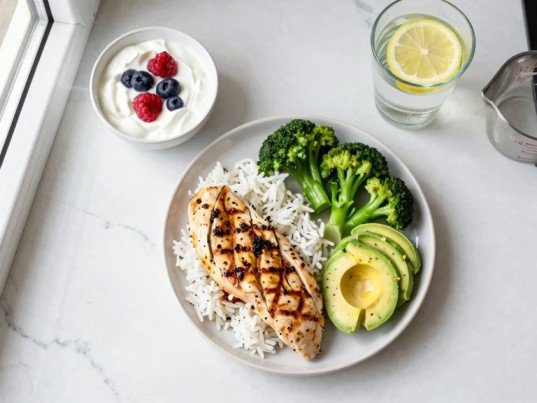
Pre-workout (60–90 minutes before training): Your muscles need carbohydrates for fuel. A small carb + protein snack before training ensures your energy levels are high enough to train hard — and harder training means more muscle stimulus.
Good options: banana + peanut butter, oats with a scoop of protein powder, wholegrain toast with 2 eggs, or Greek yogurt with berries.
Post-workout (within 60–90 minutes after training): This is your anabolic window — the period when your muscles are most receptive to protein for repair and growth. Aim for a 3:1 carbohydrate-to-protein ratio. Rice with chicken, a protein shake with a banana, or salmon with sweet potato all work well.
Rest day eating: This is where many beginners make a big mistake — they drop calories dramatically on rest days thinking it speeds up fat loss. It doesn’t. Your body is rebuilding muscle on rest days. It still needs protein. Slightly reduce carbohydrates if you’d like (since you’re not fueling a workout), but keep protein intake exactly the same as training days.
Hydration: Dehydration reduces strength performance by up to 5–10% and impairs muscle protein synthesis. Aim for at least half your bodyweight in ounces of water daily. During and after your workout, drink an additional 16–20 oz.
The plateau problem — what to do when progress stops after week 4
This is the section I wished existed when I started. It would have saved me weeks of frustration.
Around week 3 or 4 of any beginner program, something often happens — the scale stops moving, the workouts start feeling easier, and the visible progress seems to slow. Most people interpret this as the program not working and either quit or jump to something completely different.
Here is what is actually happening: your body has adapted to the stimulus you gave it. This is not failure. This is success. Your body is now capable of handling what used to be hard. The solution is not to change the program — it’s to increase the challenge within the program.
The 5 Plateau-Breaking Strategies:
1. Add weight. Even 2–5 lbs more on a dumbbell exercise is a meaningfully different stimulus for your muscles. If goblet squats with 20 lbs feel easy, grab the 25s. That’s all it takes.
2. Add reps. If your target is 10–12 reps and you’re consistently hitting 12 easily, push to 14–15 before adding weight. More reps at the same weight is progressive overload.
3. Slow down your tempo. Take 4 seconds to lower the weight instead of 2. This increases time under tension — one of the primary drivers of muscle growth — without needing heavier weights at all.
4. Reduce rest time. Cutting rest between sets from 90 seconds to 60 seconds significantly increases the cardiovascular demand and metabolic stress on your muscles.
5. Add a fourth set. Going from 3 sets to 4 sets of an exercise increases your weekly training volume — a well-documented trigger for continued muscle adaptation.
Pick one of these changes per exercise per week. Small, consistent progression beats dramatic program overhauls every single time.
What if the scale hasn’t moved in two weeks?
First, check your actual calorie intake — most people underestimate portion sizes significantly. Tracking your food in an app like MyFitnessPal or Cronometer for even one week provides enormous clarity.
Second, measure your waist, hips, arms, and thighs. If those measurements are dropping while the scale holds steady, you are actively losing fat and gaining muscle simultaneously — exactly what body recomposition looks like. The scale is the worst tool for measuring this process.
Third, look at your strength numbers. If you’re lifting more than you were two weeks ago, your muscles are growing. Growth is happening even when the scale disagrees.
Mistakes that are quietly killing your results
Mistake 1: Only Doing Cardio
Running, cycling, and walking are excellent for cardiovascular health and burn calories during the session. But they produce almost no muscle growth signal. If your entire fitness routine is cardio, you are burning calories without building the metabolically active tissue that keeps your body burning fat at rest. Strength training is non-negotiable for body recomposition.
Mistake 2: Eating Too Little
Eating 1,000 to 1,200 calories a day when your body needs 1,900 seems logical until you understand what your body does in response — it slows your metabolism, uses muscle tissue for fuel, and creates hormonal conditions that promote fat storage once you return to normal eating. I tried this approach once. I lost 6 pounds in three weeks, then regained 9 pounds in the following month when I stopped. A 200–300 calorie deficit is sustainable. Starvation is not.
Mistake 3: Never Recording Your Workouts
Memory is terrible. You cannot reliably remember whether you did 10 or 12 reps of goblet squats last Wednesday, or whether you used 15 or 20 lb dumbbells. Without a written record, progressive overload becomes impossible to execute. Download the Strong app, use your phone’s Notes app, or keep a cheap notebook. Record every set, every rep, every weight. This habit alone is worth 30% of your results.
Mistake 4: Skipping Sleep
Growth hormone — the primary hormone responsible for muscle repair and fat metabolism — is released predominantly during deep sleep. Poor sleep also elevates cortisol, a stress hormone that promotes fat storage around the abdomen and actively breaks down muscle tissue. Training hard on 5 hours of sleep is working against yourself. Seven to nine hours per night is a training requirement, not a lifestyle preference.
Mistake 5: Letting the Scale Run Your Emotions
Body recomposition routinely produces weeks where the scale does not change — or even goes up slightly — while your body is actively losing fat and building muscle. This happens because muscle tissue is denser than fat. You can be losing fat and gaining muscle simultaneously while the scale shows no net change, or even a small increase. Measure your waist. Look at your strength progression. Take monthly photos in the same lighting. These are the honest measures of your progress.
Mistake 6: Changing Programs Every 3 Weeks
This is incredibly common and incredibly destructive to results. It takes your body 8–12 weeks to make meaningful structural adaptations to a training program. Changing after 3 weeks because you saw someone else’s routine on social media means you never give any program enough time to produce results. Commit to this 12-week plan fully before evaluating whether to change anything.
How to track progress without going crazy
Track these five things — nothing else.
1. Strength log: Every workout, record what you lifted and how many reps. Review it weekly. Progress should appear.
2. Monthly body measurements: Waist (at navel), hips (at widest point), chest (at nipple line), upper arms (flexed), thighs (midpoint). Measure on the same day each month, at the same time of day.
3. Monthly photos: Same lighting, same angle (front, side, back), same clothing. The camera is more honest than the scale and more motivating than a number.
4. Energy and recovery: Rate your energy in workouts on a scale of 1–10 each session. If it’s consistently dropping, you may need more sleep, more calories, or a rest day.
5. The scale — weekly, not daily: Weigh yourself once per week, same day, same time, after using the bathroom. Track the weekly average over a month, not individual readings.
How long before you see real results?
Honest answer — not the one that sells programs, but the one that helps you.
Weeks 1–2: Your nervous system is adapting. You’ll feel stronger at exercises quickly because your brain is getting better at recruiting muscle fibers — not because muscle tissue has grown yet. Don’t expect visual changes. Expect to feel surprisingly capable.
Weeks 3–4: Mild visual changes may begin. Clothes may feel slightly different. Bloating often reduces as your diet improves. Your workout intensity is genuinely challenging now.
Weeks 5–8: This is when body recomposition becomes visible. Fat starts leaving areas first — often the face, then abdomen, then limbs. Muscle definition under the skin becomes apparent. People who see you regularly may start commenting.
Weeks 9–12: Clear, measurable transformation. Strength numbers significantly higher than week 1. Body measurements shifted. Clothes fitting differently. You’ve built a foundation of fitness that your body will maintain much more easily than it was to build.
Month-by-Month Progress Timeline
| Month | Physical Changes | Strength Changes | What to Focus On |
|---|---|---|---|
| Month 1 | Subtle — body feels firmer | +20–30% strength gains from neural adaptation | Learning the movements perfectly |
| Month 2 | Visible fat loss, slight definition | Weights going up weekly | Adding progressive overload consistently |
| Month 3 | Noticeable body recomposition | Strong, confident with all core exercises | Tracking and reviewing progress |
| Month 4+ | Significant physique change, clothes tell the story | Plateau-busting strategies needed | Refining diet and adding training volume |
Disclaimer: This article is written for informational and educational purposes only and is not a substitute for professional medical advice, diagnosis, or treatment. Always consult your doctor or a qualified healthcare provider before beginning any new exercise or nutrition program, especially if you have pre-existing health conditions, injuries, or medical concerns. Individual results vary depending on factors including genetics, consistency, starting fitness level, diet quality, sleep, and overall lifestyle. The recommendations in this article are general guidelines intended for healthy adults and should be adapted to your personal fitness level and health circumstances. The author is not a licensed medical professional.
Frequently asked questions
Q: Can a complete beginner with no fitness experience do this workout?
Yes. Every exercise in this plan has a beginner modification noted. Start with bodyweight squats before adding dumbbells. Do knee push-ups before attempting full push-ups. The program is designed to meet you exactly where you are and progress from there.
Q: How many days per week should I train for the best results?
Three non-consecutive days per week is the optimal starting point for beginners. This provides enough training stimulus to drive muscle growth while giving your body adequate recovery time. After 3–4 months, you can progress to four days per week with a more advanced plan.
Q: Can I do this full body workout entirely at home without any gym equipment?
Yes. The entire plan works with bodyweight alone. Adding a set of adjustable dumbbells (or fixed-weight dumbbells in a range of 5–25 lbs) significantly increases the options and progression potential, but is not mandatory to start.
Q: Will this plan make me look bulky or too muscular?
No. Building significant muscle mass requires months of very high calorie intake, very heavy progressive loading, and dedicated programming far beyond this plan. This program builds lean, defined muscle on a slight calorie deficit — the result is a tighter, more toned physique, not bulk. This is especially true for women, whose testosterone levels are significantly lower than men’s, making large muscle mass accumulation physiologically very difficult without extreme effort.
Q: What should I eat on rest days?
Keep protein intake identical to training days — your muscles are rebuilding on rest days and need the raw material. Reduce carbohydrates slightly if you’d like (since you’re not fueling a workout), but do not significantly drop total calories. Eating very little on rest days can interfere with muscle protein synthesis and slow recovery.
Q: How do I know if I’m in a calorie deficit?
Use a free TDEE calculator (Total Daily Energy Expenditure) to find your maintenance calories. Subtract 200–300 calories. Track your food intake using MyFitnessPal or Cronometer for 2–3 weeks. You don’t need to track forever — just long enough to understand your typical eating patterns and portion sizes.
Q: Do I need to do cardio on top of this plan?
Cardio is not mandatory for fat loss if your nutrition is dialed in. That said, 20–30 minutes of brisk walking on rest days is an excellent low-impact addition that burns extra calories without interfering with muscle recovery. Avoid intense cardio on the same day as your heavy strength sessions.
Q: I’m over 40. Can I still do body recomposition effectively?
Yes. The Frontiers in Endocrinology study mentioned earlier included participants up to age 74 and found body recomposition was achievable across all age groups. Recovery may take slightly longer, which means rest days matter more and sleep quality becomes even more important. The core principles — strength training, adequate protein, modest calorie deficit — are the same at every age.
Q: How do I break through a plateau after a few weeks?
Add weight, add reps, slow down your tempo, reduce rest periods, or add a fourth set. Pick one change at a time. Give it two weeks before evaluating whether it worked. Never change the entire program at once — isolate variables so you know what’s driving results.
Q: What if I miss a workout?
Miss it and move on. One missed session has essentially zero impact on long-term results. What kills progress is missing a session, feeling guilty, and then missing two weeks while waiting to “start fresh.” There is no fresh start needed. Just show up theA next day.