Table of Contents
- Why Dumbbells Are the Best Home Workout Tool You’re Not Using Enough
- What Weight Dumbbells Should You Start With?
- The 7 Best Dumbbell Exercises for a Full-Body Home Workout
- The Weekly Schedule: 3-Day Full Body Dumbbell Workout Plan
- The Secret Most Articles Skip: Progressive Overload
- The 5 Mistakes I Made in My First 3 Months
- Nutrition and Sleep: The Part That Actually Builds the Muscle
- Adjustable Dumbbells vs. Fixed: Which Should You Buy?
- Workout Tracking Apps Worth Using
- What Results Can You Realistically Expect?
- Dumbbell Workout for Weight Loss at Home: What Actually Works
- What to Do After 8 Weeks: Your Next Progression Path
- Final Thoughts
- Disclaimer
- Frequently Asked Questions About Home Workouts With Dumbbells
The Day I Stopped Making Excuses (And Started Seeing Results)
Honestly? I bought my first pair of dumbbells out of pure frustration.
It was a Tuesday evening. I’d driven to the gym, found no parking, waited 15 minutes for a bench, and then watched someone do half-rep bicep curls on the only cable machine I needed. I drove home, ordered a pair of adjustable dumbbells online, and told myself I’d “figure it out at home.”
That was almost three years ago.
What I didn’t expect was that home workouts with dumbbells would actually work better for me than the gym ever did. No waiting. No judgment. No wasted commute time. Just me, my living room floor, a pair of dumbbells, and eventually — real, visible results.
This guide is everything I wish I had when I started. We’ll cover the best dumbbell exercises for home, how to structure your weekly schedule, the exact mistakes I made (so you don’t repeat them), and why recovery and nutrition are the two things almost every home workout article forgets to talk about.
Why Dumbbells Are the Best Home Workout Tool You’re Not Using Enough
Before we get into the workouts themselves, let me make a case for why dumbbells are so underrated for home training.
Unlike barbells, dumbbells let each arm or leg work independently. That means your stronger side can’t secretly carry the weaker one — which is exactly how people develop those lopsided bodies where one shoulder sits higher than the other. Dumbbells force balance.
They’re also incredibly versatile. A single pair of 20-pound dumbbells can work your chest, back, shoulders, arms, legs, and core — all in the same session. You don’t need a squat rack, a bench press station, or even a pull-up bar.
And here’s the thing most people skip over: research shows that dumbbell exercises improve bone density, enhance muscle strength and growth, increase your metabolism, and help reduce injury risk. The American Heart Association even recommends strength training at least twice a week for general heart health — and a pair of dumbbells gets that done without leaving your house.
What Weight Dumbbells Should You Start With?
This question trips up almost every beginner. The honest answer: lighter than you think.
If you’ve never trained with weights before, start with 5–15 lbs for upper body and 15–25 lbs for lower body movements. The goal in the first two weeks isn’t to feel destroyed the next morning — it’s to learn the movement patterns properly before your muscles get too fatigued to hold form.
Here’s a rough starting point:
| Exercise Type | Beginner (Women) | Beginner (Men) |
|---|---|---|
| Bicep Curls | 5–8 lbs | 10–15 lbs |
| Shoulder Press | 8–10 lbs | 12–20 lbs |
| Goblet Squats | 10–15 lbs | 20–30 lbs |
| Romanian Deadlift | 10–15 lbs | 20–35 lbs |
| Dumbbell Rows | 10–15 lbs | 20–30 lbs |
Most beginners see visible strength gains within 6–8 weeks of consistent training when they combine proper form with gradual weight increases.
The 7 Best Dumbbell Exercises for a Full-Body Home Workout
These are the exercises I actually use. Not the flashy Instagram moves — the ones that consistently build real muscle across every major group.
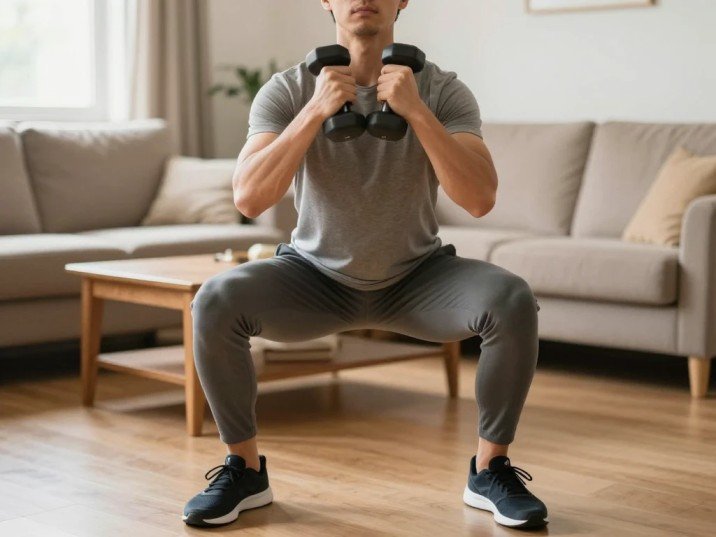
1. Goblet Squat (Lower Body + Core)
Hold one dumbbell vertically at your chest with both hands. Feet shoulder-width apart, toes slightly turned out. Sit back and down like you’re lowering into a chair. Drive through your whole foot to stand back up — not just your toes.
The most common mistake here: knees caving inward on the way down. Push them out, track them over your toes.
Do: 3 sets of 10–12 reps
2. Dumbbell Romanian Deadlift (Hamstrings + Glutes + Lower Back)
Hold a dumbbell in each hand in front of your thighs. Hinge at the hips — not your waist — and lower the weights along the front of your legs while keeping a flat back. Feel the stretch in your hamstrings, then drive your hips forward to return to standing.
This one changed how my lower back felt during everyday life. Stronger posterior chain = less back pain. It’s that simple.
Do: 3 sets of 10–12 reps
3. Dumbbell Floor Press (Chest + Triceps + Shoulders)
No bench? No problem. Lie on your back, knees bent, feet flat on the floor. Hold a dumbbell in each hand above your chest, palms facing forward. Lower until your elbows touch the floor, then press back up.
The floor acts as a natural range-of-motion limiter, which actually makes this safer than a full bench press for people with shoulder issues.
Do: 3 sets of 10–12 reps
4. Dumbbell Row (Back + Biceps)
Place one hand and knee on a chair or bench for support. Let the other arm hang holding a dumbbell. Row the weight up toward your hip — not your shoulder — by driving your elbow back. Squeeze your back at the top.
Think “elbow back and up” rather than “pull the weight up.” That mental cue is everything for actually feeling it in your back instead of your arms.
Do: 3 sets of 10–12 each side
5. Dumbbell Shoulder Press (Shoulders + Triceps)
Sit or stand with a dumbbell in each hand at shoulder height, palms facing forward. Press overhead until your arms are almost fully extended, then lower with control. Don’t arch your lower back to get the weight up — that’s your back telling you the weight is too heavy.
Do: 3 sets of 10–12 reps
6. Dumbbell Lunges (Legs + Glutes + Balance)
Hold a dumbbell in each hand by your sides. Step one foot forward and lower your back knee toward the floor. Push off your front foot to return to standing. Alternate legs each rep.
Lunges are particularly good for fixing strength imbalances between legs — most people are surprised to discover one side is noticeably weaker than the other.
Do: 3 sets of 10 each leg
7. Dumbbell Bicep Curl to Shoulder Press (Arms + Shoulders)
A two-for-one movement. Curl the dumbbells up to your shoulders, then rotate your palms forward and press overhead. Lower back to your shoulders, rotate back, and lower the curl. This compound movement is one of the most efficient exercises in any home dumbbell routine.
Do: 3 sets of 10 reps
The Weekly Schedule: 3-Day Full Body Dumbbell Workout Plan
One of the biggest misconceptions in home training is thinking you need to work out five or six days a week to see results. You don’t. In fact, three well-structured sessions per week — with rest days in between — is one of the most effective approaches for building muscle and strength.
The key is this: muscles grow during rest, not during the workout itself. You break them down in the session; they rebuild stronger while you sleep and recover. Working the same muscles every day short-circuits that process.
Recommended schedule: Monday / Wednesday / Friday (or Tuesday / Thursday / Saturday)
Day 1 — Full Body (Push + Pull Focus)
- Goblet Squats — 3 × 12
- Dumbbell Floor Press — 3 × 12
- Dumbbell Rows — 3 × 12 each side
- Shoulder Press — 3 × 10
- Romanian Deadlift — 3 × 12
Rest: 60–90 seconds between sets. Total time: 35–45 minutes.
Day 2 — Full Body (Legs + Core Focus)
- Dumbbell Lunges — 3 × 10 each leg
- Romanian Deadlift — 3 × 12
- Dumbbell Goblet Squat — 3 × 12
- Russian Twists with Dumbbell — 3 × 15 each side
- Dumbbell Plank Pull-Throughs — 3 × 12
Rest: 60 seconds between sets. Total time: 35–40 minutes.
Day 3 — Full Body (Arm + Shoulder Focus)
- Bicep Curl to Press — 3 × 10
- Dumbbell Tricep Kickbacks — 3 × 12
- Lateral Raises — 3 × 12
- Bent-Over Rear Delt Raises — 3 × 12
- Dumbbell Step-Ups — 3 × 10 each leg
Rest: 60–90 seconds. Total time: 30–40 minutes.
The Secret Most Articles Skip: Progressive Overload
Here’s the thing nobody talks about clearly in beginner dumbbell guides — and it’s the reason most people plateau after 4 weeks and quit.
The reason your workouts stop working is because your body is smart. If you do three sets of 10 with the same weight every single week, your body adapts, decides it can handle that stress with ease, and stops building new muscle. It has no reason to keep growing.
The solution is called progressive overload — deliberately making your workouts slightly harder over time.
You can do this in several ways without necessarily buying heavier dumbbells:
- Add 1–2 reps per set each week (3 × 10 becomes 3 × 11, then 3 × 12)
- Slow down the lowering phase to a 3-second count (this increases time under tension)
- Add an extra set (3 × 12 becomes 4 × 12)
- Reduce rest time between sets
- Switch from two-arm to single-arm exercises (a goblet squat with 30 lbs becomes a single-arm front rack split squat — completely different challenge)
I tracked my workouts in a simple Notes app on my phone. Nothing fancy — just the exercise, weight, and reps. Every session I’d look at last week’s numbers and try to beat them by just one small thing. That one habit made the biggest single difference in my results.
The Golden Rule of Home Dumbbell Training: If your workout feels exactly the same as it did three weeks ago, your body has stopped adapting. Add one rep, slow one phase down, or cut ten seconds off your rest. That small change is what keeps the results coming.
Progressive Overload Cheat Sheet
| When This Feels Easy… | Do This Next |
|---|---|
| 3 × 10 with current weight | Add 1–2 reps per set |
| 3 × 12 with current weight | Increase weight by 2.5–5 lbs |
| Can’t add weight yet | Slow lowering phase to 3 seconds |
| Single-arm feels easy | Add a 2-second pause at the bottom |
| 3 sets feel manageable | Add a 4th set |
The 5 Mistakes I Made in My First 3 Months
Mistake 1: Starting Too Heavy
My ego absolutely wrecked my first month. I grabbed the heaviest dumbbells I could curl for one rep, grunted through terrible form, and wondered why my shoulders hurt the next day. Start lighter, master the form, then increase the weight.
Mistake 2: Skipping Leg Day at Home
This one is incredibly common for home trainers. Upper body exercises with dumbbells feel intuitive — squats and lunges feel awkward in a living room. But skipping legs means you’re training half a body. Goblet squats, Romanian deadlifts, and lunges all work beautifully with dumbbells and require zero equipment beyond the weights themselves.
Mistake 3: No Warm-Up
Jumping straight into heavy sets without warming up is a fast track to injury. Spend five minutes on dynamic movements: arm circles, hip hinges, bodyweight squats, and leg swings. Your joints will thank you, especially if you’re training first thing in the morning when everything is stiff.
Mistake 4: Ignoring Recovery
I used to train five days a week and wonder why I felt exhausted and stopped making progress. Muscle grows during rest, not during training. Three quality sessions per week with adequate sleep and nutrition will outperform five sloppy, under-recovered sessions every time.
Mistake 5: Inconsistency Over Intensity
It doesn’t matter how perfect your workout is if you only do it twice a month. A solid 35-minute dumbbell session three times per week, done consistently for 12 weeks, will produce results that no “perfect program” done sporadically ever will.
Nutrition and Sleep: The Part That Actually Builds the Muscle
Here’s something I wish I’d known earlier: the workout breaks the muscle down. Nutrition and sleep are what build it back up.
You can follow the best dumbbell home workout plan ever written, but if you’re sleeping five hours a night and eating mostly processed food, you will be disappointed with your results.
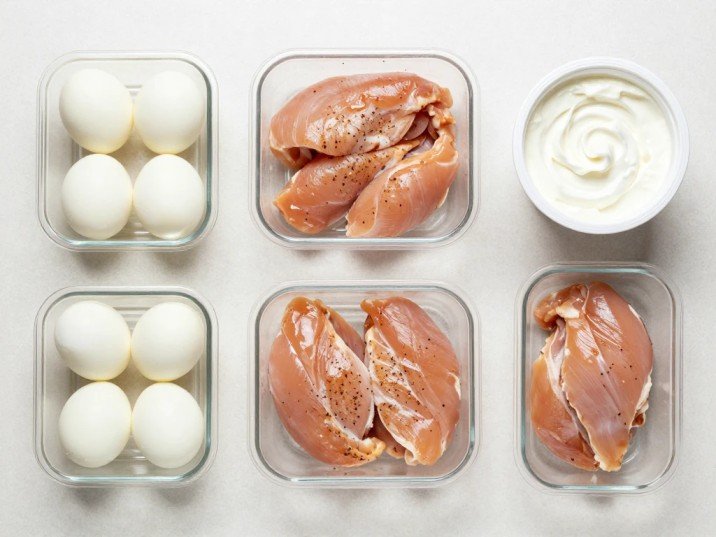
Protein is the most important nutritional variable for muscle building. Aim for around 0.7–1 gram of protein per pound of bodyweight daily, spread across three to four meals. Good sources include eggs, chicken, fish, Greek yogurt, cottage cheese, lentils, and if needed, a quality whey or plant protein powder. You don’t need to obsess over it — just make sure most meals have a protein source.
Sleep is non-negotiable. Muscle protein synthesis peaks during deep sleep. Getting less than seven hours a night raises cortisol (a stress hormone that breaks down muscle), reduces growth hormone release, and literally makes it harder to build the muscle you’re training so hard for. Seven to nine hours, consistently.
Calories matter too. If your goal is muscle gain, you need a slight calorie surplus — roughly 250–500 extra calories per day above what you burn. If fat loss is the goal, a 300–500 calorie deficit with high protein intake will preserve muscle while burning fat.
Adjustable Dumbbells vs. Fixed: Which Should You Buy?
If you’re building a home setup, this question comes up immediately. Here’s the honest breakdown:
Fixed dumbbells (the classic cast iron or rubber-coated pairs) are durable, simple, and reliable. The downside is you need multiple pairs to cover a useful weight range — that gets expensive and takes up space.
Adjustable dumbbells (like Bowflex, PowerBlock, or NordicTrack) replace an entire rack of weights with a single compact unit. They’re more expensive upfront, but far more practical for home workouts. You can switch from 10 lbs to 50 lbs in seconds. For most people training at home, a set of adjustable dumbbells is the better investment.
If budget is tight, start with two fixed pairs — one lighter (for upper body isolation moves) and one heavier (for rows, squats, and deadlifts). That covers most exercises for a beginner.
Workout Tracking Apps Worth Using
A few tools that actually help with home dumbbell training:
StrengthLog (free) — Clean interface, lets you log sets, reps, and weights, and tracks progressive overload automatically. Great for beginners.
Strong App — Simple workout logger with a timer built in. Available for iOS and Android.
Google Sheets or Notes App — Genuinely, a simple spreadsheet or even just Notes on your phone works perfectly. The tool doesn’t matter; the habit of tracking does.
What Results Can You Realistically Expect?
People want to know how quickly this works. Here’s an honest timeline based on three workouts per week:
- Weeks 1–2: Improved coordination and mind-muscle connection. You’ll start feeling exercises where you’re supposed to feel them. Energy levels improve.
- Weeks 3–4: Noticeable strength increases. Weights that felt hard start feeling manageable.
- Weeks 6–8: Visible changes in muscle definition and body composition with consistent training and proper nutrition.
- Weeks 12+: Significant transformation, measurable strength gains, and the habits become natural.
The people who don’t see results fall into one of two categories: they stop before week six, or they never address nutrition and sleep. The training itself, when done consistently with progressive overload, absolutely works.
Dumbbell Workout for Weight Loss at Home: What Actually Works
A lot of people come to home dumbbell training specifically to lose fat — and this is where some important context helps.
Dumbbells don’t burn fat directly. No single exercise does. Fat loss happens when you consistently burn more calories than you consume. But here’s why dumbbell training is one of the best tools for it:
Building muscle increases your resting metabolic rate — meaning you burn more calories even sitting at your desk or sleeping. Research shows resistance training can elevate your basal metabolic rate by up to 7%. Over weeks and months, that adds up significantly.
The most effective approach for fat loss with dumbbells is combining compound movements (goblet squats, rows, Romanian deadlifts, floor press) with shorter rest periods — around 45–60 seconds between sets instead of 90. This keeps your heart rate elevated while still building muscle. Think of it as strength training with a cardio benefit baked in.
On the nutrition side, a calorie deficit of 300–500 calories per day combined with high protein intake (0.8–1g per pound of bodyweight) is the evidence-backed approach. High protein preserves the muscle you’re building while your body burns fat for fuel.
The combination that works: 3 dumbbell sessions per week + moderate calorie deficit + 0.8–1g protein per pound of bodyweight = sustainable fat loss while maintaining or gaining muscle.
Don’t obsess over “fat burning” workouts specifically. Build strength, eat right, sleep well. The fat loss follows.
What to Do After 8 Weeks: Your Next Progression Path
This is the section almost nobody writes — and it’s the exact point where most home trainers stall, get bored, and stop.
After 8–12 weeks on a beginner full-body program, your body has adapted to those movement patterns. You’re stronger, your form is better, and the workouts that once challenged you feel manageable. That’s not failure — that’s progress. But it means it’s time to evolve the stimulus.
Here are three clear paths forward depending on your goal:
Path 1 — More Volume (Build More Muscle) Move from 3 full-body sessions to a 4-day upper/lower split. Monday and Thursday become upper body days (chest, back, shoulders, arms). Tuesday and Friday become lower body days (quads, hamstrings, glutes, calves). This increases total weekly volume per muscle group, which is the primary driver of continued hypertrophy.
Path 2 — More Intensity (Build Strength) Keep the 3-day schedule but introduce supersets — pairing two exercises back-to-back with no rest in between (e.g., dumbbell rows immediately followed by floor press). This increases intensity and time under tension without requiring heavier weights.
Path 3 — Add Equipment (Expand Your Options) If you’ve maxed out your dumbbell range, consider adding an adjustable bench (opens up incline and decline press variations) or a resistance band set (adds variety for pull-apart movements and banded squats). A pull-up bar for the doorframe is the single best addition for home training — it adds a true vertical pull that dumbbells can’t replicate.
Whatever path you choose, don’t do nothing. The worst thing after a successful 8-week run is to stop because you feel like you’ve “finished.” You haven’t — you’ve just gotten started.
Final Thoughts
The gym is great if it works for you. But if it doesn’t — the commute, the cost, the waiting, the schedule — home workouts with dumbbells are not the consolation prize. Done right, they’re a legitimate, efficient, and sustainable way to build strength and transform your body.
Start with the basics. Focus on form before weight. Track your progress — even in a notes app. Add a little more challenge each week. Eat enough protein. Sleep enough. Show up three times a week.
That’s genuinely it. Three years ago I drove home from a gym in frustration and ordered a pair of dumbbells. I haven’t looked back since.
Disclaimer: This article is written for general informational and educational purposes only. It is not intended as a substitute for professional medical advice, diagnosis, or treatment. Always consult a qualified healthcare provider or certified fitness professional before beginning any new exercise program, particularly if you have a pre-existing medical condition, injury, or health concern. The author and publisher accept no liability for any injury, loss, or damage incurred as a result of the use or reliance on the information provided in this article. Exercise involves inherent risks — always listen to your body and train within your limits.
Frequently Asked Questions About Home Workouts With Dumbbells
Can you build real muscle with just dumbbells at home?
Yes — absolutely. Your muscles cannot tell the difference between a dumbbell at home and a machine at the gym. They only respond to the mechanical tension placed on them. With a sufficient weight range, progressive overload, adequate protein, and proper sleep, dumbbells are more than enough to build real, visible muscle.
How many days a week should I do dumbbell workouts at home?
Three days per week is the sweet spot for most beginners and intermediates. This gives each muscle group enough stimulus to grow while providing enough recovery time between sessions. Training more frequently than that without adequate recovery typically leads to stalled progress or burnout.
What dumbbell exercises should I do for a full-body workout at home?
The core movements to cover for a complete full-body session: goblet squats or lunges (legs), Romanian deadlifts (posterior chain), dumbbell floor press (chest/triceps), rows (back/biceps), and shoulder press (shoulders). These five compound movements hit every major muscle group efficiently.
How long should a home dumbbell workout be?
Anywhere from 30 to 45 minutes is plenty for a well-structured session. You don’t need to be in the room for 90 minutes. Quality of effort, not quantity of time, is what drives results.
What if my dumbbells are too light?
Slow the tempo down — a 3-second lowering phase significantly increases the challenge. Move from two-arm to single-arm versions of exercises. Add pauses at the bottom of squats and floor presses. These all count as progressive overload and drive real muscle adaptation.
Is it okay to do dumbbell workouts every day?
Not recommended for most people. Muscles need 48–72 hours of recovery between sessions targeting the same group. Daily training with no rest days impairs muscle protein synthesis and increases injury risk. Three to four days per week with proper rest is far more effective.
Do I need a bench for home dumbbell workouts?
No. The dumbbell floor press replaces the bench press effectively, and many exercises work just as well standing or on the floor. If you want to progress further, an adjustable bench is a worthwhile addition — but it’s not a requirement to get started or see real results.
Can dumbbell home workouts help me lose belly fat?
Yes — but with an important clarification. You can’t spot-reduce fat from your belly specifically. What dumbbell training does is build muscle, which raises your resting metabolism so you burn more calories throughout the day. Combine that with a moderate calorie deficit and high protein intake, and your body will shed fat across your whole body — including your midsection. The compound dumbbell movements (squats, rows, deadlifts, floor press) are the most effective for this because they engage multiple large muscle groups simultaneously, burning the most calories per session.
What is the best dumbbell home workout for beginners with no experience?
Start with the 3-day full-body program outlined in this article. Focus on the five foundational movements: goblet squat, Romanian deadlift, floor press, dumbbell row, and shoulder press. Use lighter weights than you think you need for the first two weeks, prioritize form over everything, and add one small challenge each week. That approach alone, done for 8–12 weeks consistently, produces real, visible results for complete beginners.