Zone 2 Cardio Home Workout No Equipment: The Beginner’s Complete Guide
By Saad | Fitness & Fat Loss Coach | 6+ Years Experience | Updated: June 2026
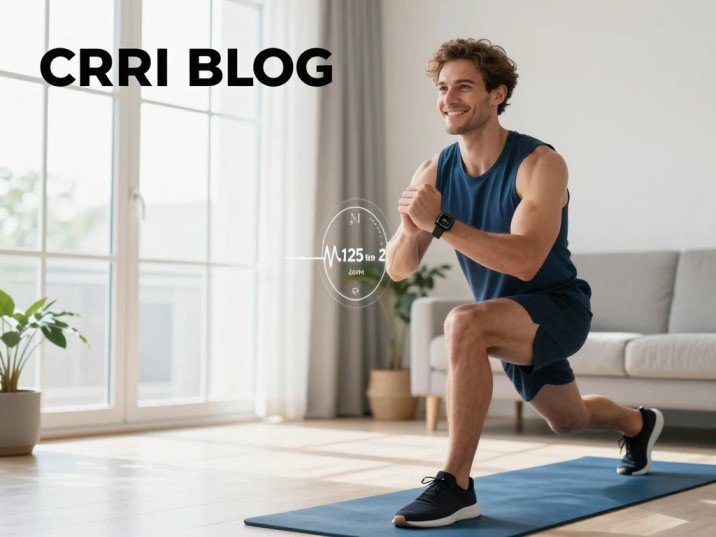
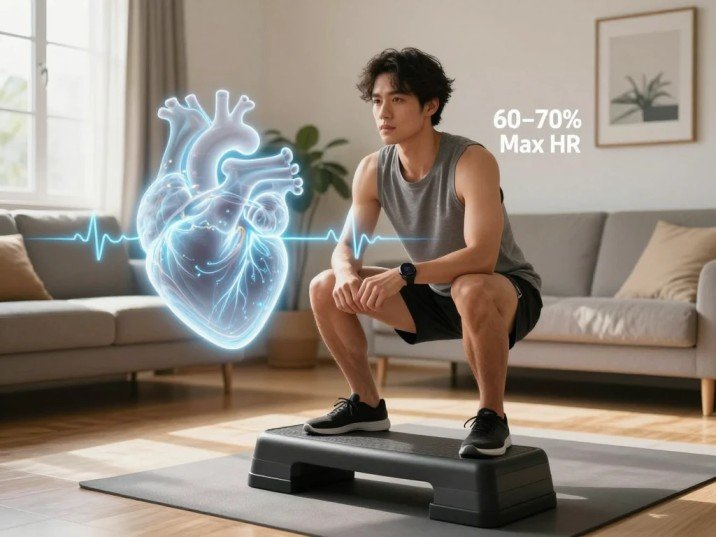
Zone 2 cardio is low-intensity exercise at 60–70% of your max heart rate — where you can talk in full sentences but still feel your breathing. You can do it at home with zero equipment using marching in place, step jacks, shadow boxing, and lateral steps. Done 2–3 times per week for 30 minutes, it builds your aerobic base, burns fat, and strengthens your heart.
What Is Zone 2 Cardio and Why Is Everyone Talking About It?
I remember the first time a client named Hira came to me completely burnt out from HIIT. She had been doing intense workouts five days a week for two months and had lost almost no weight. She was exhausted, her joints ached, and she was about to quit fitness altogether.
I put her on a Zone 2 Cardio Home Workout No Equipment plan exclusively for six weeks. Three sessions per week. Thirty minutes each. Marching in place, slow jumping jacks, some shadow boxing.
By week six, she had lost 3.5 kg, her resting heart rate had dropped by 8 beats per minute, and — most importantly — she was actually enjoying exercise for the first time in her life.
That is what Zone 2 does. It is not flashy. But it works consistently, for almost everyone.
Your heart operates in five training zones based on a percentage of your maximum heart rate. Zone 2 sits at 60–70% — the intensity where your body primarily burns fat as fuel, your mitochondria multiply and strengthen, and your cardiovascular system quietly rebuilds itself over weeks and months. A well-structured Zone 2 Cardio Home Workout No Equipment makes it easy to achieve these benefits without needing a gym or expensive machines.
| Zone | % of Max HR | How It Feels | Energy Source |
|---|---|---|---|
| Zone 1 | 50–60% | Very easy, almost resting | Fat |
| Zone 2 | 60–70% | Comfortable, conversational | Primarily fat |
| Zone 3 | 70–80% | Moderately hard, breathing fast | Fat + carbs |
| Zone 4 | 80–90% | Hard, speaking is difficult | Primarily carbs |
| Zone 5 | 90–100% | Maximum effort, unsustainable | Carbs |
Zone 2 exploded into mainstream fitness culture in 2025 and 2026 largely through longevity researchers and sports scientists. Dr. Iñigo San Millán, one of the world’s leading exercise physiologists, has spent decades studying how elite endurance athletes — cyclists like Tadej Pogačar — train predominantly in Zone 2 to build an aerobic base that supports every other type of performance.
The principle translates directly to beginners training at home with no equipment whatsoever.
What Is Zone 2 Cardio Heart Rate and How Do You Find Yours?
This is the most important number before you start any Zone 2 session. Training at the wrong intensity — even slightly too hard — means you are no longer in Zone 2. You are in Zone 3, and all the specific metabolic benefits shift.
The Simple Formula
220 − your age = estimated maximum heart rate Multiply by 0.60 and 0.70 to get your Zone 2 range
| Age | Est. Max HR | Zone 2 Lower (60%) | Zone 2 Upper (70%) |
|---|---|---|---|
| 20 | 200 BPM | 120 BPM | 140 BPM |
| 25 | 195 BPM | 117 BPM | 137 BPM |
| 30 | 190 BPM | 114 BPM | 133 BPM |
| 35 | 185 BPM | 111 BPM | 130 BPM |
| 40 | 180 BPM | 108 BPM | 126 BPM |
| 45 | 175 BPM | 105 BPM | 122 BPM |
| 50 | 170 BPM | 102 BPM | 119 BPM |
| 55 | 165 BPM | 99 BPM | 116 BPM |
This formula gives an estimate. Individual maximum heart rates can vary 10–15 BPM from the formula result. Use these numbers as a starting target, not a rigid prescription.
The Talk Test — No Device Required
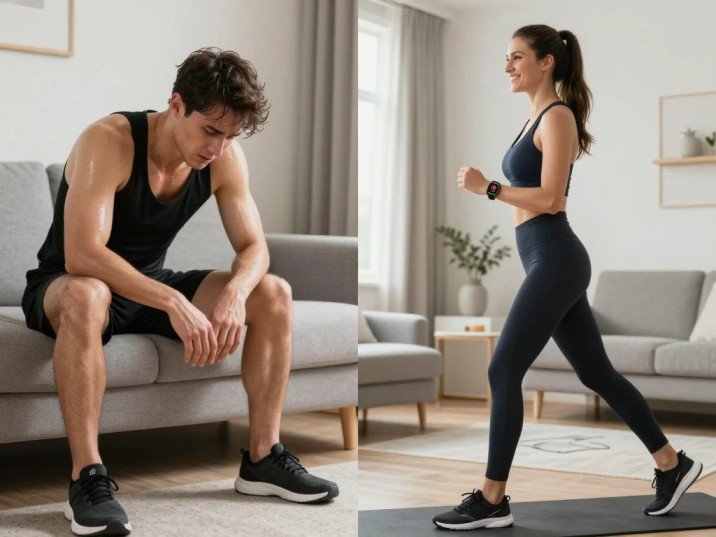
If you do not own a heart rate monitor or smartwatch, the talk test is your most reliable tool. Dr. Iñigo San Millán validates conversational breathing as a genuine field marker for Zone 2 across both elite and recreational populations.
Here is how to use it during your session:
- Speak a full sentence out loud every 5 minutes — literally talk to yourself
- Full sentence, no pause, slight breathing effort → Zone 2 ✅
- Gasping or breaking mid-sentence → too hard, ease off immediately ❌
- Zero effort speaking, could go all day → too easy, pick up slightly ❌
A secondary marker: at true Zone 2 intensity, nasal breathing should be possible. The moment your mouth automatically opens for air, you have likely crossed into Zone 3.
The RPE Scale for Those Who Prefer Numbers
RPE (Rate of Perceived Exertion) runs from 0 to 10. Zone 2 sits at 4–6. It should feel like a brisk, purposeful walk — clearly working, nowhere near your limit, sustainable for a long time.
My take as a coach: “The number one Zone 2 mistake I see is going too hard. The first 10 minutes will feel almost insultingly easy. That is not a problem — that is exactly right. Zone 2 is not supposed to feel like a workout in the traditional sense. It is supposed to feel like sustained, controlled effort.”
Why Does Zone 2 Cardio Actually Work? (The Science, Honestly)
What Happens Inside Your Body
When you sustain Zone 2 intensity, several specific adaptations accumulate over weeks of consistent training:
Mitochondrial density increases. Zone 2 primarily recruits Type I slow-twitch muscle fibers — the fibers richest in mitochondria, your cells’ energy-producing structures. Research by San Millán and George Brooks, published on PubMed Central (PMC8291023), shows Zone 2 training upregulates mitochondrial biogenesis and trains mitochondria to process lactate more efficiently rather than letting it accumulate.
Fat oxidation improves. Fat is the dominant fuel at Zone 2 intensity. Over weeks of consistent training, your body becomes measurably better at mobilizing and burning stored fat — during exercise and at rest. This is not a marketing claim. It is a well-documented metabolic adaptation.
Cardiovascular markers improve. According to a review by Franklin et al. in the American Journal of Cardiology, cardiorespiratory fitness is among the strongest predictors of long-term health outcomes — stronger than most traditional risk factors. Zone 2 consistently improves resting heart rate, heart rate variability, stroke volume, and VO2 max over time.
Recovery capacity expands. Because Zone 2 produces minimal lactic acid, it does not require recovery days the way HIIT does. Elite endurance athletes spend roughly 80% of their weekly training volume in Zone 2 and 20% at high intensity — a distribution called polarized training.
What the 2025 Research Actually Says — The Honest Version
I want to be transparent with you here, because I think honesty builds better fitness habits than hype.
A 2025 narrative review by Storoschuk, Moran-MacDonald, Gibala, and Gurd — published in Sports Medicine and indexed on PubMed — concluded that current evidence does not support Zone 2 as the single optimal intensity for improving mitochondrial or fatty acid oxidative capacity. For people training fewer than 6 hours per week, higher intensities may produce greater VO2 max improvements per hour invested.
What this means practically:
Zone 2 is not magic. It is one valuable training intensity among several. For a beginner building their first consistent cardio habit, it remains the most accessible, most sustainable, and lowest-risk starting point. It works best as part of a broader program — not as the only thing you ever do.
The real win is not any specific physiological adaptation. It is building the consistency that makes all adaptation possible.
What Are the Best Zone 2 Cardio Exercises at Home With No Equipment?
Here are the best Zone 2 cardio examples you can do right now in your living room. These are your core exercise library. The goal across all of them is sustained, steady effort — not speed, not power, not explosive movement. Think simmering, not boiling.
1. Marching in Place — The Foundation Exercise
This is where I start every single beginner client. No exceptions.
How to do it: Stand tall, feet hip-width apart. Lift each knee to hip height alternately. Pump your arms naturally in opposition — the arm swing adds cardiovascular demand without requiring extra thought.
What it feels like: A purposeful, deliberate march. Not a shuffle. Not a sprint. An intentional, rhythmic movement you could sustain for 40 minutes if needed.
Why it works for Zone 2: The combination of leg drive and arm swing raises heart rate steadily into Zone 2 for most beginners without any risk of spiking into Zone 3 accidentally.
Best for: Absolute beginners, small spaces, anyone with knee or hip sensitivity, people who have not exercised in months.
Common mistake: Going too slow and staying in Zone 1. Drive your knees higher and add more arm swing if your heart rate sits below your Zone 2 floor.

2. Step Jacks — Low-Impact Jumping Jacks
The gentler version of the classic jumping jack. Zero impact, same heart rate benefit.
How to do it: Instead of jumping both feet simultaneously, step one foot out to the side and bring it back, then the other. Arms move overhead in the same arc as regular jumping jacks.
Why it works for Zone 2: Step jacks maintain consistent cardiovascular demand without the joint impact of a jump. They are also your best tool for bringing heart rate back into range when other exercises push it slightly above your Zone 2 ceiling.
Best for: Apartment training where jumping is not an option, anyone with ankle or knee issues, HR management within a session.
3. Slow Jumping Jacks — The Controlled Version
Standard jumping jacks performed at roughly 40–50% of the speed you would use in a HIIT workout. Slower than it sounds.
How to do it: Classic jumping jack pattern — both feet out, arms overhead, return — executed at a slow, deliberate, rhythmic pace. Think Sunday morning, not competition.
The critical rule: The moment your heart rate climbs above your Zone 2 ceiling, switch immediately to step jacks. Do not try to power through — you will leave Zone 2 without realizing it.
Best for: Adding light impact variety, transitions between lower-intensity exercises, intermediate beginners a few weeks into training.
4. Shadow Boxing — Zone 2 for People Who Get Bored
When a client tells me marching in place bores them after 10 minutes, I put them on shadow boxing. It is one of the most effective Zone 2 cardio examples for sustained engagement and consistent heart rate management.
How to do it: Stand in a comfortable stance with soft, bent knees. Throw controlled jabs, crosses, hooks, and uppercuts in smooth flowing combinations. Move around your space with light footwork between combinations. Work in 2–3 minute rounds with 30 seconds of easy stepping to reset.
The Zone 2 rule for shadow boxing: Volume and continuity, not power. Do not throw hard punches — that spikes effort into Zone 4 within seconds. Think fluid movement, not force. Your combinations should look effortless, not explosive.
Best for: People who find repetitive cardio mentally exhausting, anyone who wants Zone 2 training that does not feel like cardio, longer sessions of 35–45 minutes.
5. Low-Intensity High Knees — Controlled Marching Amplified
High knees performed at a slow, sustainable pace — nothing like the sprint version used in HIIT circuits.
How to do it: Lift each knee to hip height with each step. Pump arms naturally in opposition. Maintain a consistent, unhurried rhythm. This should look like an exaggerated march with intention, not a run in place.
Best for: Adding variety after standard marching, slightly higher HR demand, more deliberate leg drive.
6. Lateral Side Steps — Your Heart Rate Management Tool
The lowest-impact exercise in this list, and arguably the most useful one to have in your toolkit.
How to do it: Step one foot out to the side, bring the other foot to meet it. Step the other direction. Continue in a continuous, rhythmic side-to-side pattern. Slight knee bend, light arm swing for balance.
When to use it: Any time another exercise pushes your heart rate toward or above your Zone 2 upper limit. Lateral steps keep you moving and in the aerobic zone without letting HR crash back to Zone 1.
Best for: HR management, low-impact active recovery between higher-demand exercises, final minutes of a session when legs are fatiguing.
Rotation principle: “Rotate between 2–3 exercises every 90 seconds. Zone 2 at home is about managing steady effort across imperfect movements — not finding one perfect exercise and grinding it for 40 minutes. The variety keeps your heart rate stable and your mind engaged.”
How Do You Do a Zone 2 Cardio Home Workout With No Equipment? (30-Minute Beginner Plan)
This is the exact session structure I use for beginners in their first month of Zone 2 training. No equipment. No jumping required if you substitute step jacks throughout. Fits in a 2m × 2m space.
Before you start: Identify your Zone 2 heart rate range from the table above. Decide how you will monitor — smartwatch, heart rate monitor, or the talk test every 5 minutes.
The Session
| Phase | Duration | Exercises | Coaching Cue |
|---|---|---|---|
| Warm-Up | 5 min | Arm swings, hip circles, slow marching | Let HR rise gradually. Do not rush into Zone 2 |
| Block 1 | 7 min | Marching in Place + Step Jacks | Alternate every 90 sec. Talk test at minute 3 |
| Block 2 | 7 min | Slow Jumping Jacks + Lateral Steps | If HR spikes → stay on lateral steps until it settles |
| Block 3 | 7 min | Shadow Boxing + Low High Knees | Rotate every 2 min. Keep punches fluid, not powerful |
| Cool-Down | 4 min | Walking in place → standing stretches | Let HR drop below 100 before sitting down |
Total: 30 minutes. Zero equipment. Complete.
How to Monitor Yourself During the Session
Every 5 minutes, say a full sentence out loud. If you can finish it with slight breathing effort — you are in Zone 2. If you cannot finish it — ease off. If there is zero effort at all — pick up the pace slightly.
Your heart rate will naturally drift upward as body temperature rises across the session. This is normal. You may need to slow the pace slightly in the final 10 minutes to maintain your Zone 2 range even if the exercise feels identical to earlier.
4-Week Beginner Progression
| Week | Duration | Frequency | Goal |
|---|---|---|---|
| Week 1 | 20 min | 2x/week | Learn pacing, find Zone 2 feel, build the habit |
| Week 2 | 25 min | 2x/week | Build duration, consistent talk test every 5 min |
| Week 3 | 30 min | 3x/week | Full session, all three blocks |
| Week 4 | 35–40 min | 3x/week | Extended sessions, notice reduced perceived effort |
Real expectation: “Week 1 genuinely feels too easy. Clients always tell me this. My answer is always the same: that means you are doing it correctly. The perceived effort of Zone 2 at the same pace should decrease week by week as your aerobic base develops. If it still feels hard after four weeks, you are still going too hard.”
Zone 2 Home vs. Treadmill vs. CrossFit: Which Is Actually Best?
Side-by-Side Comparison
| Method | Equipment | Zone 2 Control | Best For | Limitation |
|---|---|---|---|---|
| Home bodyweight (marching, shadow boxing) | None | Moderate | Beginners, daily habit | HR control requires effort |
| Brisk outdoor walking | Shoes only | High | Anyone, most natural | Weather dependent |
| Treadmill walking/jogging | Treadmill | Very high | Precise HR control | Requires equipment |
| Stationary cycling | Bike | Very high | Joint issues, longer sessions | Requires equipment |
| Assault bike (CrossFit style) | Assault bike | Very high | Intermediate athletes | Expensive equipment |
| Rowing machine | Rower | High | Full-body Zone 2 | Steep technique learning curve |
For a beginner with no equipment, home bodyweight training is not second-best — it is the right starting point. The best Zone 2 cardio workout is the one you will actually do consistently for 8 to 12 weeks.
Zone 2 Cardio Treadmill Speed — A Practical Reference
For anyone who uses a treadmill occasionally at a gym, hotel, or home:
Zone 2 treadmill speed is not a universal number — it depends entirely on your individual fitness level. Here is a practical starting guide:
Beginners: 2.8–3.5 mph on a flat surface typically places most people in Zone 2. If flat walking stays in Zone 1, add incline. Walking at 10–15% incline at 3.0–3.4 mph — popularized by physician Peter Attia as his personal go-to Zone 2 session — pushes most people firmly into Zone 2 without increasing speed at all. This is also the basis of the viral “12-3-30” treadmill workout: 12% incline, 3 mph, 30 minutes.
Intermediate runners: A slow jog at 4.5–5.5 mph — which feels almost embarrassingly slow for experienced runners — typically sits in Zone 2. Your Zone 2 running pace might be 90 seconds to 2 minutes per mile slower than your normal easy run. That feeling of going too slowly is actually correct.
The rule that overrides all of this: Always verify with the talk test. Two people the same age can have Zone 2 treadmill speeds that differ by 1.5 mph. Speed is a reference point. The talk test is the measurement.
Zone 2 Workouts CrossFit Style — What This Actually Means
In CrossFit programming, Zone 2 training is used as aerobic base conditioning between high-intensity WODs (Workouts of the Day). CrossFit athletes typically perform Zone 2 on an assault bike, rowing machine, or ski erg at a fully conversational pace for 45–60 minutes — often scheduled on recovery days or as session finishers.
The critical difference from a standard WOD: no rest intervals, no intensity spikes, no competition. The entire session runs at one continuous, controlled, boring-on-purpose effort.
A Zone 2 Cardio Home Workout No Equipment follows the same training principle at home. A 40-minute shadow boxing and marching circuit accurately replicates this session type without requiring any machines. The principle — sustained aerobic effort below the lactate threshold — is identical whether you are on an assault bike in a CrossFit box or marching in your bedroom.
How Do You Add Zone 2 Into a Weekly Schedule Without Overtraining?
The Physical Activity Guidelines for Americans recommend 150–300 minutes of moderate-intensity aerobic activity per week. Zone 2 satisfies this standard directly.
Frequency by Fitness Level
Complete beginners: 2 sessions per week, 20–30 minutes each. Build the habit before building the volume.
Intermediate: 3–4 sessions per week, 30–45 minutes each. This is where most meaningful aerobic adaptations accelerate.
Advanced or athletes building aerobic base: Up to 5 sessions per week, 45–60 minutes each, as part of a polarized training program — 80% Zone 2, 20% higher intensity.
Can Zone 2 and Strength Training Coexist?
Yes — and this matters for anyone reading this who also lifts weights.
Exercise physiologist Dr. Andy Galpin has noted that Zone 2 cardio has almost no ability to interfere with hypertrophy. It is extended high-intensity cardio — long hard runs, intense cycling sessions — that can compete with muscle-building signals through AMPK-mTOR pathway interference. Zone 2 does not generate that conflict.
Practical guidance:
- Do Zone 2 after your strength session, not before
- Or schedule on completely separate days
- Either approach works — preference and schedule determine the choice
Sample Weekly Schedule
| Day | Training |
|---|---|
| Monday | Strength training |
| Tuesday | Zone 2 home cardio (30 min) |
| Wednesday | Rest or light mobility |
| Thursday | Strength training |
| Friday | Zone 2 home cardio (30 min) |
| Saturday | Optional outdoor walk (Zone 2) |
| Sunday | Full rest |
What Are the Most Common Zone 2 Mistakes Beginners Make?
Going too hard. The most common mistake by a significant margin. Most beginners accidentally convert Zone 2 into hidden interval training by letting effort creep upward. Without regular talk test checks, you will spend most of your session in Zone 3 and wonder why you are not seeing the results associated with Zone 2 training.
Sessions under 20 minutes. The aerobic adaptations that make Zone 2 valuable — mitochondrial changes, fat oxidation improvements — require sustained moderate effort. A 15-minute Zone 2 session produces limited aerobic stimulus. Aim for at least 20 minutes of actual Zone 2 time, not total workout time including warm-up and cool-down.
Skipping the warm-up. Starting cold and expecting heart rate to settle calmly into Zone 2 immediately is unrealistic. A 5-minute warm-up lets your cardiovascular system ramp up so your Zone 2 range is reachable within the first minutes of actual training.
Trusting the heart rate number blindly. A wrist-based sensor during step-based movement can lag 30–60 seconds and sometimes misread due to arm movement. Use heart rate as one signal. Cross-check with the talk test and RPE. If all three roughly agree, you are in Zone 2.

Expecting results in two weeks. Zone 2 builds deep foundational fitness that surfaces over 6–12 weeks of consistent work. Your resting heart rate, fat oxidation capacity, and aerobic efficiency all improve gradually. The changes are real. They just require patience that most people are not used to from fitness marketing.
Skipping strength training entirely. Zone 2 builds cardiovascular fitness. It does not build muscle, preserve bone density, or develop functional strength. For complete long-term fitness, pair it with at least 2 strength sessions per week.
Real Results: What Happens When Beginners Stick With Zone 2 for 8 Weeks
One reason a Zone 2 Cardio Home Workout No Equipment plan works so well is that it is easy to stay consistent. I want to share two short case studies from clients because real outcomes often communicate more than research data for most people.
Case 1 — Hira, 34, No Prior Fitness Background
Hira was completely burnt out from HIIT when she came to me. Six weeks of Zone 2 Cardio Home Workout No Equipment training — three 30-minute sessions per week, no equipment. By week six: 3.5 kg lost, resting heart rate down 8 BPM, sleeping better, and for the first time enjoying exercise consistently. She went from dreading workouts to looking forward to her marching-and-shadow-boxing sessions because they did not destroy her.
Case 2 — Ahmed, 42, Desk Job, No Time
Ahmed had 30 minutes three times a week and only a living room. Eight weeks of Zone 2 home workouts. He was not trying to lose significant weight—he wanted better energy levels at work. By week eight, his resting heart rate had dropped from 78 to 69 BPM. He described climbing stairs without losing breath as “something that just quietly started happening around week five.”
Neither of these outcomes required equipment, a gym, or extreme intensity. They required consistency at the right effort level.
The Bottom Line
Zone 2 cardio at home without equipment does not look impressive. Marching in your living room. Shadow boxing next to your bed. Stepping side to side in your kitchen.
But done at the right intensity, consistently, for 8 to 12 weeks — it quietly rebuilds your aerobic system from the ground up. Resting heart rate drops. Breathing during daily activities becomes easier. Your other workouts start to feel more manageable. Fat oxidation improves. And you build the most underrated fitness quality there is: the ability to sustain effort without burning out.
Start with 20 minutes twice a week. Follow the 4-week progression. Check the talk test every 5 minutes. That is the entire strategy.
Zone 2 is not a secret. It is just consistent, honest work at the right intensity. And it works.
About the Author
Saad
I am a certified fitness and fat loss coach with over six years of hands-on coaching experience. I runs FitnessFlora.com, where i writes practical, research-backed fitness and nutrition guides for beginners and intermediate trainees. My coaching philosophy centers on sustainable habits over short-term intensity — building fitness that people can actually maintain for life.
Related Articles
- No Gym? Best Calisthenics Workout Plan for Beginners at Home
- 10 Bodyweight Back Exercises to Build a Strong Back at Home
- Calorie Deficit: Complete 2026 Guide to Lose Weight Safely
- Ultimate Gym Workout for Weight Loss Beginners
Frequently Asked Questions
What is zone 2 cardio in simple terms? Zone 2 is low-to-moderate intensity exercise at 60–70% of your maximum heart rate — the level where you can speak in full sentences but still feel your breathing. It is the aerobic zone where fat burning is highest, mitochondria multiply, and your cardiovascular system strengthens over time without burning you out.
Can I do zone 2 cardio at home without any equipment? Yes. Marching in place, step jacks, slow jumping jacks, shadow boxing, low-intensity high knees, and lateral side steps are all effective Zone 2 cardio exercises at home. A 2m × 2m space is enough. No treadmill, bike, or gym membership is needed.
What is my zone 2 cardio heart rate? Subtract your age from 220 to get your estimated maximum heart rate. Multiply by 0.60 for your lower Zone 2 boundary and 0.70 for your upper boundary. A 35-year-old has an estimated max HR of 185, making their Zone 2 range approximately 111–130 BPM. If you have no heart rate monitor, use the talk test.
What are some zone 2 cardio examples? Zone 2 cardio examples include brisk walking, marching in place, slow jumping jacks, shadow boxing at controlled effort, light jogging, stationary cycling at low resistance, and rowing at easy pace. The shared characteristic is sustained moderate effort at a conversational breathing level for 30–60 minutes.
What is zone 2 cardio treadmill speed? Zone 2 treadmill speed varies by fitness level. Most beginners reach Zone 2 at 2.8–3.5 mph flat. If flat walking stays in Zone 1, add 10–15% incline at 3.0 mph. Intermediate runners often find Zone 2 at 4.5–5.5 mph — a pace that feels surprisingly slow. Always verify with the talk test rather than trusting speed alone.
Are zone 2 workouts used in CrossFit? Yes. CrossFit athletes regularly use Zone 2 as aerobic base conditioning — typically on assault bikes, rowers, or ski ergs at conversational pace for 45–60 minutes between high-intensity WODs. At home without equipment, a 40-minute shadow boxing and marching circuit replicates this session type accurately.
How long should a zone 2 session be for beginners? Start with 20 minutes and build to 30–40 minutes over 4 weeks. Two to three sessions per week produces real aerobic improvement. The key measurement is time spent actually in Zone 2, not total session time — warm-up and cool-down do not count toward your Zone 2 minutes.