AUTHOR: Saad | Fitness Flora LAST UPDATED: June 2026
Gym workouts combine strength training, cardio, and mobility work to build muscle, burn fat, and improve overall fitness. Beginners should train 3 days per week using compound exercises — squats, deadlifts, bench press, rows, and overhead press — with 3 sets of 8–12 reps and 60–90 seconds rest between sets. A 2019 meta-analysis in the British Journal of Sports Medicine found that strength training twice per week reduces all-cause mortality risk by 23%. The most important factor is not the programme you choose — it is showing up consistently and adding small amounts of weight every week.
I Was Completely Lost in the Gym for My First 3 Months
When I walked into a gym for the first time at 22, I had no idea what I was doing. I spent 20 minutes on the treadmill, did some bicep curls I’d seen on YouTube, and left feeling like I’d wasted an hour.
That pattern continued for three months. I was busy, confused, and getting nowhere.
The turning point came when an experienced lifter at my gym sat down with me and drew a simple plan on a napkin. Three exercises per session. Three sessions per week. Add weight every week. That was it.
Within 8 weeks I had gained 4 kg of muscle, my strength had nearly doubled, and — more importantly — I understood what I was doing and why.
That napkin plan is essentially what this guide is. Everything I wish someone had handed me on day one.
What the Research Says About Gym Training
Before we get into the practical guide, here is why gym training is worth your time — backed by data.
A landmark 2019 meta-analysis published in the British Journal of Sports Medicine analysed 16 studies covering over 1.5 million participants and found that muscle-strengthening activities performed twice per week were associated with a 23% reduction in all-cause mortality risk and a 31% reduction in cancer mortality risk.
A 2021 review in the Journal of Strength and Conditioning Research confirmed that progressive resistance training — the kind you do in a gym — is the single most effective intervention for increasing lean muscle mass, improving bone density, and boosting resting metabolic rate.
A higher resting metabolic rate means your body burns more calories at rest. Every kilogram of muscle you build burns approximately 13 additional calories per day while you do nothing. Over a year, that compounds significantly.
In plain terms: gym training does not just change how you look. It changes how long and how well you live.
The 4 Types of Gym Workouts Explained
Not all gym training is the same. Here is a clear breakdown of the four main approaches and who each one is best for.
1. Strength Training (Resistance Training)
What it is: Lifting weights — barbells, dumbbells, machines, or cables — to build muscle and increase strength.
Best for: Anyone who wants to build muscle, lose fat long-term, improve body composition, or increase functional strength.
Key principle: Progressive overload — consistently adding more weight, reps, or sets over time.
Example exercises: Squat, deadlift, bench press, overhead press, barbell row.
2. Cardiovascular Training
What it is: Sustained aerobic exercise that elevates heart rate — treadmill, rowing machine, cycling, stair climber.
Best for: Improving heart health, increasing stamina, burning calories, reducing stress.
Key principle: Zone 2 cardio (conversational pace) for health; HIIT for time-efficient calorie burn.
Example sessions: 30-minute steady jog, 20-minute rowing intervals, 45-minute cycling.
3. HIIT (High-Intensity Interval Training)
What it is: Short bursts of maximum effort alternated with brief rest periods.
Best for: People short on time who want cardiovascular benefit and calorie burn in minimal time.
Key principle: Work-to-rest ratio (typically 1:1 or 1:2). Intensity is everything.
Example session: 30 seconds sprint / 30 seconds rest × 10 rounds = 10 minutes.
4. Functional Training
What it is: Movement-based training that mimics real-world activities — carries, pulls, pushes, rotations.
Best for: Athletes, older adults, and anyone who wants strength that transfers to daily life.
Key principle: Multi-plane movement, stability, and coordination over isolated muscle work.
Example exercises: Kettlebell swings, farmer’s carries, Turkish get-ups, sled pushes.
Strength Training vs Cardio — Which Should You Prioritise?
This is the most common question I get from new gym members. Here is the honest answer.
| Factor | Strength Training | Cardio |
|---|---|---|
| Calories burned during session | Moderate (200–400) | High (300–600) |
| Calories burned after session (EPOC) | High (up to 48 hours) | Low (1–2 hours) |
| Muscle building | Yes | No |
| Fat loss | Very effective long-term | Effective short-term |
| Bone density | Significant improvement | Minimal improvement |
| Resting metabolic rate | Increases permanently | Minimal long-term effect |
| Injury risk for beginners | Low (with proper form) | Low |
| Time to see results | 4–8 weeks | 2–4 weeks |
My honest opinion: For 90% of people, strength training should be the foundation and cardio should be the supplement. Cardio burns calories now. Strength training changes your metabolism permanently by building muscle that burns calories 24 hours a day.
The ideal approach: 3 days of strength training + 2 days of moderate cardio per week.
The 5 Most Important Gym Exercises for Beginners
These are not my personal favourites — they are the five movements that research and decades of coaching consistently show produce the greatest results for the greatest number of people.
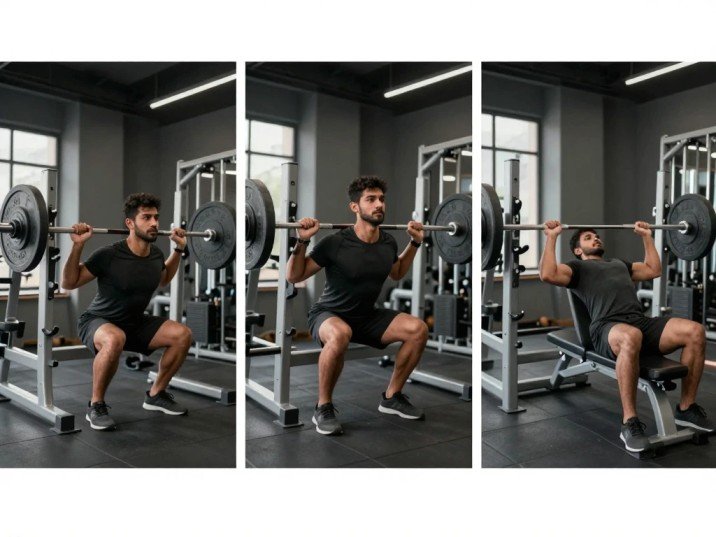
1. Barbell Back Squat
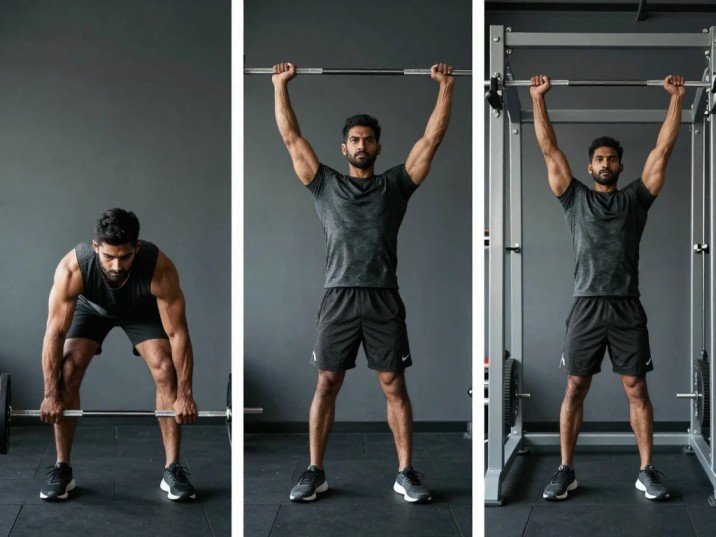
Why it matters: Trains quads, glutes, hamstrings, and core simultaneously. No other exercise builds lower body strength as efficiently.
Beginner sets/reps: 3 × 8 reps | Rest: 90 seconds
Key form cues:
- Feet shoulder-width apart, toes out 15–30 degrees
- Brace core before descent
- Knees track over toes
- Thighs parallel to floor at minimum depth
- Drive through heels to stand
Beginner modification: Goblet squat with a light dumbbell before moving to barbell.
2. Conventional Deadlift
Why it matters: Builds the entire posterior chain — hamstrings, glutes, lower back, traps. Also one of the best grip strength developers available.
Beginner sets/reps: 3 × 5 reps | Rest: 2 minutes
Key form cues:
- Bar over mid-foot, shins touching bar at setup
- Hip hinge, not a squat
- Big breath and brace before pulling
- Bar stays close to body throughout
- Lock out with glutes at the top
Beginner modification: Romanian deadlift (RDL) with dumbbells to learn the hip hinge pattern first.
3. Bench Press
Why it matters: The fundamental upper body pushing exercise. Builds chest, shoulders, and triceps with heavy compound load.
Beginner sets/reps: 3 × 8–10 reps | Rest: 90 seconds
Key form cues:
- Feet flat on floor, slight arch in lower back
- Grip slightly wider than shoulder-width
- Bar touches lower chest (not neck)
- Elbows at 45 degrees (not flared at 90)
- Press explosively, lower under control
Beginner modification: Dumbbell bench press — easier to control and safer without a spotter.
4. Barbell Row (Bent-Over Row)
Why it matters: The pulling counterpart to the bench press. Builds the lats, rhomboids, and biceps. Also counteracts the rounded-shoulder posture caused by desk work.
Beginner sets/reps: 3 × 8–10 reps | Rest: 90 seconds
Key form cues:
- Hinge at hips to approximately 45 degrees
- Pull bar to lower chest/upper abdomen
- Squeeze shoulder blades together at the top
- Lower under control — 2 seconds down
Beginner modification: Dumbbell single-arm row with one hand supported on a bench.
5. Overhead Press (OHP)
Why it matters: Builds shoulder strength and stability in the overhead position — a movement pattern most people never train and desperately need.
Beginner sets/reps: 3 × 8–10 reps | Rest: 90 seconds
Key form cues:
- Start with bar at shoulder height
- Brace core and squeeze glutes before pressing
- Press straight up — bar travels in a vertical line
- Full lockout at the top
- Lower under control back to shoulders
Beginner modification: Seated dumbbell shoulder press to build stability before standing barbell work.
The Beginner Gym Programme (3 Days Per Week)
Run this for 8–12 weeks before progressing to anything more complex. Simplicity is a feature, not a bug.
Day A — Monday
| Exercise | Sets | Reps | Rest |
|---|---|---|---|
| Barbell Squat | 3 | 8 | 90 sec |
| Bench Press | 3 | 8–10 | 90 sec |
| Barbell Row | 3 | 8–10 | 90 sec |
| Plank | 3 | 30–45 sec | 45 sec |
Day B — Wednesday
| Exercise | Sets | Reps | Rest |
|---|---|---|---|
| Deadlift | 3 | 5 | 2 min |
| Overhead Press | 3 | 8–10 | 90 sec |
| Dumbbell Lunges | 3 | 10/leg | 60 sec |
| Cable Row | 3 | 10–12 | 60 sec |
Day C — Friday
| Exercise | Sets | Reps | Rest |
|---|---|---|---|
| Barbell Squat | 3 | 10 | 90 sec |
| Incline Dumbbell Press | 3 | 10 | 90 sec |
| Pull-Up or Lat Pulldown | 3 | 6–10 | 90 sec |
| Romanian Deadlift | 3 | 10 | 90 sec |
Progressive overload rule: Every time you complete all sets and reps with good form, add 2.5 kg the next session. This simple rule is responsible for more progress than any complicated periodisation scheme.
How to Structure Your Gym Session (The 4-Phase Framework)
Every gym session should follow the same four-phase structure. This is the framework I use with every client on day one.
Phase 1 — Warm-Up (5–8 minutes) Light cardio (rowing machine or bike) to raise body temperature, followed by dynamic stretching of the muscles you’re about to train. Never skip this. Cold muscles tear.
Phase 2 — Main Lifts (25–35 minutes) The 2–3 compound exercises that are the core of your session. These go first when your nervous system is fresh and your energy is highest. This is where the real work happens.
Phase 3 — Accessory Work (10–15 minutes) Smaller isolation exercises that target specific muscles — bicep curls, tricep pushdowns, lateral raises, face pulls. These support the main lifts but never replace them.
Phase 4 — Cool Down (5 minutes) Light walking and static stretching. This improves flexibility, reduces next-day soreness, and signals to your nervous system that the training stress is over.
Total session time: 45–60 minutes
Anything beyond 60 minutes and your cortisol levels rise sharply, diminishing the anabolic benefit of the session. More is not always better.
Gym Equipment Guide — What to Use and When
Walking into a gym for the first time is overwhelming. Here is a simple framework for deciding what equipment to use.
Free Weights (Barbells and Dumbbells)
Use for: The big compound lifts — squats, deadlifts, bench press, rows, overhead press. Why: Free weights require your stabiliser muscles to work, building more functional strength than machines. Best for: Intermediate and advanced lifters who have learned the movement patterns.
Machines (Cable, Plate-Loaded, Selectorised)
Use for: Accessory work and isolation exercises — lat pulldowns, leg press, chest flyes, leg curls. Why: Machines guide the movement path, reducing injury risk for beginners and allowing targeted muscle isolation. Best for: Beginners learning movement patterns, and advanced lifters targeting specific muscle groups.
Kettlebells
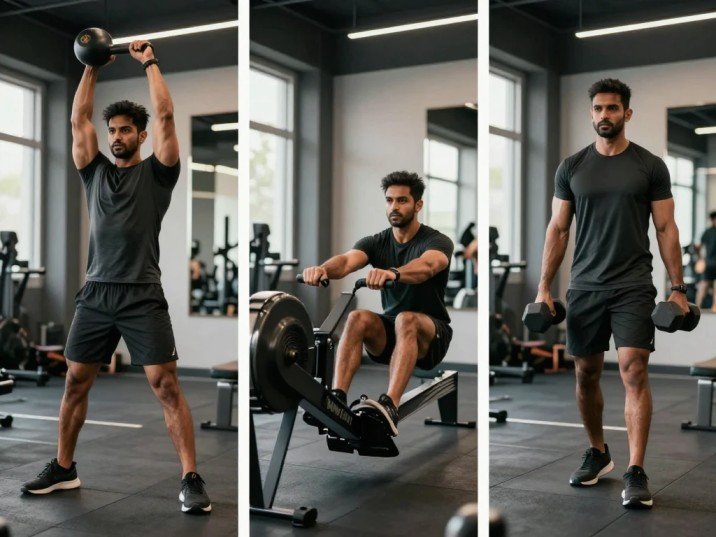
Use for: Swings, Turkish get-ups, goblet squats, carries. Why: Excellent for developing power, grip strength, and cardiovascular conditioning simultaneously. Best for: Anyone who wants functional strength and conditioning in one tool.
Cardio Machines
Use for: Warm-up, cool-down, dedicated cardio sessions, active recovery days. Ranking by calorie burn (per 30 minutes at moderate effort):
- Rowing machine (~300 cal) — full body
- Stair climber (~270 cal)
- Treadmill — running (~250 cal)
- Cycling (~200 cal)
- Elliptical (~180 cal)
Real-World Case Study: Hassan’s 12-Week Gym Transformation
Hassan was 28 when he first came to me. He had a desk job, hadn’t exercised since university, and told me his main goal was to “not feel embarrassed taking his shirt off at the beach.”
He was 84 kg, estimated 24% body fat, and couldn’t do a single pull-up.
I put him on the 3-day beginner programme above with one addition: 20 minutes of Zone 2 cardio on the rowing machine after each session.
Week 12 results:
- Weight: 84 kg → 81.5 kg (−2.5 kg)
- Estimated body fat: 24% → 19%
- Squat: 40 kg → 85 kg (5 reps)
- Bench press: 30 kg → 62.5 kg (8 reps)
- Pull-ups: 0 → 7
- Self-reported confidence: “I actually looked forward to going. That was the biggest surprise.”
Hassan did not follow a complicated programme. He did not take supplements beyond creatine and protein. He followed the simple 3-day plan, added weight consistently, and ate 150g of protein per day.
The simplicity was the strategy.
The 5 Biggest Gym Mistakes Beginners Make
Mistake 1: Training without a plan Walking into the gym without knowing what you’re going to do leads to random, unfocused sessions that produce random, unfocused results. Always arrive with a written plan — even if it’s just your phone notes.
Mistake 2: Ego lifting Using weight that’s too heavy for your current strength level forces you to compensate with momentum and poor form. This does not build muscle — it builds injury risk. Use the heaviest weight you can lift with perfect form for every rep of every set.
Mistake 3: Skipping legs The legs contain the largest muscle groups in your body. Training them releases the most growth hormone and testosterone, benefits your entire physique — not just your lower body — and produces the highest calorie burn. Skipping legs is the most counterproductive decision a beginner can make.
Mistake 4: Not eating enough protein Training without adequate protein is like building a house without cement. The structure cannot hold. Aim for 1.6–2.2g of protein per kg of bodyweight every day. For an 80 kg person that is 128–176g daily.
Mistake 5: Changing the programme too often Every time you change your programme before it has had time to work, you reset the adaptation process. Give any programme a minimum of 8 weeks before evaluating it. Progress is rarely visible week to week — it becomes visible month to month.
Gym Nutrition Basics — What to Eat Around Your Training
You cannot out-train a poor diet. Here are the fundamentals that support any gym programme.
Pre-Workout (60–90 minutes before)
- Carbohydrates: Rice, oats, bread, banana — these fuel the session
- Protein: Chicken, eggs, Greek yoghurt — starts muscle protein synthesis early
- Avoid: High-fat foods (slow digestion) and high-fibre foods (digestive discomfort during training)
Example pre-workout meal: 150g chicken breast + 200g rice + handful of spinach
Post-Workout (within 60 minutes)
- Protein: 30–40g to initiate muscle repair
- Carbohydrates: To replenish muscle glycogen depleted during training
- Avoid: Skipping this meal — the post-workout window is the highest priority nutritional moment of the day
Example post-workout meal: Protein shake (30g protein) + 1 banana, then a full meal within 2 hours
Daily Non-Negotiables
- Water: 3–4 litres per day (more on heavy training days)
- Sleep: 7–9 hours — muscle grows during sleep, not during training
- Calorie surplus for muscle gain: 200–300 calories above maintenance
- Calorie deficit for fat loss: 300–500 calories below maintenance
How Long Before You See Results?
Here is an honest, research-backed timeline based on consistent training and adequate nutrition:
Weeks 1–2: Neural adaptations — you get stronger without visible muscle changes. Your nervous system is learning the movement patterns. This feels like magic.
Weeks 3–4: Slight muscle fullness and pump. Clothes begin to fit differently. Energy levels noticeably higher.
Weeks 6–8: Visible muscle definition. Strength has typically doubled from week 1 for beginners. Friends begin commenting.
Weeks 10–12: Significant body composition change. Most beginners who train consistently and eat adequate protein lose 3–5 kg of fat and gain 2–3 kg of muscle in this period.
Months 4–6: The physique shift becomes undeniable. This is where the habit has been built and results compound.
The research is consistent: the most dramatic improvements happen in the first 12 weeks, because the baseline is low and the body responds rapidly to a new stimulus. After that, progress slows but continues indefinitely with progressive overload.
About the Author
I am a certified fitness and fat loss coach with over 6 years of hands-on experience helping everyday people build strength, lose fat, and stay consistent with training. Through Fitness Flora, I shares practical, no-nonsense gym and nutrition guidance grounded in real coaching experience and current research. My approach: keep it simple, stay consistent, and trust the process.
Final Thought
The gym is not complicated. The principles that produce results have not changed in decades — compound movements, progressive overload, adequate protein, sufficient sleep, and consistency over time.
What makes gym training hard is not the knowledge. It is showing up when you don’t feel like it, adding weight when it gets uncomfortable, and staying the course when progress feels slow.
Start with the 3-day beginner programme in this guide. Follow it for 12 weeks without changing anything. Then assess.
I promise the results will speak for themselves.
Related Articles:
- 13 Best Full Body Exercises for Strength
- 10-Minute Workout at Home – No Equipment Needed
- 10 Bodyweight Back Exercises to Build a Strong Back at Home
- Best Smoothie Recipes for Weight Loss
Gym Workout FAQs
Q: How many days per week should a beginner go to the gym?
Three days per week is optimal for beginners. It provides enough training stimulus to produce rapid results while allowing 48 hours of recovery between sessions. Going more frequently before your body has adapted increases injury risk without increasing results.
Q: Should I do cardio before or after weights?
After weights — always. Weight training requires your central nervous system to be fresh. Cardio before weights depletes glycogen (your muscles’ fuel) and fatigues the nervous system before you’ve done the work that matters most. Exception: 5–8 minutes of light cardio as a warm-up is fine.
Q: How long should a beginner gym session last? 45–60 minutes is the sweet spot. Beyond 60 minutes, cortisol rises and the return on each additional minute diminishes sharply. If your sessions run longer, you are either resting too long between sets or doing too much volume.
Q: What should I do on rest days?
Light walking, stretching, or a 20-minute easy swim. Complete inactivity is not ideal — light movement improves blood flow to recovering muscles and accelerates repair. What you should not do: another intense training session.
Q: Do I need supplements to see results?
No — but two are worth considering. Creatine monohydrate (5g per day) is the most researched supplement in sports science and consistently improves strength and muscle gains. Whey protein makes hitting your daily protein target more convenient. Everything else is mostly marketing.
Q: Is it normal to feel sore after every gym session?
Soreness (DOMS — Delayed Onset Muscle Soreness) is normal for the first 2–3 weeks as your body adapts. After that, you should only feel significant soreness after introducing new exercises or substantially increased volume. Chronic soreness after every session usually indicates insufficient recovery — check your sleep and nutrition first.
Q: Can I build muscle and lose fat at the same time?
Yes — but primarily in two scenarios: beginners (who experience “newbie gains”) and people returning after a long break. For everyone else, the body generally does one more efficiently than the other. The most practical approach for most people is to focus on fat loss first (if significantly overweight) or muscle gain first (if already lean), then switch phases.
Q: What is the best gym programme for beginners?
The best programme is the one you will follow consistently. That said, proven beginner programmes include Starting Strength, StrongLifts 5×5, and the beginner programme in this article. All share the same core principle: 3 days per week, compound movements, progressive overload. Pick one and commit to it for 12 weeks minimum.
Q: How important is sleep for gym results?
Critically important. A 2019 study found that sleep deprivation reduces muscle protein synthesis by up to 18% and significantly impairs recovery between sessions. You can have the perfect programme and perfect nutrition — but without 7–9 hours of sleep, you are leaving a significant portion of your results on the table.
Q: Do I need a personal trainer?
Not necessarily, but investing in 3–5 sessions with a qualified trainer at the start pays dividends. Having your form checked on the big lifts — squat, deadlift, bench press — before you load them heavily prevents injuries that could set you back months. If budget is a concern, many gyms offer a free introductory session.