Discover the Ultimate High Protein Indian Food Chart for Muscle Gain
A high protein Indian food chart maps common vegetarian and non-vegetarian foods — like paneer, moong dal, rajma, soya chunks, eggs, and chicken — to their protein content per 100g, so you can plan meals around a daily target. Most healthy Indian adults need roughly 0.83g protein per kg body weight (ICMR-NIN 2020 RDA), rising to 1.2–1.6g/kg for muscle gain or intense training.
I’ve lost count of how many clients — mostly vegetarian, mostly convinced they “just can’t get enough protein on Indian food” — have come to me with a diet chart printed off some random website, half the numbers clearly wrong, no source in sight. So I built this one properly: real gram-per-100g values, cross-checked against India’s own nutrition data, organized the way you’d actually eat — dal, roti, paneer, and all.
This isn’t a generic protein indian food list copy-pasted from a supplement brand’s blog. It’s the same high protein indian food chart I hand to my own coaching clients, veg and non-veg, built around what’s actually in an Indian kitchen.
Why Protein Deserves the Center of Your Plate
Protein does the actual construction work — repairing and building the muscle tissue you break down in the gym, and it’s the single most satiating macronutrient, which matters as much for someone trying to gain weight without overeating junk as it does for someone cutting. On a purely physiological level, more dietary protein means more available amino acids for muscle protein synthesis, the process your body uses to build new muscle after training.
Here’s the uncomfortable part for most Indian diets: protein foods in india tend to lose out to carbohydrate-heavy staples. National dietary data consistently shows that a large share of the average Indian’s daily protein still comes from cereals — rice, wheat — rather than pulses, dairy, or meat. That’s not a disaster; cereal protein still counts. But it’s lower-quality protein, and ICMR specifically recommends that at least two-thirds of your protein rich food in indian diet should come from higher-quality sources like pulses, dairy, eggs, and meat rather than grains alone.
What This High Protein Indian Food Chart Actually Covers
This chart splits into vegetarian and non-vegetarian protein sources, every value given per 100g so you can scale it to your own portions — a small katori of dal isn’t 100g, a full chicken breast might be closer to 150g. I’ve also added where each food actually shows up on a plate, because a gram count means nothing if you don’t know how to cook it into dinner. Where I disagree with the standard approach — and where I’ve seen it work differently with real clients — I’ve flagged it directly rather than smoothing it over.
Understanding Your Protein & Caloric Needs
Before the chart is useful, you need a target. The ICMR-NIN 2020 guidelines set the baseline Recommended Dietary Allowance at 0.83g of protein per kg of body weight per day for a healthy, sedentary adult (the Estimated Average Requirement sits at 0.66g/kg). That’s the floor, not the goal, if you train.
- Sedentary: ~0.8g/kg (the ICMR baseline)
- Moderate exercise, 3–5 days/week: ~1.0–1.2g/kg
- Intense training or muscle-gain focus: ~1.2–1.6g/kg
For a 70kg man actively training for muscle gain, that’s roughly 85–110g of protein a day — a very achievable number once you see it broken into meals rather than as one intimidating total.
2000 Calorie Indian Diet Plan (For Muscle Gain)
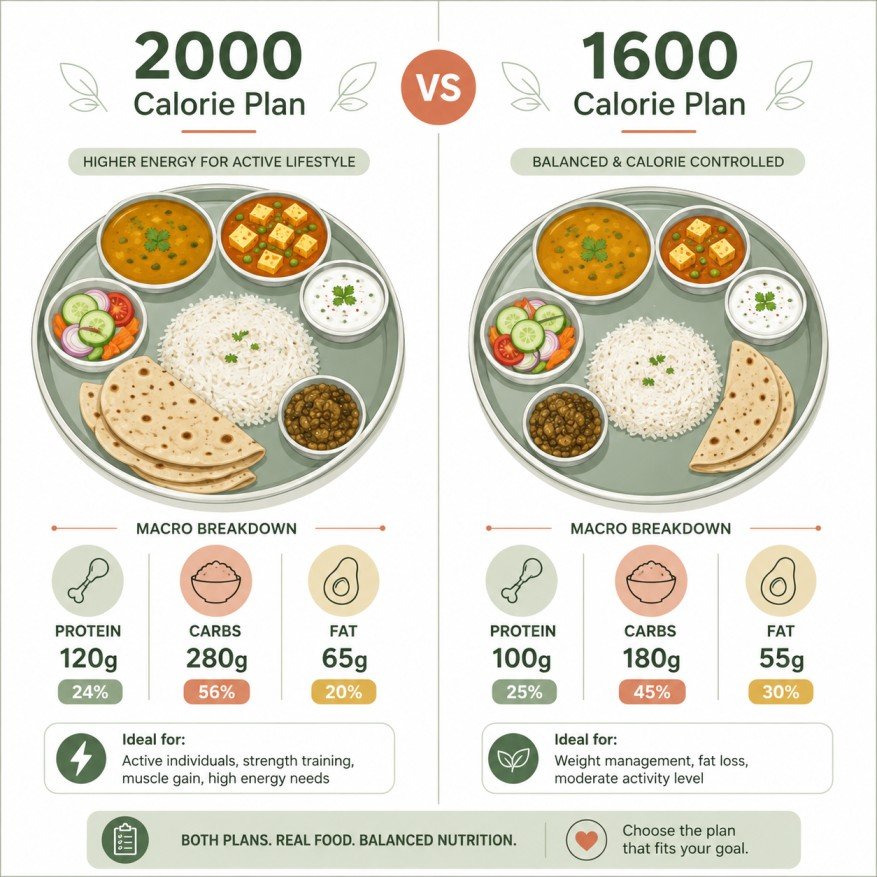
A 2000 calorie indian diet plan is a common starting point for moderate-activity muscle gain in a person around 60–70kg. An approximate macro split that works well in practice:
| Macro | Grams | Calories | % of total |
|---|---|---|---|
| Protein | ~130g | 520 kcal | 26% |
| Carbohydrates | ~230g | 920 kcal | 46% |
| Fat | ~62g | 560 kcal | 28% |
This is a starting point, not a prescription — adjust up or down based on your own bodyweight and how your weight trend responds over 2–3 weeks.
1600 Calorie Indian Diet Plan
A 1600 calorie plan suits a smaller frame, a slower lean-gain approach, or someone recomping (building muscle while staying close to maintenance calories):
| Macro | Grams | Calories | % of total |
|---|---|---|---|
| Protein | ~110g | 440 kcal | 27.5% |
| Carbohydrates | ~170g | 680 kcal | 42.5% |
| Fat | ~53g | 480 kcal | 30% |
2000 vs 1600 Calorie Plan: Which One’s Right for You?
| 2000 Calorie Plan | 1600 Calorie Plan | |
|---|---|---|
| Best for | Faster, more aggressive muscle gain | Lean/slow gain, recomposition |
| Typical body weight | 65–75kg | 50–60kg |
| Protein target | ~130g | ~110g |
| Weekly weight change | +0.3–0.5 kg | +0.1–0.25 kg |
| Risk if overdone | More fat gain alongside muscle | Slower visible progress |
Neither is “correct” in isolation — pick the one that matches your current bodyweight and how fast you actually want to gain.
High Protein Indian Food Chart: Vegetarian Sources
This is where most of my clients’ high protein vegetarian diet questions start — and where most generic charts online get lazy, copying the same five foods without checking real digestibility or how much of it actually shows up on a plate.
Legumes and Pulses
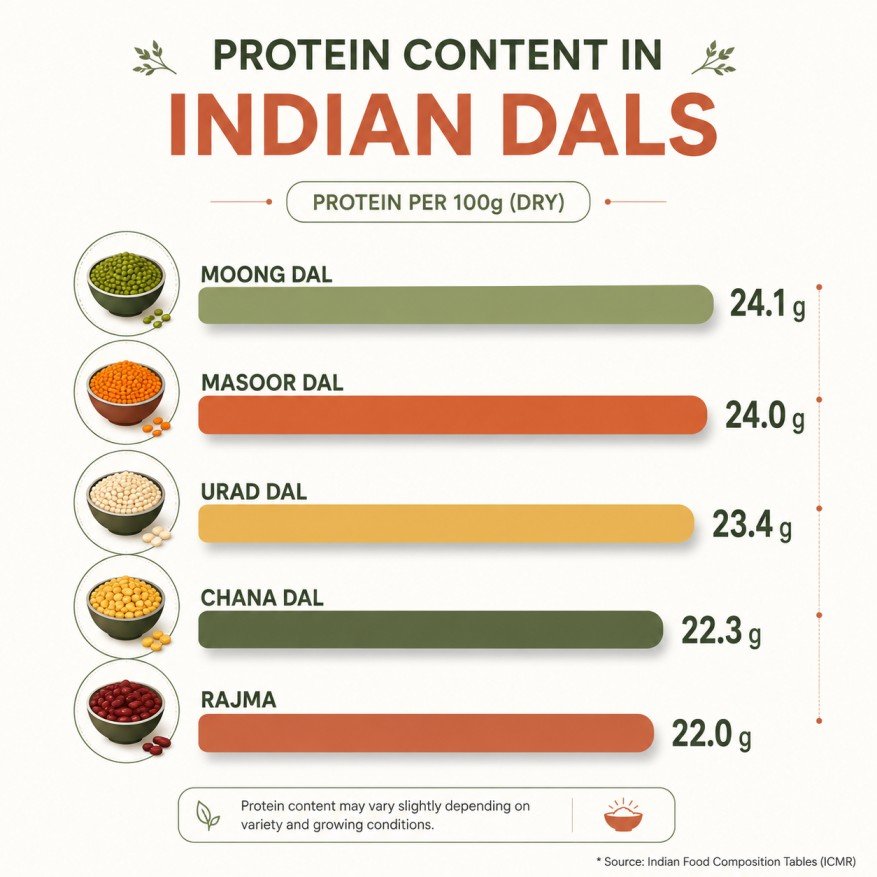
Dal is the backbone of a vegetarian protein sources india strategy, and not all dals are equal. Here’s how the common ones compare, values per 100g raw/dry:
| Dal / Pulse | Protein per 100g (raw) |
|---|---|
| Soybean | ~36g |
| Masoor dal (red lentil) | ~25–26g |
| Urad dal | ~24–25g |
| Moong dal | ~24g |
| Rajma (kidney beans) | ~22–24g |
| Chana dal | ~20–22g |
| Peanuts | ~25g |
That’s your core protein foods veg list for daily cooking. A quick coaching note most charts skip: gram-for-gram, masoor and urad edge out moong on raw protein — but moong digests more easily and causes less bloating, which is why I still recommend it as the daily default for most clients and save the denser dals for when appetite and digestion allow.
Dairy Products
Paneer sits at roughly 18g protein per 100g, curd/dahi at 3–4g per 100g, and milk at about 3–3.5g per 100ml. Paneer vs. dal is a question I get constantly — here’s the honest comparison:
| Paneer | Dal (cooked) | |
|---|---|---|
| Protein per 100g | ~18g | ~7–9g (cooked, water-diluted) |
| Cost per gram of protein | Higher | Lower |
| Digestibility | High (complete protein, dairy) | Good, improves when paired with rice/grain |
| Best use | Protein-dense single dish | Daily staple, larger volume |
Neither wins outright — the highest-protein high protein vegetarian foods in india diets I’ve built for clients use both, not one instead of the other.
Soy & Beyond: The Most Underrated High Protein Vegetarian Foods
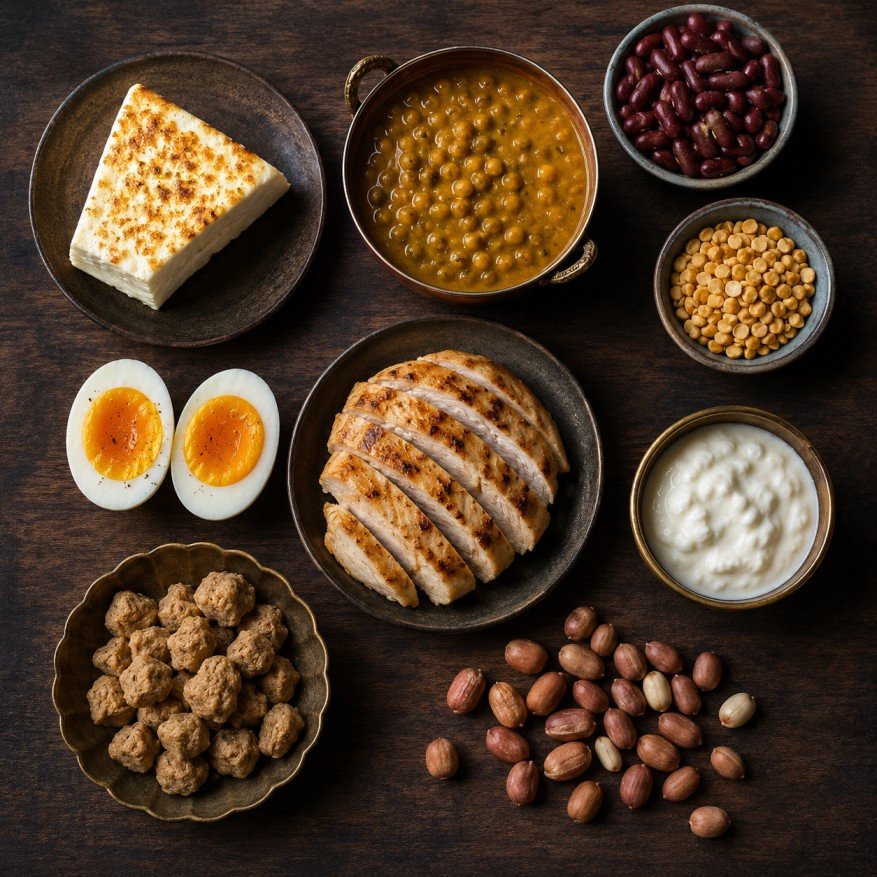
If you want the single highest high protein vegetarian foods per 100g, dry soya chunks are hard to beat — around 50g+ protein per 100g dry, dropping to roughly 15–17g once rehydrated and cooked into a curry. Tofu is another strong, underused option most Indian diet charts skip entirely, despite being an easy paneer substitute in curries and stir-fries. If you’re building a protein rich food veg in india plan and haven’t touched soya chunks yet, this is the single easiest swap to make this week.
Coach’s note: One of my vegetarian clients — a 24-year-old office worker in Pune — was stuck around 55g of protein a day despite “eating a lot of dal.” The fix wasn’t more dal. It was adding 30g of dry soya chunks into his evening curry and swapping his mid-morning biscuit for roasted chana. That alone closed most of the gap without changing anything else about his diet.
High Protein Indian Food Chart: Non-Vegetarian Sources
Chicken and Fish
Cooked chicken breast delivers roughly 26–31g of protein per 100g — the densest common non-veg source. Fish like rohu or pomfret comes in around 18–20g per 100g cooked, lower than chicken but still a strong, easy-to-digest option, especially for anyone training and eating chicken every day and wanting variety.
Eggs
A whole egg runs about 13g of protein per 100g (roughly 6g per large egg), with most of that concentrated in the white. Eggs remain one of the most practical high protein vegetarian foods for muscle building for ovo-vegetarians specifically, since they’re fast to cook and don’t require the meal-prep planning dal and paneer do.
Sample Diet Plans Using This Chart
Here’s how this high protein indian food chart turns into an actual day of eating, across three common goals.
Indian Diet Chart for Weight Gain
| Meal | What to Eat | Approx. Protein |
|---|---|---|
| Early morning | Soaked almonds + walnuts | 5g |
| Breakfast | 3-egg omelette + 2 paratha + glass of milk | 35g |
| Mid-morning | Banana + peanut butter | 8g |
| Lunch | 2 roti + rice + rajma + paneer sabzi + curd | 35g |
| Evening | Sprouts chaat + roasted chana | 15g |
| Dinner | 2 roti + chicken curry + dal + salad | 35g |
| Total | ~133g |
Indian Diet Chart for Muscle Gain
| Meal | What to Eat | Approx. Protein |
|---|---|---|
| Early morning | Soaked moong + almonds | 8g |
| Breakfast | Paneer bhurji + 2 multigrain roti | 25g |
| Mid-morning | Boiled eggs (2) + fruit | 12g |
| Lunch | Dal + rice + chicken/soya sabzi + curd | 40g |
| Evening | Roasted chana + green tea | 12g |
| Dinner | 2 roti + fish/paneer curry + dal + salad | 35g |
| Total | ~132g |
Example Gym Diet Chart for Vegetarian
All-veg, built to hit a high protein target without eggs, chicken, or fish:
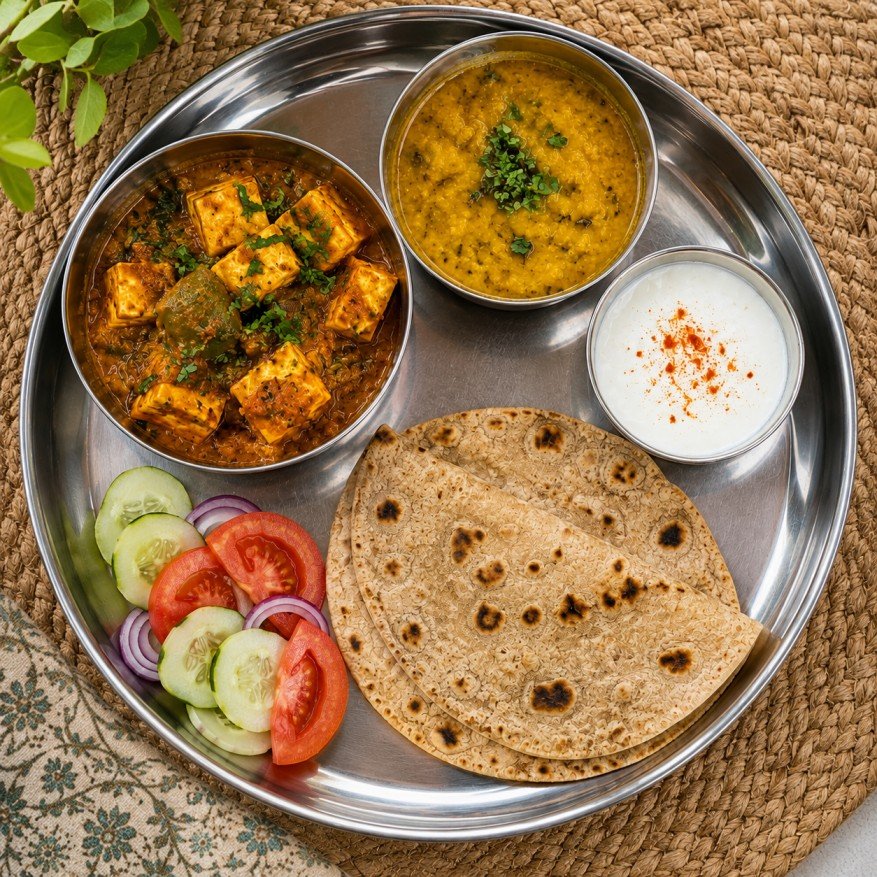
| Meal | What to Eat | Approx. Protein |
|---|---|---|
| Early morning | Soaked moong + almonds | 8g |
| Breakfast | Paneer bhurji + 2 multigrain roti + milk | 30g |
| Mid-morning | Roasted chana + sprouts | 15g |
| Lunch | Dal + rice/roti + paneer sabzi + curd | 35g |
| Evening | Soya chunk chaat + peanuts | 15g |
| Dinner | Soya curry + roti + dal + salad | 20g |
| Total | ~123g |
Want This as a Printable PDF?
I keep a print-and-stick-on-your-fridge version of this exact high protein indian food chart for coaching clients — just say the word and I’ll turn this into a downloadable PDF you (or your readers) can save and print directly.
Saad’s 4×25 Framework
Here’s an original insight most protein charts miss entirely: hitting a daily gram target matters less than hitting it consistently, meal by meal. Trying to cram 60g of protein into one dinner is exactly why most people give up on high protein eating within two weeks.
Instead, I coach clients on what I call the 4×25 framework — spread your protein target across four meals at roughly 25–30g each (breakfast, lunch, an evening snack, and dinner). On an Indian plate, that looks like: eggs or paneer at breakfast, dal + a protein side at lunch, roasted chana or sprouts as an evening snack, and dal or a meat/soya curry at dinner. It’s a far more sustainable way to hit 100–120g a day than trying to force it all into one or two “big” protein meals — and it lines up with what sports nutrition research on muscle protein synthesis has generally found: your body uses a moderate, repeated dose of protein per meal better than one massive one.
Coach’s note: A lean 19-year-old college student I worked with in Delhi had the opposite problem to most people trying to gain weight — he genuinely wanted to eat more but lost his appetite completely by evening, so dinner would end up being a few bites of roti and nothing else. Loading protein into two big meals wasn’t working for him at all. Switching him to the 4×25 pattern — smaller, protein-forward portions spread across the day instead of two large ones — meant he was actually finishing his meals instead of leaving half a plate, and his weekly weigh-ins started moving in the right direction within about three weeks.
The Bottom Line on High Protein Indian Foods
A high protein indian food chart is only useful if it changes what actually lands on your plate tonight. Whether you’re vegetarian or not, the foods here — dal, paneer, soya, eggs, chicken, fish — are already sitting in most Indian kitchens. The gap usually isn’t access to protein rich indian food; it’s not knowing how much of it you’re actually eating.
Start with one change this week: pick your weakest meal of the day and add one item from this chart to it. That’s a more sustainable first step than trying to overhaul your entire diet around a number.
About the Author
I’m Saad, a fitness, fat loss, and nutrition coach with over six years of experience designing practical diet and training plans for clients across body-composition goals. I specialize in high-protein meal planning for vegetarian and mixed diets, with a particular focus on making evidence-based nutrition work within everyday Indian eating patterns — dal, roti, paneer, and all. This chart draws on ICMR-NIN’s 2020 dietary guidelines combined with what’s actually worked, plate by plate, with my own coaching clients.
This article is for general nutrition guidance and isn’t a substitute for personalized medical advice — I always recommend consulting a registered dietitian or doctor for medical conditions, pregnancy, or diagnosed nutrient deficiencies.
The Bottom Line on High Protein Indian Foods
A high protein indian food chart is only useful if it changes what actually lands on your plate tonight. Whether you’re vegetarian or not, the foods here — dal, paneer, soya, eggs, chicken, fish — are already sitting in most Indian kitchens. The gap usually isn’t access to protein rich indian food; it’s not knowing how much of it you’re actually eating.
Frequently Asked Questions
What is a high protein Indian food chart?
It’s a reference table of common Indian foods — vegetarian and non-vegetarian — mapped to their protein content per 100g, so you can plan meals around a daily protein target rather than guessing.
What’s a good gym diet plan for muscle gain?
A gym-focused plan built from this chart aims for 1.2–1.6g of protein per kg body weight, spread across 4–5 meals using the 4×25 framework above — roughly 130g total protein a day at 2000 calories, sourced from eggs, chicken or paneer, dal, and dairy.
How do I calculate how much protein I need?
Multiply your body weight in kg by your target factor: 0.83g/kg for the ICMR baseline, or 1.2–1.6g/kg if you train regularly for muscle gain. A 70kg person training for muscle gain would land around 85–110g a day.
What does a 100g protein a day meal plan look like?
Using this chart, 100g looks like: 2 eggs, a portion of paneer or chicken, a cup of cooked dal, a glass of milk or curd, and a handful of peanuts or roasted chana — spread across meals rather than eaten in one sitting.
What are the best high protein foods for an Indian diet?
Paneer, moong/masoor/urad dal, soya chunks, eggs, chicken, fish, curd, and peanuts cover almost every high-protein need on a typical Indian plate — see the full gram-by-gram breakdown in the chart above.
How much protein is in soya chunks per 100g?
Dry soya chunks pack roughly 50g+ protein per 100g, dropping to about 15–17g per 100g once rehydrated and cooked into a curry — still one of the densest vegetarian sources on this chart.
How much protein is in one egg? One large egg (about 50g) has roughly 6g of protein, most of it concentrated in the white — which works out to about 13g per 100g of whole egg.
How much protein is in tofu per 100g?
Firm tofu has roughly 12–17g of protein per 100g, while softer silken tofu runs lower, around 6–8g, since it holds more water — either works as a paneer substitute in curries.
Do I need protein powder to hit my protein target on an Indian diet?
No — whole foods like dal, paneer, eggs, and soya chunks can cover most people’s targets. Protein powder is a convenient top-up when appetite or time is limited, not a requirement.