Unlock Your Strength: 7 Must-Try Upper Body HIIT Exercises
The best upper body HIIT exercises combine push, pull, and stability movements — like push-up variations, dumbbell shoulder press, tricep dips, and plank-to-shoulder taps — performed in 30-45 second work intervals with 15-20 second rest. This trains muscular strength and cardiovascular endurance at the same time, in as little as 15-20 minutes.
I’ve coached clients through hundreds of upper body HIIT sessions, and the biggest mistake I see isn’t picking the wrong exercises — it’s picking the right high intensity upper body exercises and running them at the wrong intensity, skipping modifications, or ignoring recovery. Get the full picture right, and even seven simple moves can outperform an hour of steady-state cardio for upper body conditioning.
Why Upper Body Strength Matters
Most people default to lower body or full-body HIIT and treat their arms, chest, and back as an afterthought. That’s a mistake. Upper body strength affects posture, shoulder stability, and your ability to do everyday tasks — carrying groceries, lifting a suitcase into an overhead bin, pushing a stalled car. Researchers studying functional fitness in aging populations have identified muscular strength in both the upper and lower body as one of five core components needed to maintain independent daily function — this isn’t just about aesthetics.
Beyond function, a strong upper body protects you. Weak stabilizer muscles around the shoulder joint are one of the most common reasons I see new clients dealing with nagging shoulder or upper back pain. This is where HIIT training upper body work has an edge over slower methods: it forces your muscles to fire under fatigue, which is exactly the condition where injuries tend to happen in real life, so training that way builds resilience where it counts.
If you’d rather start with a shorter, gentler introduction to structured training before jumping into full intervals, my 10-minute workout at home guide is a good on-ramp.
What Is Upper Body HIIT?
Definition of HIIT
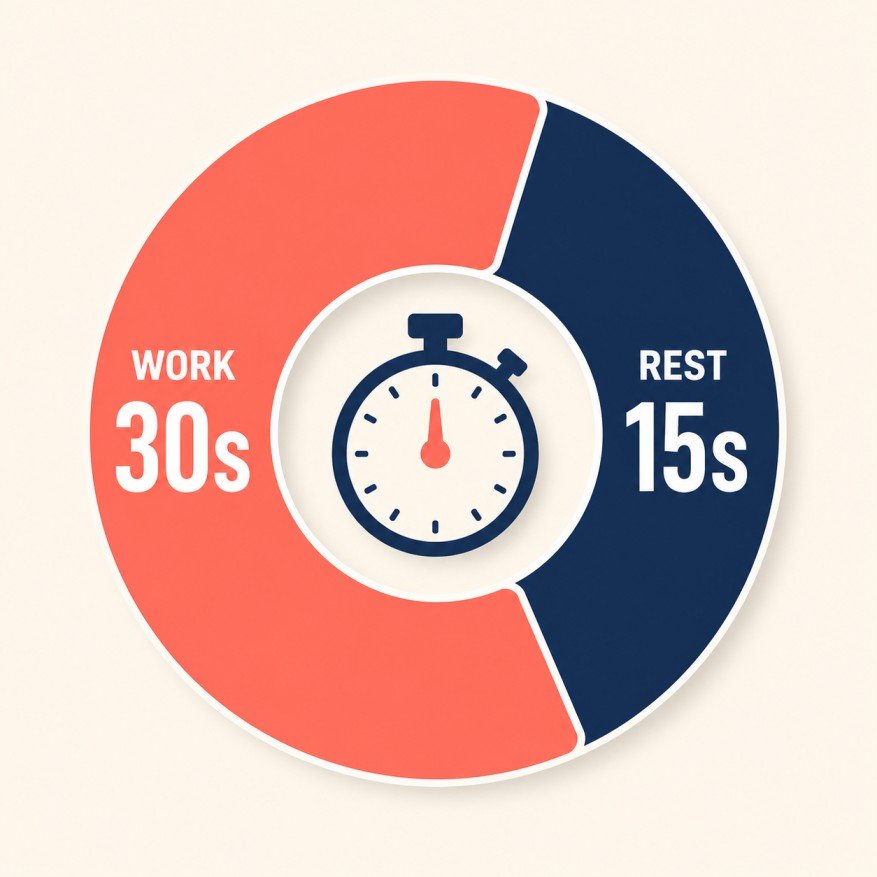
High-intensity interval training upper body work alternates short bursts of maximum-effort work with brief recovery periods. A typical structure is 30-45 seconds of work followed by 15-20 seconds of rest, repeated for 4-8 rounds. What makes it “upper body” HIIT specifically is simple: every exercise in the circuit targets the chest, shoulders, back, arms, or core stabilizers — legs are along for the ride, not the focus.
Benefits of HIIT for Upper Body
- Time efficiency — a full session takes 15-25 minutes, including warm-up
- EPOC effect — you keep burning calories for hours after the session ends (the “afterburn” effect), which is more pronounced with HIIT than steady-state cardio. This happens because heavier training loads and shorter recovery intervals increase demand on the anaerobic energy pathways during exercise, which produces a greater EPOC response during recovery NASM
- Strength and conditioning together — you build muscular endurance and cardiovascular fitness in the same session instead of needing separate workouts
- No equipment required — most of the exercises below work with just bodyweight, which matters if you train at home or travel often
- Improved shoulder and core stability — many of these movements are plank-based, which doubles as core and shoulder-stabilizer training
In my own coaching practice, clients who added two upper body HIIT sessions per week to their existing lower-body-focused routine reported noticeably less shoulder fatigue during pressing exercises within about four weeks — a pattern I’ve seen repeat across dozens of intake conversations.
Top 7 Upper Body HIIT Exercises
These exercises double as a complete hiit chest workout when you want to emphasize pressing strength, and as a full upper body circuit when performed together.
1. Push-Up Variations
Muscles worked: chest, shoulders, triceps, core
Standard Push-Ups
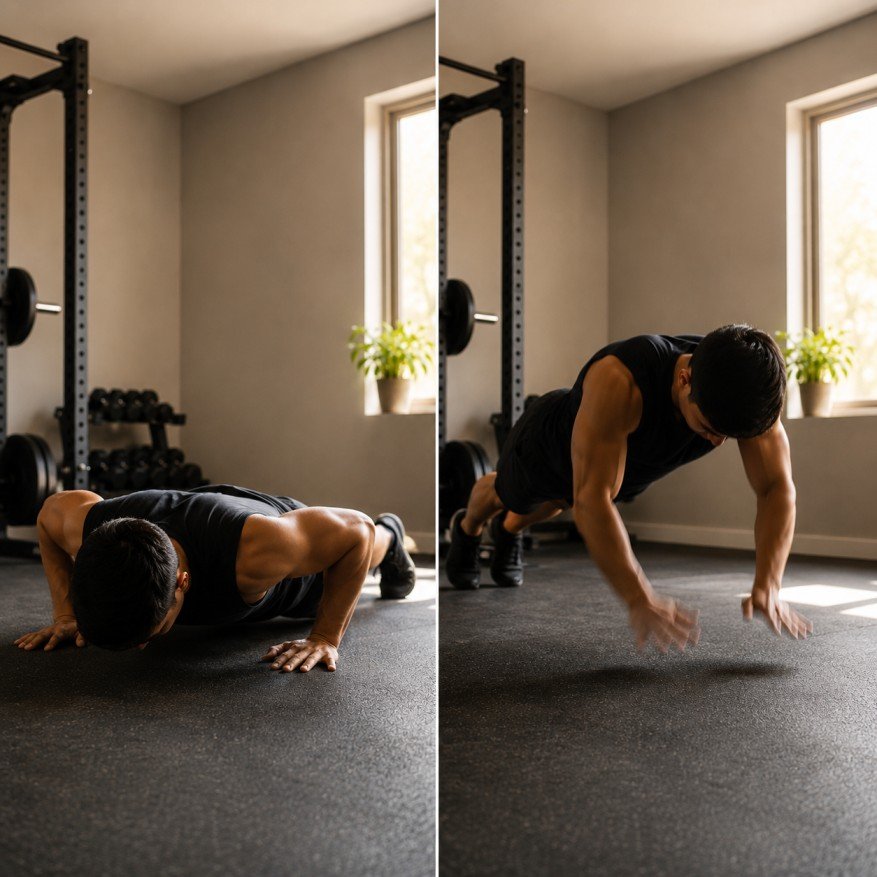
Hands slightly wider than shoulder-width, body in a straight line from head to heels. Lower your chest toward the floor with elbows at roughly a 45-degree angle, then press back up explosively. This is the foundation of any chest workout high intensity circuit.
Plyometric Push-Ups
Same setup, but push off the ground hard enough that your hands briefly leave the floor at the top. This adds a power component that standard push-ups don’t train. Only progress to push-ups once you can do 15+ strict standard push-ups with good form — this is the exercise I see most beginners rush into before they’re ready, and it’s a fast track to a wrist or shoulder strain.
Modifications:
- Beginner: Elevate your hands on a bench, step, or countertop to reduce the load on your chest and shoulders. This lets you build strict form before moving to the floor.
- Intermediate: Standard push-ups at full depth, focusing on a controlled 2-second descent.
- Advanced: Plyometric push-ups, or add a resistance band across your upper back for extra tension on the press.
2. Dumbbell Shoulder Press
Muscles worked: shoulders, triceps, upper chest
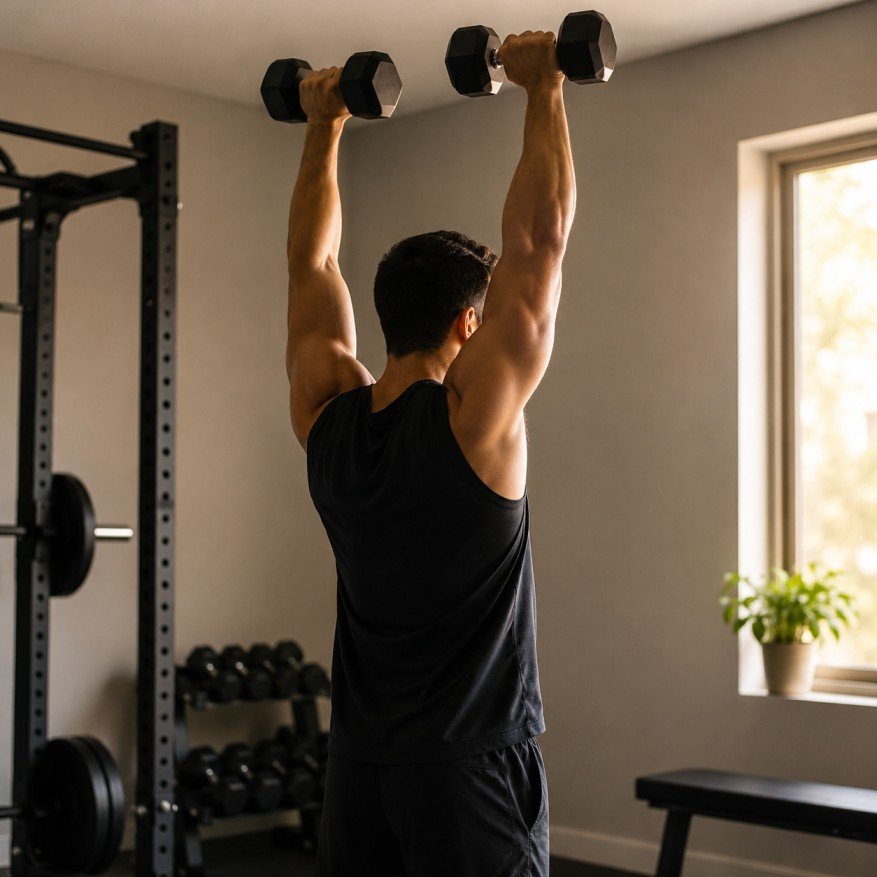
Stand or sit with a dumbbell in each hand at shoulder height, palms facing forward. Press both dumbbells overhead until your arms are fully extended, then lower with control. Keep your ribs down and avoid arching your lower back — that’s the compensation pattern that turns a shoulder exercise into a lower-back problem.
Modifications:
- Beginner: Use light dumbbells (or none at all) and focus on a controlled range of motion rather than speed.
- Intermediate: Moderate dumbbells, pressing at a pace that keeps you within the interval without breaking form.
- Advanced: Alternate single-arm presses to add a core anti-rotation challenge on top of the shoulder work.
3. Chest Press with Resistance Bands
Muscles worked: chest, shoulders, triceps
Anchor a resistance band behind you at chest height (a door anchor works well). Hold one handle in each hand, step forward to create tension, then press both hands forward until your arms are extended. This is one of my favorite chest hiit exercises for anyone who doesn’t have dumbbells or wants a joint-friendlier alternative to weighted presses — bands keep tension constant through the whole range of motion instead of loading heaviest at the bottom like a dumbbell press does.
Modifications:
- Beginner: Use a lighter band and stand closer to the anchor point to reduce tension.
- Intermediate: Step further forward to increase resistance through the full range.
- Advanced: Perform single-arm presses to add a rotational core demand.
4. Tricep Dips
Muscles worked: triceps, shoulders, chest
Using a stable bench or chair, hands shoulder-width apart, fingers pointing forward, legs extended in front of you. Lower your body by bending your elbows until they reach roughly 90 degrees, then press back up. Keep elbows tracking backward, not flaring out — that’s what protects the shoulder joint during this movement.
Modifications:
- Beginner: Keep your knees bent and feet close to your body to reduce the load on your arms.
- Intermediate: Extend your legs fully, feet flat on the floor.
- Advanced: Elevate your feet on a second surface or add a weight plate on your lap.
5. High Knees with Arm Swings
Muscles worked: shoulders, cardiovascular system, hip flexors
This is the “recovery-that-doesn’t-feel-like-recovery” move in the circuit. Drive your knees up toward your chest while swinging your arms overhead and back down in a controlled, rhythmic pattern. It keeps your heart rate elevated between the heavier strength movements without adding more load on fatigued arms.
Modifications:
- Beginner: March in place with arm swings instead of a full high-knee drive, if you need to protect your knees or hips.
- Intermediate: Standard high knees at a moderate pace.
- Advanced: Increase the pace and add a slight jump between each knee drive.
6. Plank to Shoulder Tap
Muscles worked: core, shoulders, chest stabilizers
Start in a high plank, hands under shoulders, feet slightly wider than hip-width for stability. Without rotating your hips, tap your right hand to your left shoulder, then your left hand to your right shoulder. This is one of the best anti-rotation core exercises you can pair with upper body pressing work, and it directly reinforces the shoulder stability I mentioned earlier.
Modifications:
- Beginner: Widen your stance further and slow the tempo down to keep your hips completely still.
- Intermediate: Standard stance and tempo, focusing on a dead-still torso.
- Advanced: Add a push-up between each shoulder tap.
7. Burpees
Muscles worked: full body, with heavy emphasis on chest, shoulders, and cardiovascular conditioning
Drop into a squat, kick your feet back into a plank, perform a push-up, jump your feet back to your hands, then explode upward into a jump. Burpees are brutal by design — they’re the exercise clients dread most and improve fastest at. If a full burpee is too much early on, drop the push-up and the jump and build up from there. For a broader look at how this move fits alongside other compound movements, see my 13 best full body exercises for strength.
Modifications:
- Beginner: Step back into the plank instead of jumping, skip the push-up, and step up to standing instead of jumping.
- Intermediate: Full burpee without the added jump at the top.
- Advanced: Full burpee with a tuck jump at the top for an extra power demand.
Common Mistakes to Avoid
I see the same handful of errors repeated across almost every new client’s first few upper body HIIT sessions:
- Sacrificing form for speed. HIIT is about intensity within good form, not just moving fast. A sloppy push-up at speed trains bad movement patterns, not strength.
- Skipping the warm-up because the workout is “only 20 minutes.” Short workouts still need a proper warm-up — arguably more, since you’re going near-maximal effort within the first few minutes.
- Jumping straight to advanced variations. Plyometric push-ups and full burpees look impressive, but if your standard push-up form breaks down under fatigue, the advanced version will break down faster and put more strain on your wrists and shoulders.
- Ignoring shoulder discomfort. A little muscular burn is normal; sharp or pinching pain in the shoulder joint is not. Stop the movement and regress to an easier variation if this happens.
- Doing this every day. Upper body HIIT creates real muscular fatigue. Training the same muscle groups without recovery days slows your progress and raises injury risk.
Structure of a HIIT Upper Body Workout
Suggested Time Intervals
| Level | Work | Rest | Rounds | Total Time |
|---|---|---|---|---|
| Beginner | 30 sec | 30 sec | 4-5 | ~15 min |
| Intermediate | 40 sec | 20 sec | 5-6 | ~18-20 min |
| Advanced | 45 sec | 15 sec | 6-8 | ~22-25 min |
Cycle through all 7 exercises in order for one full round, rest 60-90 seconds between rounds, and repeat for your target number of rounds.
Warm-Up and Cool-Down Tips
Never skip the warm-up on upper body HIIT days — cold shoulders under plyometric or explosive load are an injury waiting to happen. Spend 5 minutes on arm circles, band pull-aparts, and slow push-up-to-downward-dog transitions to get blood into the shoulder joint and warm the wrists.
After your last round, walk it out for 2-3 minutes, then stretch chest, shoulders, and triceps with static holds of 20-30 seconds each. This is also a good window to do a few minutes of deep breathing to bring your heart rate back down gradually rather than stopping cold.
A Simple 4-Week Progression Plan
You don’t need to redesign your workout every week — you need to progress it deliberately. Here’s the framework I use with new clients:
- Week 1: Beginner intervals (30/30), beginner modification on every exercise. Focus entirely on form.
- Week 2: Beginner intervals (30/30), move to intermediate modifications where form feels solid.
- Week 3: Intermediate intervals (40/20), intermediate modifications across the board.
- Week 4: Intermediate intervals (40/20), introduce one advanced modification per session, rotating which exercise you push.
By week 5, most clients are ready to move fully into the advanced interval structure, at least for the exercises where their form has stayed consistent under fatigue.
Recovery and Nutrition Support
Training hard is only half the equation — how you recover determines how much of that training actually translates into strength and muscle.
- Protein intake: Aim to include a protein source in your meal within a couple of hours after training to support muscle repair.
- Sleep: Shoulder and chest muscles worked hard in a HIIT session need quality sleep to recover; this is often the most overlooked variable in a client’s progress.
- Hydration: HIIT sessions are sweat-heavy even at 15-20 minutes; rehydrate before your next session, not just during it.
- Active recovery days: On days between upper body HIIT sessions, light walking, mobility work, or lower body training keeps blood flow moving without adding fatigue to the same muscle groups.
Who Should Modify or Avoid This Workout
Upper body HIIT is demanding on the shoulder joint, wrists, and cardiovascular system. If you have a pre-existing shoulder injury, wrist pain, uncontrolled high blood pressure, or a cardiovascular condition, talk to your doctor before starting, and consider working with a coach or physical therapist to select safe modifications. Pregnant individuals should also consult their physician, as high-impact and plyometric movements may need to be adjusted or removed.
Bringing Upper Body HIIT Into Your Routine

You don’t need a gym membership or an hour of free time to build a genuinely strong, well-conditioned upper body. Pick 2-3 days a week, run through these seven exercises using the interval structure above, and be consistent with your warm-up and recovery. Start conservative on intensity — you can always add rounds, shorten rest periods, or progress modifications as you adapt, but you can’t un-injure a shoulder you pushed too hard too soon.
Try the beginner interval structure and modifications this week. If it feels manageable by round three, you’re ready to progress the following week using the 4-week plan above.
Medical disclaimer: This article is for informational purposes only and is not a substitute for professional medical advice. Consult your physician before beginning any new exercise program, especially if you have a pre-existing shoulder, wrist, elbow, or cardiovascular condition.
About the Author: I’m Saad, a certified fitness, fat loss, and nutrition coach with over 6 years of experience helping clients build strength and lose fat sustainably. I’m the founder of Fitness Flora.
Frequently Asked Questions
Can I do an upper body HIIT workout with no weights?
Yes. Push-up variations, tricep dips, plank to shoulder taps, high knees with arm swings, and burpees all work with just bodyweight. A no-weights session still builds real strength and cardiovascular conditioning if you keep work intervals intense and rest periods short.
What upper body HIIT exercises can I do at home?
All seven exercises in this guide work at home with minimal setup — a sturdy chair or low bench covers tricep dips, and a resistance band covers the chest press. No home gym or dedicated equipment is required to run a full circuit.
How does an upper body HIIT workout with weights differ from a bodyweight one?
Adding dumbbells to moves like the shoulder press and single-arm presses increases muscular load, which builds more strength over time. Bodyweight-only sessions still elevate heart rate and build endurance, but weighted versions progress strength gains faster once bodyweight form is solid.
What are good upper body HIIT exercises for beginners?
Start with modified push-ups (hands elevated), bent-knee tricep dips, marching in place with arm swings, and a widened-stance plank to shoulder tap. Use the 30-second work, 30-second rest interval and stick to beginner modifications until form holds up under fatigue.
Which upper body HIIT exercises work well with dumbbells?
Dumbbell shoulder press, weighted plank arm raises, and single-arm presses are the most effective dumbbell additions to an upper body HIIT circuit. Start with light weights and prioritize controlled form over speed, since added load increases injury risk if reps get sloppy.
What are good lower body HIIT exercises to pair with an upper body routine?
Squat jumps, reverse lunges, glute bridges, and mountain climbers are common lower body HIIT moves. Alternating upper and lower body HIIT days across the week lets each muscle group recover properly while you still train HIIT-style several times per week.
Is upper body HIIT effective for men specifically?
Upper body HIIT works the same way regardless of gender — it builds muscular endurance, strength, and cardiovascular fitness through the same intervals and exercises. Men often add heavier dumbbells or resistance bands sooner, but the core exercise selection and structure stay the same.