Discover the Best Dumbbell Full Body Workout for Women to Sculpt Your Dream Physique
A dumbbell full body workout for women is one of the most efficient ways to build lean muscle, burn fat, and transform your physique — without a gym membership, without complicated equipment, and without spending hours training every day. With just one or two pairs of dumbbells, you can hit every major muscle group in a single session, build real functional strength, and start seeing measurable results within weeks. This guide gives you the exact program, the science behind it, and the coaching cues that make it work.
Introduction
Most women I meet before they start working with me have tried everything — cardio classes, HIIT videos, 30-day challenges, calorie restriction. They’ve put in the effort. They’ve shown up. And they’re still not where they want to be.
Here’s what almost none of those approaches address: building actual muscle. Not bulk. Not size. Lean, functional muscle that reshapes your body, raises your metabolism, makes you stronger in everyday life, and — critically — holds fat loss results permanently instead of letting them reverse the moment you stop.
My name is Saad. I’m a certified fitness, fat loss, and nutrition coach with over six years of experience working specifically with women on strength, body composition, and long-term training consistency. The program in this guide is not something I found online and reformatted. It’s built from real coaching experience — the same framework I’ve used with clients ranging from 23-year-old beginners to 58-year-old women rebuilding strength after decades away from training.
What you’re about to read is the most complete, honest, and practical dumbbell full body workout guide I know how to write. No fluff. No filler. Just the plan, the reasoning behind every decision, and the coaching details that separate results from wasted effort.
Why Strength Training Is the Most Important Thing Women Can Do for Their Bodies
The Muscle-Metabolism Connection
Every pound of muscle on your body burns approximately 6 to 10 calories per day at rest — compared to roughly 2 calories per pound of fat. That gap compounds over time. A woman who builds 5 lbs of lean muscle through a 12-week strength program increases her resting metabolic rate by 30 to 50 calories per day. Over a year, that’s the equivalent of burning off an additional 3 to 5 lbs of fat — without changing anything else.
Cardio burns calories during the session. Muscle burns calories around the clock. This is the fundamental reason why women who rely exclusively on cardio for fat loss struggle to maintain results, while women who combine strength training with a modest calorie deficit keep the weight off long-term.
The Bone Density Argument Nobody Talks About Enough
Women begin losing bone density as early as their 30s. After menopause, the rate of bone loss accelerates sharply. Osteoporosis currently affects approximately 10 million Americans, and 80 percent of them are women. The medical standard of care increasingly includes resistance training as a frontline intervention — not a supplement to it.
Weight-bearing exercise creates mechanical stress on bone tissue that triggers remodeling and density increases. Dumbbells provide exactly this stimulus. No other form of exercise does it as efficiently or as scalably.
The Mental Health Case
A 2020 review published in JAMA Psychiatry analyzed 33 clinical trials and found that resistance training significantly reduced symptoms of depression — with effects comparable to antidepressant medication in mild to moderate cases. A separate 2019 meta-analysis in Sports Medicine found that strength training produced significant reductions in anxiety symptoms across populations.
I see this in practice constantly. Clients come to me for body composition goals. They stay because of how training makes them feel — the clarity, the stress outlet, the sense of competence that carries into every other area of life.
The “Bulky” Myth — Put to Rest Permanently
Women have between 15 and 20 times less testosterone than men. Testosterone is the primary hormonal driver of large-scale muscle growth. Without it in abundance, the hypertrophic response to strength training in women produces defined, athletic muscle — not mass. Building the kind of physique that looks “too muscular” requires years of dedicated training, a very specific diet, and in many cases pharmacological assistance. It does not happen accidentally from picking up dumbbells three times a week.
Every woman I’ve coached who was afraid of getting bulky from lifting weights had the opposite experience. They got leaner, more defined, and more confident. Not one exception in six years.
Why Dumbbells Are the Ideal Tool for Women
Unilateral Training Corrects Imbalances
When you use a barbell or a machine, your dominant side compensates for your weaker side without you ever knowing it. Dumbbells force each side of your body to work independently. This exposes and corrects left-to-right strength imbalances — which are nearly universal, especially in women who carry children, bags, or anything else on a preferred side.
Natural Joint Mechanics
A barbell locks your hands into a fixed position throughout the entire range of motion. Dumbbells allow your wrists, elbows, and shoulders to rotate naturally as the movement demands. This is significantly more joint-friendly, particularly for shoulder pressing and chest pressing movements. For women dealing with shoulder impingement or wrist issues, this distinction alone makes dumbbells the better choice.
Scalability From Beginner to Advanced
The same pair of 15 lb dumbbells that challenges a beginner in week one can be used in a more advanced movement pattern by an experienced lifter. Dumbbells grow with you through exercise variation, not just load increases.
Home-Friendly and Equipment-Minimal
Two pairs of dumbbells — one lighter for upper body, one heavier for lower body — are all this program requires. That’s a one-time investment of $40 to $120 depending on your weight selection, and no ongoing gym membership.
Understanding Dumbbell Exercises for Women
The Four Foundational Movement Patterns
Every exercise in this program falls into one of four categories. Understanding these patterns helps you see why the program is structured the way it is — and allows you to make intelligent substitutions if needed.
Push — Moving a load away from your body. Primary muscles: chest, front deltoids, triceps. Examples: floor press, shoulder press, push-up.
Pull — Moving a load toward your body. Primary muscles: lats, rhomboids, rear deltoids, biceps. Examples: bent-over row, single-arm row, renegade row.
Hinge — Loading the posterior chain through hip flexion with a neutral spine. Primary muscles: glutes, hamstrings, spinal erectors. Examples: Romanian deadlift, single-leg deadlift, good morning.
Squat — Knee-dominant lower body loading. Primary muscles: quadriceps, glutes, adductors. Examples: goblet squat, sumo squat, reverse lunge.
A well-programmed full body session includes at minimum one movement from each pattern. This ensures nothing is undertrained, nothing is overtrained, and the session produces a complete stimulus across all major muscle groups.
Key Muscle Groups Targeted
Glutes and hamstrings: The largest muscle group in the body. Training them produces the strongest metabolic response and creates the shape most women are actually after.
Quadriceps: Front of the thighs. Critical for knee joint health, particularly as women age.
Back (lats, rhomboids, traps): The most undertrained area in most women’s programs. Strong back muscles create posture, prevent injury, and produce the lean, pulled-together look that no amount of ab work can replicate.
Chest and shoulders: Upper body pressing strength. Functional for daily life and essential for balanced aesthetics.
Core: Not just rectus abdominis but the deep stabilizing system — transverse abdominis, multifidus, obliques — that protects the spine under load. Every compound dumbbell movement trains this system.
Arms: Biceps and triceps respond quickly to targeted dumbbell work and are often undertrained in programs that focus exclusively on compound movements.
Basic Principles of Resistance Training
These principles are the foundation of every program I’ve ever built for a client. The women who plateau fastest are almost always the ones ignoring progressive overload — keeping the same weight week after week and wondering why nothing changes. Here’s what actually works.
Progressive Overload
Your body is extraordinarily efficient at adapting. The moment a stimulus becomes familiar, adaptation slows and eventually stops. Progressive overload is the systematic increase of training demand over time — more weight, more reps, shorter rest, or more sets. Without it, you are maintaining, not progressing.
In practical terms: if you can complete all prescribed reps with good form and feel like you could do 4 or 5 more, you need to go heavier. If you hit the top of a rep range for two sessions in a row, increase the weight by 2.5 to 5 lbs at the next session.
Tension Over Momentum
The dumbbell is only producing adaptation if your muscles are under tension. Swinging, bouncing, or using momentum to complete a rep removes that tension and shifts stress to your joints instead of your muscles. Control the eccentric (lowering) phase of every rep to a 2 to 3 second count. This single adjustment makes moderate weights significantly more effective than heavier weights thrown around carelessly.
Compound Movements First
Multi-joint movements — squats, deadlifts, rows, presses — require the most neuromuscular coordination and the most energy. Always perform them at the beginning of a session when you’re fresh. Isolation work (curls, lateral raises, kickbacks) comes last.
Rest Periods Are Part of the Program
Rest is not wasted time. It’s when your energy systems recover so the next set can be performed with sufficient intensity. Rest too little and your sets become low-quality cardio. Rest too long and you lose the metabolic benefit of the session.
Frequency and Recovery
For full body training, 3 sessions per week with at least one full rest day between sessions is the evidence-backed sweet spot for most women. More is not better. Quality of training and quality of recovery together produce results.
Sample Dumbbell Workout Plan for Beginners
This is a 3-day-per-week plan designed for women who are new to resistance training or returning after a break. Run it for 6 to 8 weeks before progressing.
Program structure:
- Day A: Monday
- Day B: Wednesday
- Day C: Friday
- Rest or light walking: Tuesday, Thursday, Saturday, Sunday
Week 1–2: Learn every movement. Prioritize form completely. Weight is irrelevant at this stage.
Week 3–4: Push reps to the top of each prescribed range with good form.
Week 5–6: Increase weight by 2.5 to 5 lbs on any exercise where you’ve hit the top of the rep range for two consecutive sessions.
Week 7–8: Assess. Most women are ready to increase overall volume by adding a 4th set to the main compound movements, or to transition to a 4-day upper/lower split.
Full Body Dumbbell Workout Routine
Day A — Lower Body + Push
Straight sets. Rest 60 to 90 seconds between sets.
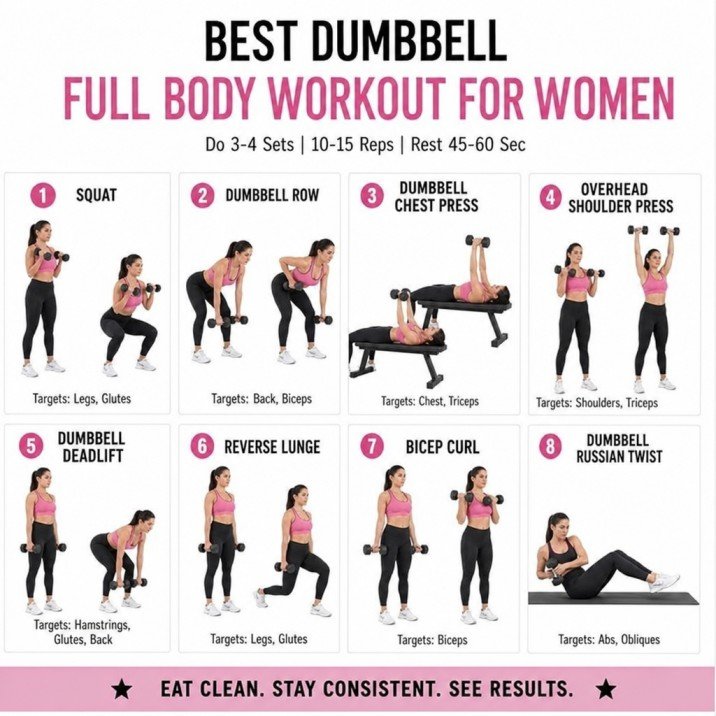
1. Dumbbell Goblet Squat
Sets: 3 | Reps: 10–12
Hold one dumbbell vertically at your chest, cupping the top end with both hands. Stand with feet shoulder-width apart, toes turned out 10 to 15 degrees. Brace your core, take a breath, and sit your hips back and down simultaneously — not just down. Keep your chest tall and your knees tracking directly over your second and third toes. Descend until your thighs are at least parallel to the floor. Drive through the full foot to return to standing. Squeeze your glutes at the top.
Coach’s cue: If your heels rise off the floor, your ankle mobility is limiting your depth. Place a thin plate or folded mat under your heels as a temporary fix while you work on ankle mobility separately.
2. Dumbbell Romanian Deadlift
Sets: 3 | Reps: 10–12
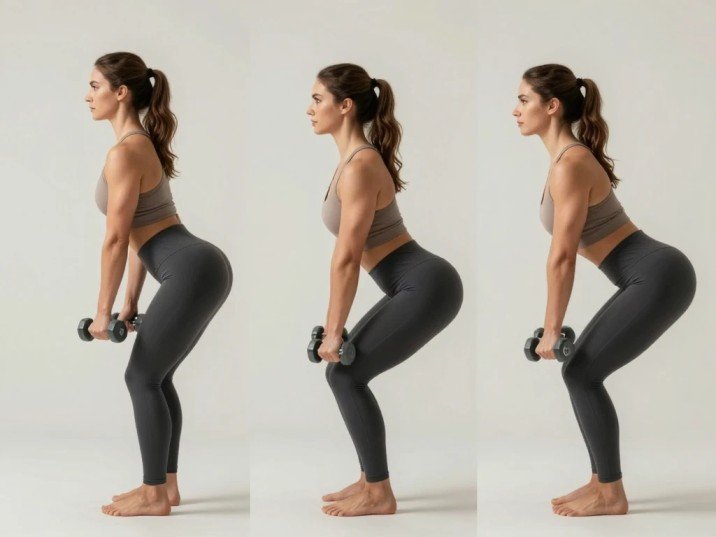
Hold a dumbbell in each hand, hanging at the front of your thighs with palms facing your body. Stand with feet hip-width apart. Before you move: brace your core, pull your shoulders back and down, and take a deep breath into your belly. Hinge at your hips — pushing them straight back — while your hands trace down the front of your legs. Your back stays flat and your spine stays neutral throughout. Lower until you feel a strong tension in your hamstrings, then drive your hips forward to return to standing. The movement ends with your glutes fully contracted, not your lower back extended.
Coach’s cue: Think of the movement as closing a car door with your hips, not lifting with your back. If your lower back rounds, you’ve gone too deep or the weight is too heavy.
3. Dumbbell Reverse Lunge
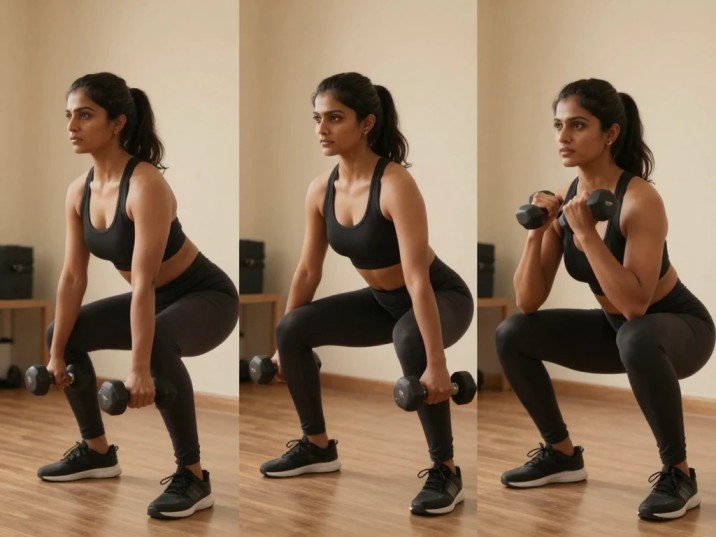
Sets: 3 | Reps: 10 per leg
Hold a dumbbell in each hand at your sides. Stand tall with feet hip-width apart. Step one foot directly backward and lower your back knee toward the floor, stopping just before it touches. Your front shin should remain close to vertical. Keep your torso upright and your core braced throughout. Push through your front heel to return to the starting position.
Coach’s cue: Reverse lunges are significantly more knee-friendly than forward lunges because the loading angle reduces shear force on the patella. If you have knee pain with forward lunges, reverse lunges are almost always comfortable.
4. Dumbbell Floor Press
Sets: 3 | Reps: 10–12
Lie on your back with knees bent and feet flat on the floor. Hold a dumbbell in each hand at chest height, elbows at approximately 45 degrees from your torso. Press both dumbbells up until your arms are fully extended directly above your chest. Lower slowly and with control until your triceps make contact with the floor. Pause for one second, then press again.
Coach’s cue: The floor acts as a natural range-of-motion limiter, removing the portion of the press where shoulder impingement is most likely. This makes it safer than a bench press for most women and requires no bench.
5. Dumbbell Lateral Raise
Sets: 2 | Reps: 12–15
Stand with a dumbbell in each hand at your sides, palms facing inward. Maintain a slight bend in your elbows throughout. Raise both arms out to the sides until they reach shoulder height — no higher. Lower slowly over 3 seconds.
Coach’s cue: Use lighter weight than you think you need. Most women can lateral raise 15 lbs with momentum but only 8 lbs with strict form and a controlled negative. Use the lighter weight. Your shoulders will thank you.
Day B — Upper Body + Hinge
Straight sets. Rest 60 to 90 seconds between sets.
1. Dumbbell Romanian Deadlift (Heavy)
Sets: 3 | Reps: 8–10
Same movement as Day A with one critical difference: use a heavier load and reduce the rep range. You are now training for strength in the hinge pattern, not just learning it. Focus on maximizing hamstring tension at the bottom and glute contraction at the top.
2. Dumbbell Bent-Over Row
Sets: 3 | Reps: 10–12
Hold a dumbbell in each hand. Hinge forward at the hips until your torso is at roughly 45 degrees. Let the dumbbells hang directly below your shoulders. Pull both weights toward your lower rib cage simultaneously, leading with your elbows rather than your hands. At the top, hold for one second and actively squeeze your shoulder blades together. Lower slowly.
Coach’s cue: The most common error here is letting the elbows flare outward, which turns a back exercise into a shoulder exercise. Keep your elbows tracking close to your torso on the way up and down. Think: elbows to hips, not elbows to ceiling.
3. Single-Arm Dumbbell Row
Sets: 3 | Reps: 10–12 per side
Place one hand and the same-side knee on a chair for support. Your spine should be parallel to the floor. Let the dumbbell hang directly below your shoulder. Row it to your hip in a straight line, keeping your elbow close to your body. Lower slowly. Complete all reps on one side before switching.
Coach’s cue: Single-arm rows allow heavier loading than bilateral rows because your torso stabilizers can focus entirely on one side. If you’ve been rowing 15 lbs with both hands, you should be able to single-arm row 20 lbs or more.
4. Dumbbell Shoulder Press
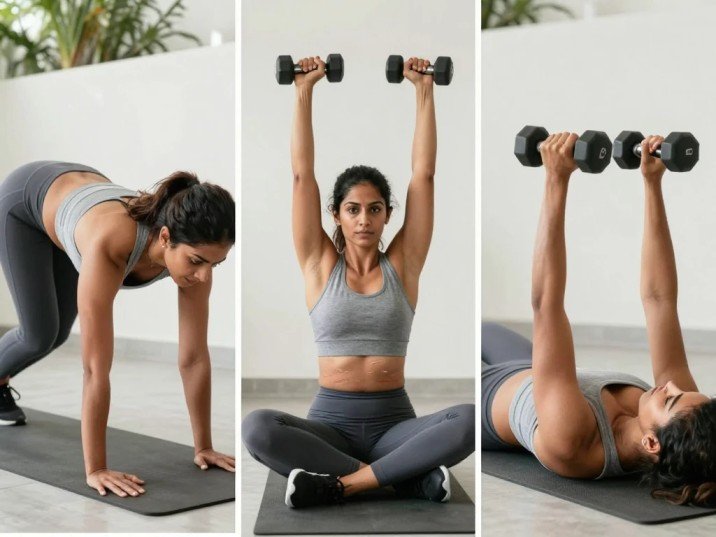
Sets: 3 | Reps: 10–12
Sit or stand with a dumbbell in each hand at shoulder height, palms facing forward. Press both dumbbells directly overhead until your arms are fully extended. Lower slowly to the starting position. Keep your core braced throughout and avoid arching your lower back as the weight gets heavy.
5. Dumbbell Bicep Curl
Sets: 2 | Reps: 12–15
Stand with a dumbbell in each hand, arms at your sides, palms facing forward. Pin your elbows to your sides — they should not move forward during the curl. Curl both weights simultaneously to shoulder height. Lower over 3 full seconds. The eccentric phase is where the most muscle damage and subsequent growth occurs.
6. Dumbbell Tricep Kickback
Sets: 2 | Reps: 12–15 per arm
Hinge forward at the hips until your torso is near parallel to the floor. Hold a dumbbell in one hand and pin your upper arm against your side so it’s parallel to the floor. Extend your forearm back until your arm is fully straight. Hold for one second at the peak contraction, then lower slowly.
Coach’s cue: The tricep makes up roughly two-thirds of your upper arm. If you want defined arms, tricep training matters more than bicep training.
Day C — Full Body Metabolic Circuit
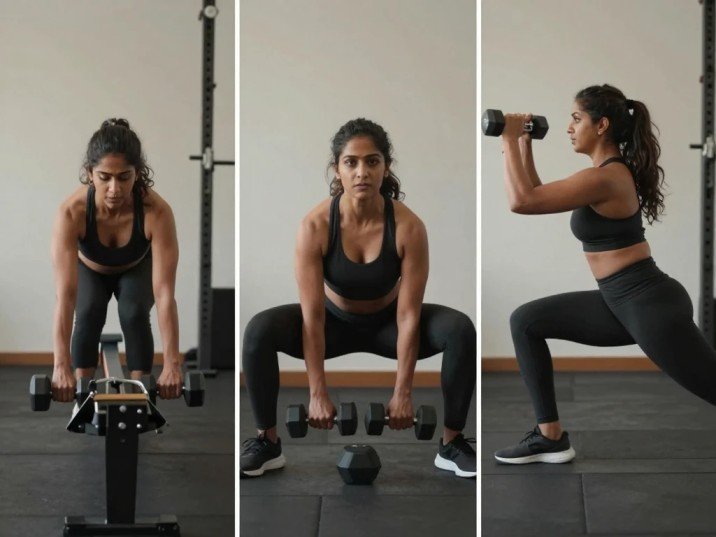
Complete all six exercises back-to-back with 15 to 20 seconds transition time between exercises. Rest 90 seconds after completing the full circuit. Repeat for 3 to 4 rounds total.
This session is intentionally designed to elevate heart rate, increase caloric expenditure, and build muscular endurance. It is harder than Days A and B. That’s the point.
1. Dumbbell Sumo Squat — 15 reps
Stand with feet wider than shoulder-width, toes pointed out 45 degrees. Hold one heavier dumbbell vertically between your legs with both hands. Squat deep — below parallel if your mobility allows — with your knees tracking over your toes. Drive up through the floor. This targets the inner thighs and glutes more directly than a standard squat.
2. Dumbbell Push Press — 10 reps
Hold a dumbbell at each shoulder. Dip your knees slightly, then explosively extend your legs and use that momentum to help drive the dumbbells overhead. Lock out your arms at the top, then lower slowly back to your shoulders. The leg drive allows heavier loads than a strict press, increasing total power output and caloric cost.
3. Dumbbell Reverse Lunge to Curl — 10 reps per leg
Step back into a reverse lunge. At the bottom of the lunge — when both knees are at 90 degrees — perform a full bicep curl with both dumbbells. Drive back to standing. This combination spikes heart rate and works multiple muscle groups simultaneously.
4. Dumbbell Renegade Row — 8 reps per side
Start in a push-up position with a dumbbell in each hand, feet slightly wider than hip-width for stability. Keeping your hips square to the floor, row one dumbbell to your hip while the other supports your weight. Lower it, then row the other side.
Coach’s cue: If your hips are rotating or your lower back is rounding, drop to your knees. A renegade row from the knees with perfect form is dramatically more effective than a full-position row with poor form.
5. Dumbbell Romanian Deadlift to Row — 12 reps
Perform a full Romanian deadlift. At the bottom of the movement, pause and perform a double bent-over row. Drive your hips forward to return to standing. This combination targets the entire posterior chain — hamstrings, glutes, lower back, lats, and rhomboids — in one continuous movement.
6. Dumbbell Goblet Squat Isometric Hold — 30 seconds
Descend into the bottom of a goblet squat and hold. Your quads and glutes are under sustained tension without the relief of standing up. Breathe steadily, keep your chest tall, and don’t let your knees cave in. This is the finisher. Earn it.
Recommended Reps, Sets, and Weight Selection
| Goal | Reps | Sets | Rest | Perceived Effort |
|---|---|---|---|---|
| Strength | 3–6 | 4–5 | 2–3 min | Could do 1–2 more reps |
| Hypertrophy / tone | 8–12 | 3–4 | 60–90 sec | Could do 2–3 more reps |
| Endurance / fat loss | 15–20 | 2–3 | 30–45 sec | Could do 3–5 more reps |
| Beginners | 10–12 | 3 | 60–90 sec | Challenging but controlled |
RPE = Rate of Perceived Exertion on a scale of 1 to 10. A 7 means you could do 3 more reps before failure. A 9 means you could do 1 more rep.
Choosing starting weights: Select a load where the final 2 reps of each set require genuine effort but your form stays perfect. If you finish a set feeling like you could easily do 5 more reps, go heavier. If your form breaks down before you reach the target rep count, go lighter.
Workout Variations for Different Ages and Goals
Full Body Dumbbell Workout for Women Over 40
Hormonal shifts after 40 — particularly declining estrogen — accelerate muscle loss (sarcopenia) and bone density reduction. The good news: resistance training is the single most evidence-based intervention to counteract both.
Key adjustments for women over 40:
- Extend warm-up to 8 to 10 minutes, including dedicated hip mobility and thoracic spine rotation
- Prioritize hip hinge movements which load bone tissue most directly
- Add one rest day per week if recovery feels incomplete
- Focus on progressive overload with moderate loads rather than chasing maximum weights
- Add 5 to 10 minutes of posterior chain stretching after every session
The research on women over 40 and strength training is unambiguous: the women who build and maintain muscle through their 40s have significantly better health outcomes in their 50s and 60s.
Full Body Dumbbell Workout for Women Over 50
Post-menopausal women face the steepest rate of bone density loss in the years immediately following menopause. Resistance training is the most effective non-pharmacological intervention for preserving bone mineral density.
Additional adjustments for women over 50:
- Replace all high-impact variations with controlled, deliberate loading
- Use a sturdy chair or wall for balance assistance on single-leg exercises
- Include dedicated wrist and shoulder joint warm-up before pressing movements
- Start with 2 training days per week and build to 3 as recovery improves
- Consult your physician if you have diagnosed osteoporosis, cardiovascular conditions, or a history of joint replacements
30-Minute Full Body Dumbbell Workout for Women
When time is genuinely limited, use this condensed circuit. It covers all four movement patterns in under 30 minutes.
Complete as a circuit. Rest 60 seconds between rounds. Perform 3 rounds.
- Goblet squat — 12 reps
- Bent-over row — 12 reps
- Romanian deadlift — 12 reps
- Dumbbell floor press — 12 reps
- Reverse lunge — 10 reps per leg
- Lateral raise — 12 reps
Total training time: 24 to 28 minutes. This is not the ideal session. It is significantly better than no session.
Best Practices for Effective Workouts
Warm-Up Protocol (5 to 8 Minutes)
Never skip the warm-up. Cold muscles are injury-prone muscles. Use this sequence before every session:
- 2 minutes of light cardio: marching in place, jumping jacks, or skipping
- 10 bodyweight squats (slow, focus on depth and knee tracking)
- 10 hip circles per side
- 10 arm circles per direction
- 10 cat-cow stretches on hands and knees
- 5 inchworms: walk hands out to push-up position and back, slow and controlled
If you are over 40 or training first thing in the morning, add: 10 glute bridges, 10 banded lateral walks, 10 thoracic rotations per side.
Cool-Down Protocol (5 Minutes)
Post-session, hold each stretch for 30 to 45 seconds:
- Standing quad stretch
- Figure-four glute stretch
- Standing chest opener: clasp hands behind back, gently open chest
- Child’s pose
- Seated hamstring stretch
Proper Form and Technique: The Three Errors That Kill Results
After six years of coaching, these are the most common technique breakdowns — and the specific fixes that work.
Error 1 — Lower back rounding in the Romanian deadlift: This is almost always a failure to brace the core before initiating the hinge. Fix: take a deep breath into your belly before every rep, brace your core as if bracing for a punch, and maintain that intra-abdominal pressure throughout the entire movement.
Error 2 — Elbow flare on rowing movements: When elbows flare outward, the movement shifts from a lat and rhomboid exercise into a rear deltoid exercise. Fix: think about driving your elbow into your back pocket — straight back and down, not up and out.
Error 3 — Knee valgus during squats and lunges: Valgus collapse is disproportionately common in women and is linked to hip abductor weakness. Left uncorrected, it increases ACL stress and produces knee pain over time. Fix: actively push your knees outward against imaginary resistance on every squat rep. Add banded squats to your warm-up for proprioceptive feedback and forced glute activation.
Real-World Case Study: Eight Weeks, One Pair of Dumbbells, Permanent Change
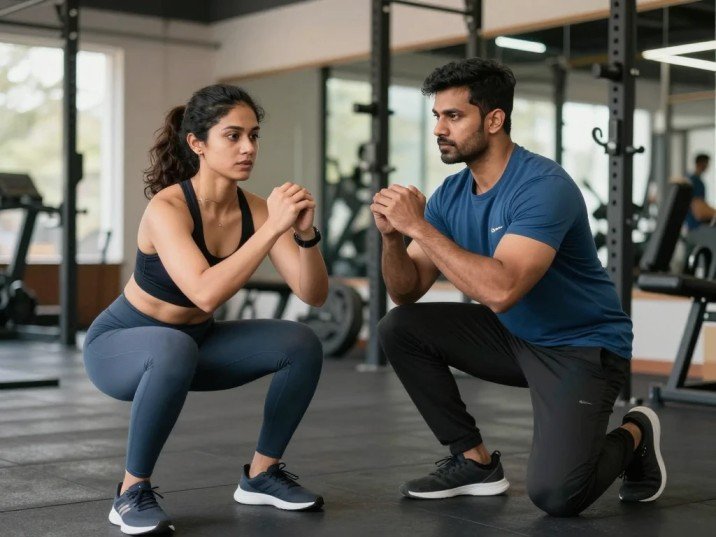
One of my clients — a 38-year-old mother of two from Chicago — came to me after two failed attempts at group fitness classes. She’d quit both times because she felt lost and self-conscious. She had two 10 lb dumbbells, a small living room, and 45 minutes three times a week.
We started her on this exact program. Week one, she struggled to complete two rounds of Day C. Her goblet squat form collapsed below parallel and her Romanian deadlift looked more like a stiff-legged good morning than a true hip hinge. We spent the first two sessions on technique alone.
By week three, the form was there. By week four, she was completing all three rounds of the circuit without stopping. By week six, she had moved up to 15 lb dumbbells on lower body movements and was asking about adding a fourth training day.
At the end of eight weeks:
- 6 lbs of body fat lost
- Measurable definition in her arms, shoulders, and glutes
- Goblet squat progressed from 10 lbs for 8 shaky reps to 20 lbs for 12 clean reps
- Romanian deadlift progressed from 10 lbs to 20 lbs
Her words after the final session: “I’ve never in my life felt strong. This is the first time I’ve actually looked forward to working out.”
She is still training 14 months later. The dumbbells haven’t changed. The person using them has.
Nutrition: The Non-Negotiable Partner
A dumbbell workout program will stall without adequate nutrition aligned behind it. Here’s what matters most.
Protein: Your Highest Priority
Protein is the raw material your body uses to repair and build muscle tissue after training. Without adequate protein, the training stimulus produces breakdown without the subsequent rebuilding.
Target: 0.7 to 1.0 grams of protein per pound of bodyweight per day. For a 150 lb woman, that’s 105 to 150 grams daily.
In my experience, the single most consistent nutritional finding across all my clients is protein under-consumption. Most women I work with come in eating 50 to 70 grams per day. Before you change anything else about your diet, measure your current protein intake for one week. The gap between where you are and where you need to be will motivate the change more than any instruction I can give you.
High-quality protein sources: chicken breast, Greek yogurt (plain, full-fat), eggs, cottage cheese, salmon, lentils, tempeh, whey or plant-based protein powder.
Carbohydrates: Do Not Fear Them
Muscle glycogen — the stored form of carbohydrate — is your primary fuel source for strength training. Severe carbohydrate restriction impairs performance, accelerates fatigue, and makes every session harder than it needs to be. Cut total calories modestly. Don’t eliminate carbohydrates.
Caloric Balance
Body recomposition — building muscle and losing fat simultaneously — is possible, especially for beginners. It requires eating at or slightly below maintenance calories with adequate protein. For women primarily focused on fat loss, a deficit of 200 to 400 calories below maintenance produces consistent, sustainable progress without impairing recovery. Larger deficits produce muscle loss alongside fat loss — the opposite of what this program is designed to achieve.
Hydration
Strength output decreases measurably at dehydration levels as low as 2 percent of bodyweight. Drink a minimum of half your bodyweight in ounces of water daily. Add 16 to 24 oz around each training session.
A Note From a Coach
I want to be honest with you about something before you close this page.
The internet has no shortage of dumbbell workout programs for women. Most of them — including many far less detailed than this one — would produce results if you actually executed them consistently over 8 to 12 weeks.
The program is almost never the variable. You are the variable.
The women I’ve coached who get the most dramatic results are not the most naturally athletic. They are not the most motivated at the start. They are the most consistent over time. They train on Wednesdays when they’re tired. They add 2.5 lbs when the previous weight got comfortable. They eat their protein even when they’d rather not think about food. They trust the process long enough to see it pay off.
Six years of coaching has shown me that discipline beats motivation every single time. Motivation is a feeling. Feelings change daily. Discipline is a decision you make once and re-execute every session.
Make the decision. Start Day A this week. Come back for Day B. Keep going.
Conclusion
The best dumbbell full body workout for women is not the most complex one, the most exhausting one, or the one with the most exercises. It’s the one built on sound principles, executed with intention, and repeated consistently over enough time to let the adaptation process do its work.
You have everything you need. Two pairs of dumbbells. A clear program. The reasoning behind every decision. The coaching cues to execute it correctly.
I’ve watched this program change how women move, how they feel, and how they see themselves — not just physically, but in confidence, in the quiet sense of competence that comes from consistently doing hard things.
Start with Day A this week. Add weight when it gets easy. Stay consistent for eight weeks.
The results will follow.
— Saad
Certified Fitness, Fat Loss & Nutrition Coach
FitnessFlora.com
Frequently Asked Questions
How many days per week should women do dumbbell training?
Three days per week of full body dumbbell training is the optimal starting point for most women. It provides sufficient stimulus for muscle growth and fat loss while allowing adequate recovery. Once you’ve built a foundation over 8 weeks, a 4-day upper/lower split allows greater volume and faster progress.
What weight dumbbells should a woman start with?
Most women do well starting with two pairs: 8 to 12 lbs for upper body and isolation work, and 15 to 25 lbs for lower body movements like squats and Romanian deadlifts. The specific starting weight matters less than choosing something that challenges the last few reps while allowing clean form throughout.
Will dumbbell training help me lose belly fat?
Strength training does not spot-reduce fat. However, full body dumbbell training builds muscle that raises resting metabolic rate and, combined with a modest caloric deficit, reduces overall body fat including the midsection more effectively and permanently than cardio-only approaches.
Can I do this workout at home?
Yes, completely. This program requires no bench, rack, cables, or machines. Two pairs of dumbbells and enough floor space to lie down flat are all you need.
How long before I see results?
Strength improvements typically appear within 2 weeks. Visible body composition changes typically appear after 6 to 8 weeks of consistent training combined with adequate protein intake.
Is this program suitable for women over 50?
Yes — with the modifications outlined above. Resistance training is especially critical for post-menopausal women for bone density, metabolic health, balance, and quality of life. Consult your physician if you have specific health conditions before beginning.
What if I only have one pair of dumbbells?
You can still run this program. Slow the eccentric phase to 4 to 5 seconds and add pauses at the bottom of movements if the weight is too light. Perform isolation exercises one arm at a time if the weight is too heavy for both arms simultaneously.
Should I do cardio in addition to this program?
Light to moderate cardio on rest days — walking, cycling, swimming — supports cardiovascular health without impairing strength gains. Aim for 150 minutes of moderate-intensity cardio per week and let the dumbbell program drive body composition change.