13 Best Full Body Exercises for Strength (2026 Guide)
AUTHOR: Saad | Fitness Flora |LAST UPDATED: June 2026
The 13 best full body exercises for strength are: squats, deadlifts, push-ups, burpees, lunges, pull-ups, bent-over rows, kettlebell swings, planks, shoulder press, mountain climbers, dips, and thrusters. These compound movements train multiple muscle groups at once, making them far more efficient than isolation exercises. Beginners should start with 3 sets of 8–10 reps, 3 days per week, focusing on form before adding weight. Research shows full body training 3x per week produces similar muscle gains to split routines — with less total time in the gym.
I Wasted 6 Months Doing the Wrong Workouts
Six years ago, I was doing what most beginners do — going to the gym five days a week, hitting chest on Monday, back on Tuesday, arms on Wednesday. I was exhausted, my schedule was constantly disrupted, and after six months, I had almost nothing to show for it physically.
My turning point came from a simple conversation with a veteran lifter at my gym. He watched me do my third set of cable curls and said, “Why are you training one muscle when you could train ten?”
He was right. I switched to full body compound exercises and in 8 weeks I was stronger, leaner, and spending 40% less time in the gym.
That’s the power of full body strength training. And in this guide, I’m going to walk you through every exercise I use, exactly how to do each one, the biggest mistakes I see people make, and how to build a complete programme from scratch.
What the Research Actually Says About Full Body Training
Before we get into the exercises, here’s why this approach works — backed by data, not just gym folklore.
A 2016 study published in the Journal of Strength and Conditioning Research found that training each muscle group 3 times per week (full body style) produced significantly greater muscle hypertrophy than training each muscle once per week (bro split style) — even when total weekly volume was equal.
A 2019 meta-analysis of 25 studies found that multi-joint compound exercises activate 40–60% more muscle fibres than single-joint isolation movements.
In plain English: if you want to build real strength in the least amount of time, full body compound training is the most evidence-backed approach available to you.
Full Body vs. Split Routines — Which Should You Actually Choose?
| Factor | Full Body (3x/week) | Push/Pull/Legs Split (5-6x/week) |
|---|---|---|
| Muscle frequency per week | Each muscle 3x | Each muscle 1–2x |
| Time commitment | 3 sessions × 45–60 min | 5–6 sessions × 60–75 min |
| Best for | Beginners, intermediates, busy people | Advanced lifters, dedicated athletes |
| Fat loss | Excellent (higher calorie burn/session) | Moderate per session |
| Strength gains | Very good | Very good |
| Recovery needs | Moderate | High |
| Schedule flexibility | High | Low |
My honest opinion: For 95% of people reading this article, a full body programme 3 times per week will outperform a split — because consistency beats perfection. A split only wins if you can actually show up 5–6 days a week, every week, without fail.
The 13 Best Full Body Exercises for Strength
1. Squat — The Foundation of All Strength
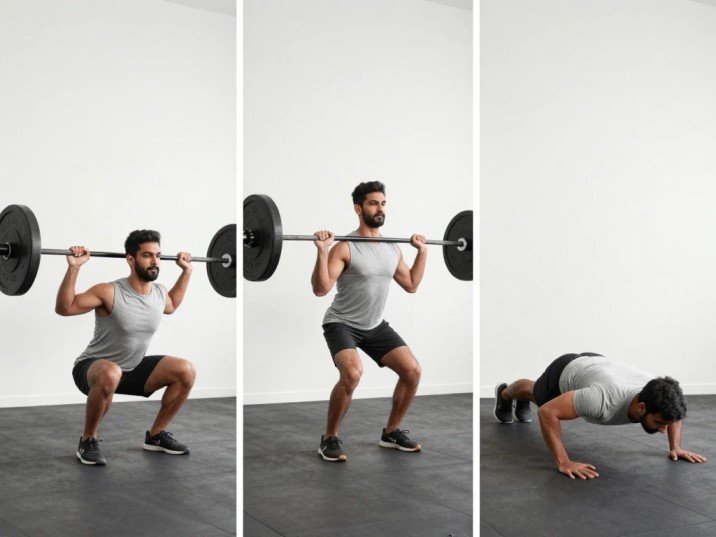
Muscles worked: Quads, hamstrings, glutes, core, lower back Equipment: Bodyweight, barbell, dumbbells, or kettlebell Difficulty: Beginner–Intermediate
The squat is the single most important strength exercise in existence. When I started training clients, the first thing I tested was squat depth — because it tells me everything about someone’s mobility, core strength, and lower body balance.
How to do it (step-by-step):
- Stand with feet shoulder-width apart, toes pointed out 15–30 degrees
- Brace your core as if you’re about to take a punch
- Push your knees out in the direction of your toes as you descend
- Lower until your thighs are at least parallel to the floor (or deeper if mobility allows)
- Drive through your heels to stand back up
- Squeeze your glutes at the top
Sets and reps:
- Beginner: 3 sets × 8–10 reps (bodyweight or goblet squat)
- Intermediate: 4 sets × 5–8 reps (barbell back squat)
- Advanced: 5 sets × 3–5 reps (heavy barbell)
The most common mistake I see: Letting the knees cave inward (valgus collapse) on the way up. This puts enormous stress on the knee ligaments. Fix it by actively pushing your knees out with your hands for 3–5 warm-up reps before adding load.
Beginner modification: Goblet squat with a light dumbbell. It forces you into better posture naturally.
Saad’s personal note: Squats gave me more confidence in daily life than any other exercise. I could carry groceries, lift my nephew, sprint up stairs — without getting winded. Strength that transfers to real life is the best kind.
2. Deadlift — Full Body Power in One Movement
Muscles worked: Hamstrings, glutes, lower back, traps, forearms, core Equipment: Barbell, dumbbells, or kettlebell Difficulty: Intermediate
The deadlift is a full body powerhouse. In a single movement, it trains your posterior chain (everything on the back of your body), builds grip strength, and develops the kind of functional power that makes you genuinely capable in real life.
How to do it (step-by-step):
- Stand with feet hip-width apart, bar over your mid-foot (about 2 cm from your shins)
- Hinge at the hips and grab the bar just outside your legs
- Drop your hips until your shins touch the bar
- Take a big breath, brace your core hard (Valsalva manoeuvre)
- Push the floor away — don’t think “pull the bar up”
- Keep the bar against your body the entire way up
- Lock out by squeezing your glutes at the top
- Hinge back down in reverse, keeping the bar close
Sets and reps:
- Beginner: 3 sets × 5 reps (Romanian deadlift or trap bar)
- Intermediate: 4 sets × 4–6 reps (conventional barbell)
- Advanced: 5 sets × 1–3 reps (heavy conventional or sumo)
The most common mistake I see: Rounding the lower back under load. This is how people injure their discs. Before you add weight, learn to hip hinge with a wooden dowel down your spine — it must stay in contact with the back of your head, upper back, and tailbone.
Beginner modification: Romanian deadlift (RDL) with dumbbells. It teaches the hip hinge pattern with less load and more control.
3. Push-Up — The Bodyweight King
Muscles worked: Chest, shoulders, triceps, core, serratus anterior Equipment: None Difficulty: Beginner
A push-up is not a beginner exercise — it’s a full body exercise that most people do wrong. Done correctly, it’s as challenging and as productive as a bench press, because it requires your entire body to remain rigid throughout.
How to do it (step-by-step):
- Place hands slightly wider than shoulder-width apart
- Form a rigid plank — squeeze glutes, brace core, tuck ribs slightly
- Elbows should travel at roughly 45 degrees from your torso (not flared at 90)
- Lower your chest to within 2–3 cm of the floor
- Pause for one second at the bottom
- Press explosively back to the top
Sets and reps:
- Beginner: 3 sets × 6–10 reps (knee push-up if needed)
- Intermediate: 3–4 sets × 15–20 reps
- Advanced: Weighted push-ups, archer push-ups, or 4 sets × 30+ reps
The most common mistake I see: Sagging hips and a “snaking” motion up from the floor — this means the core isn’t braced and the chest isn’t doing the work. Fix it by holding a rigid plank for 30 seconds before every push-up session.
Progression system I use with clients:
- Week 1–2: Incline push-ups (hands on bench)
- Week 3–4: Standard push-ups
- Week 5–6: Slow-descent push-ups (3 seconds down)
- Week 7+: Weighted vest or archer push-ups
4. Burpee — The Full Body Fat Burner
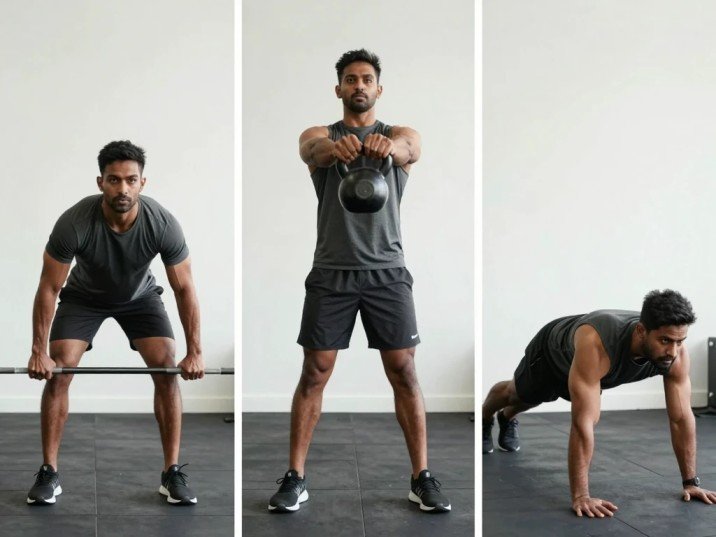
Muscles worked: Full body — chest, shoulders, triceps, quads, hamstrings, glutes, core, cardiovascular system Equipment: None Difficulty: Intermediate
Burpees are the exercise most people love to hate. I understand why — they’re brutal. But nothing else in bodyweight training gives you a simultaneous strength and cardio stimulus like a properly performed burpee.
A 2014 ACE-commissioned study found that burpees burn approximately 13–14 calories per minute when performed at a moderate pace — significantly higher than most steady-state cardio options.
How to do it (step-by-step):F
- Stand tall with feet shoulder-width apart
- Drop your hands to the floor and kick your feet back into a plank
- Perform one full push-up (chest touches floor)
- Jump your feet forward to your hands
- Explode upward into a jump, arms overhead
- Land softly with knees slightly bent
- Immediately drop back down
Sets and reps:
- Beginner: 3 sets × 5 reps (with rest between each rep)
- Intermediate: 4 sets × 10 reps
- Advanced: EMOM (Every Minute on the Minute) × 15 reps for 8–10 minutes
Beginner modification: Step-out burpee — instead of jumping back into a plank, step one foot at a time. Remove the jump at the top. Build volume before adding intensity.
5. Lunge — Single-Leg Strength and Balance
Muscles worked: Quads, glutes, hamstrings, hip flexors, core (stabilisers) Equipment: Bodyweight, dumbbells, or barbell Difficulty: Beginner–Intermediate
Lunges are single-leg exercises, which means they expose and fix muscle imbalances that bilateral exercises (squats, deadlifts) can hide. I’ve had clients who could squat 100 kg but couldn’t do 10 controlled reverse lunges without wobbling.
How to do it (step-by-step):
- Stand tall with feet together
- Step forward with your right foot, about 60–80 cm
- Lower your back knee toward (but not touching) the floor
- Both knees should be at approximately 90 degrees at the bottom
- Push through your front heel to return to standing
- Repeat on the left side
Sets and reps:
- Beginner: 3 sets × 8 reps each leg (bodyweight)
- Intermediate: 3 sets × 10–12 reps each leg (dumbbells at side)
- Advanced: Bulgarian split squat, 4 sets × 8 reps (rear foot elevated)
Lunge variations ranked by difficulty:
- Forward lunge (easiest)
- Reverse lunge (more knee-friendly)
- Walking lunge
- Lateral lunge
- Bulgarian split squat (hardest)
6. Pull-Up — The True Test of Upper Body Strength
Muscles worked: Lats, biceps, rhomboids, rear deltoids, core Equipment: Pull-up bar Difficulty: Intermediate–Advanced
Pull-ups are the upper body equivalent of the squat — the fundamental test of pulling strength. They also happen to be the exercise most people skip because they can’t do them yet. That’s exactly why you should train them.
How to do it (step-by-step):
- Hang from the bar with an overhand grip, slightly wider than shoulder-width
- Depress your shoulder blades downward (don’t shrug into your ears)
- Squeeze your lats as if you’re trying to put your shoulder blades in your back pockets
- Pull until your chin clears the bar
- Lower under control — take 2–3 seconds to descend
- Full dead hang at the bottom before the next rep
Sets and reps:
- Beginner: Negative pull-ups only (jump to top, lower for 5 seconds), 3 sets × 5
- Intermediate: 3–4 sets × 5–8 reps
- Advanced: 4–5 sets × 10–15 reps, or weighted pull-ups
The progression I used myself to go from 0 to 15 pull-ups in 8 weeks:
- Week 1–2: Dead hangs (30–45 seconds) + negative pull-ups
- Week 3–4: Band-assisted pull-ups (heavy band), 3×8
- Week 5–6: Band-assisted (light band), 3×6 + negatives
- Week 7–8: Unassisted pull-ups, building from 2–3 reps per set
7. Bent-Over Row — Posture Fixer and Back Builder
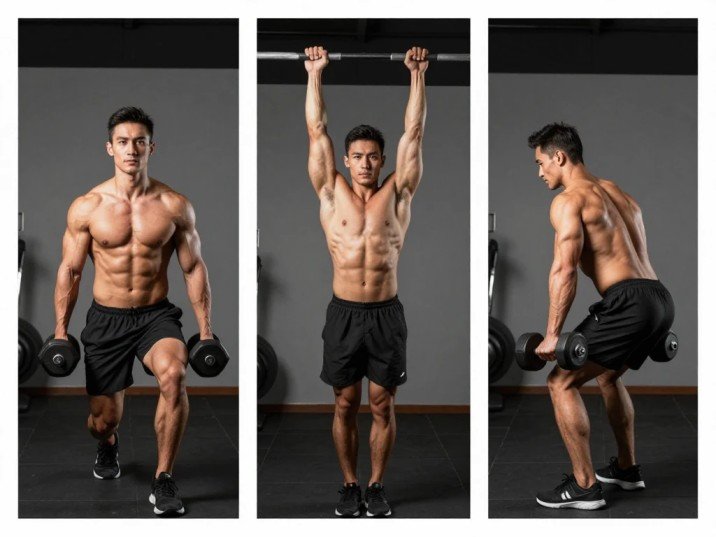
Muscles worked: Lats, rhomboids, traps, rear deltoids, biceps, erectors (stabilisers) Equipment: Barbell or dumbbells Difficulty: Intermediate
If you spend time at a desk, you almost certainly have tight chest muscles and weak upper back muscles — a combination that causes rounded shoulders and forward head posture. Bent-over rows directly counteract this. I consider them a mandatory exercise for anyone who sits for more than 4 hours per day.
How to do it (step-by-step):
- Stand with feet hip-width apart, hinge at the hips until torso is roughly 45 degrees
- Hold barbell (or dumbbells) with an overhand grip, arms hanging straight down
- Brace core to protect the lower back
- Row the bar to your lower chest/upper abdomen — elbows drive back and up
- Squeeze your shoulder blades together at the top for one second
- Lower under control
Sets and reps:
- Beginner: 3 sets × 10–12 reps (light dumbbells)
- Intermediate: 4 sets × 6–10 reps (barbell)
- Advanced: Pendlay row or Yates row, 4 sets × 5 reps (heavy)
8. Kettlebell Swing — Explosive Power and Posterior Chain
Muscles worked: Glutes, hamstrings, lower back, core, shoulders, grip Equipment: Kettlebell Difficulty: Intermediate
The kettlebell swing is one of the most misunderstood exercises in fitness. People treat it like a squat-and-raise movement. It isn’t. It’s a hip hinge with explosive power — closer to a deadlift than a squat.
A study by the American Council on Exercise found that 20 minutes of kettlebell swings burns an average of 272 calories — comparable to running at a 6-minute-per-kilometre pace.
How to do it (step-by-step):
- Stand over the kettlebell, feet slightly wider than shoulder-width
- Hinge at the hips and grip the handle with both hands
- Hike the kettlebell back between your legs like a football snap
- Drive your hips forward explosively — the power comes from the glutes, not the arms
- Let the bell float to chest height naturally
- Let it swing back between your legs and immediately repeat
Sets and reps:
- Beginner: 3 sets × 10 reps (light kettlebell, 12–16 kg)
- Intermediate: 4 sets × 15–20 reps
- Advanced: EMOM, 20 reps per minute for 10 minutes
Key cue I use with every client: “Imagine slamming a car door shut with your hips.” The explosive hip snap is everything.
9. Plank — Core Stability That Transfers to Everything
Muscles worked: Transverse abdominis, rectus abdominis, obliques, glutes, shoulders Equipment: None Difficulty: Beginner
The plank isn’t a rest exercise. Most people who think they’re doing planks are actually doing a very slow push-up position collapse. A real plank is a full-body contraction — every muscle working simultaneously.
How to do it (step-by-step):
- Rest on forearms and toes, elbows directly under shoulders
- Squeeze your glutes — this is the cue most people miss
- Tuck your pelvis slightly (posterior tilt) — flatten your lower back
- Pull your navel toward your spine
- Keep your neck neutral (look at the floor, not ahead)
- Hold without any sagging or piking
Progressions (in order):
- Knee plank (30–45 seconds)
- Full plank (30–60 seconds)
- Extended plank (arms further forward)
- Plank with shoulder taps (20–30 taps)
- RKC plank (maximum contraction, 10–20 seconds)
- Single-arm plank
Sets and time:
- Beginner: 3 sets × 20–30 seconds
- Intermediate: 3 sets × 45–60 seconds
- Advanced: 3 sets × 60–90 seconds, or RKC plank variations
10. Shoulder Press — Overhead Strength and Stability
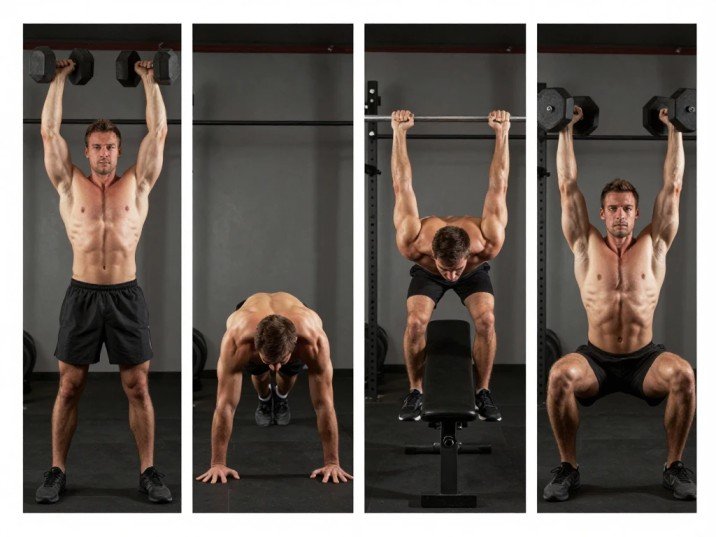
Muscles worked: Anterior deltoid, medial deltoid, triceps, upper traps, core (stabilisers) Equipment: Dumbbells, barbell, or kettlebell Difficulty: Intermediate
The overhead press is one of the best indicators of total upper body strength. It also exposes shoulder mobility limitations immediately — if you can’t press overhead without arching your lower back dramatically, you have mobility work to do before loading.
How to do it (dumbbell version, step-by-step):
- Sit on a bench (or stand — standing is harder and more functional)
- Hold dumbbells at shoulder height, palms facing forward
- Brace your core and squeeze your glutes
- Press straight up until arms are fully extended
- Lower under control back to shoulder height
- Don’t flare the elbows out — keep them at about 30–45 degrees
Sets and reps:
- Beginner: 3 sets × 10–12 reps (light dumbbells)
- Intermediate: 4 sets × 6–8 reps (dumbbells or barbell)
- Advanced: Standing barbell press, 5 sets × 3–5 reps
11. Mountain Climber — Cardio and Core Combined
Muscles worked: Core, hip flexors, chest, shoulders, quads Equipment: None Difficulty: Beginner–Intermediate
Mountain climbers are essentially a moving plank. They elevate your heart rate while building core endurance — which makes them excellent for fat loss training circuits.
How to do it (step-by-step):
- Start in a high plank position — hands under shoulders, body rigid
- Drive your right knee toward your chest
- Return it and simultaneously drive your left knee forward
- Keep your hips level — don’t pike up or sag
- Move at a pace that’s challenging but controlled
Sets and reps:
- Beginner: 3 sets × 20 reps (slow, controlled)
- Intermediate: 3 sets × 30–40 reps (moderate pace)
- Advanced: 4 sets × 30 seconds (fast pace or cross-body variation)
12. Dip — Tricep and Chest Power
Muscles worked: Triceps, chest (lower), anterior deltoid Equipment: Parallel bars or chair Difficulty: Intermediate
Dips are one of the most underrated upper body exercises. When done on parallel bars with full range of motion, they load the triceps and chest in a way that most gym machines simply can’t replicate.
How to do it (step-by-step):
- Support yourself on parallel bars with straight arms
- Slightly lean forward (10–15 degrees) to emphasise the chest
- Lower yourself by bending the elbows until your upper arms are roughly parallel to the floor
- Pause at the bottom for one second
- Press back up to the starting position
Sets and reps:
- Beginner: Assisted dips (machine or band), 3 sets × 8–10
- Intermediate: 3–4 sets × 10–12 bodyweight
- Advanced: Weighted dips, 4 sets × 6–8 reps
Chair modification: If you don’t have parallel bars, a sturdy chair works fine. Keep your hips close to the seat and lower until elbows reach 90 degrees.
13. Thruster — Total Body Conditioning in One Rep
Muscles worked: Quads, glutes, hamstrings, shoulders, triceps, core Equipment: Barbell, dumbbells, or kettlebells Difficulty: Advanced
The thruster is the most demanding exercise on this list — and the most rewarding. It combines a front squat with an overhead press in a single fluid movement. CrossFit athletes use it in “Fran” (one of the most famous conditioning benchmarks in the sport) for good reason.
How to do it (step-by-step):
- Hold dumbbells or a barbell at shoulder height (front rack position)
- Squat to parallel or below with the weight at shoulders
- As you drive up from the squat, use that momentum to press the weight overhead
- Fully extend arms at the top
- Lower back to shoulders as you simultaneously descend into the next squat
Sets and reps:
- Beginner: 3 sets × 5–6 reps (light weight, focus on form)
- Intermediate: 4 sets × 8 reps
- Advanced: 3 rounds × 21-15-9 reps (thruster + pull-up) for time
The Research-Backed Reason Full Body Training Works
Here’s a framework I call the 3M Principle — the three mechanisms that make full body training superior for most people:
1. Muscle Frequency (more practice = more strength) You train each muscle 3x per week instead of 1x. Think of it like language learning — practising Spanish daily beats one 3-hour cramming session once a week.
2. Metabolic Demand (more muscle = more calories burned) When you activate your entire body in a single session, your metabolic rate stays elevated for up to 48 hours post-exercise (EPOC — Excess Post-exercise Oxygen Consumption). Isolation exercises simply don’t create the same effect.
3. Motor Pattern Reinforcement (better movement quality) Performing compound lifts 3x per week means your nervous system gets 3x as many opportunities to refine the movement pattern. This is why full body trainees tend to have better form than split trainees — they get more practice.
My Recommended Beginner Full Body Programme (3 Days/Week)
Use this as your starting template. Run it for 8–12 weeks before progressing.
Day A:
| Exercise | Sets | Reps | Rest |
|---|---|---|---|
| Squat | 3 | 8 | 90 sec |
| Push-Up | 3 | 10 | 60 sec |
| Bent-Over Row | 3 | 10 | 60 sec |
| Plank | 3 | 30 sec | 45 sec |
Day B:
| Exercise | Sets | Reps | Rest |
|---|---|---|---|
| Deadlift | 3 | 5 | 2 min |
| Dumbbell Shoulder Press | 3 | 10 | 60 sec |
| Lunge | 3 | 8/leg | 60 sec |
| Mountain Climbers | 3 | 20 | 45 sec |
Day C (Friday/Saturday):
| Exercise | Sets | Reps | Rest |
|---|---|---|---|
| Squat | 3 | 10 | 90 sec |
| Pull-Up (or band-assisted) | 3 | 5–8 | 90 sec |
| Push-Up | 3 | 12 | 60 sec |
| Kettlebell Swing | 3 | 15 | 60 sec |
Schedule: Monday / Wednesday / Friday (or any 3 non-consecutive days)
Progressive overload rule: Add 2.5 kg (or 1 rep) to each exercise every week you complete all sets and reps successfully.
Real-World Case Study: Omar’s 12-Week Transformation
Omar came to me in January 2025. He was 34, worked a desk job, hadn’t trained seriously in 3 years, and could do exactly 2 pull-ups. His goals: gain strength, lose the belly fat he’d accumulated, and have enough energy to play football with his kids at the weekend.
I put him on a 3-day full body programme — almost identical to the one above.
Week 12 results:
- Pull-ups: from 2 to 11
- Squat: from 40 kg to 80 kg (5 reps)
- Body fat: estimated down 4%
- He reported being able to play 45 minutes of five-a-side without getting winded
The programme wasn’t complicated. What changed Omar’s body was showing up consistently 3 times a week and adding small amounts of weight each week. That’s it.
The 5 Biggest Full Body Training Mistakes (and How to Fix Them)
Mistake 1: Skipping the warm-up Cold muscles tear. Spend 5–8 minutes on dynamic movements — leg swings, arm circles, hip hinges, bodyweight squats — before loading anything.
Mistake 2: Going too heavy too soon Ego is the enemy of progress. Your form should be perfect at every weight. If it breaks down, the weight is too heavy. Start lighter than you think you need to.
Mistake 3: Not sleeping enough Muscles grow during sleep, not during the workout. Under 7 hours per night and your recovery is compromised regardless of how well you train. A 2019 study found sleep deprivation reduces muscle protein synthesis by up to 18%.
Mistake 4: Treating nutrition as optional You cannot out-train a poor diet. Aim for 1.6–2.2g of protein per kg of bodyweight per day to support muscle growth and recovery.
Mistake 5: Doing the same workout every week Progressive overload is the engine of strength. You must consistently challenge your muscles with more weight, more reps, or less rest — otherwise adaptation stops.
About the Author
I am a fitness and fat loss coach with over 6 years of hands-on experience helping everyday people build strength, lose fat, and stay consistent with training. Through Fitness Flora, I shares practical, no-nonsense fitness advice grounded in real coaching experience and backed by current research. His focus is on sustainable results that actually fit into a busy life — no complicated programmes, no gimmicks.
Final Thought
Thirteen exercises. Three sessions per week. Consistent effort over 8–12 weeks.
That’s all you need to build a genuinely strong, functional body. The exercises in this guide aren’t exciting or trendy — but they’ve been proven to work for decades, and they’ll continue to work long after the latest fitness fad has been forgotten.
Pick the beginner programme, start this week, and trust the process.
Related Articles:
- 10 Bodyweight Back Exercises to Build a Strong Back at Home
- How to Tone Your Body: A Complete Guide for Lasting Results
- Full Body Workout Routine for Women
Common Questions People Ask Me
Q: Can I do full body exercises every day?
You can do light bodyweight movements daily, but you shouldn’t train intensely with weights every day. Your muscles need 48–72 hours to recover between sessions. Three to four times per week is the sweet spot for most people.
Q: Are full body exercises better for fat loss or muscle gain?
Both, depending on how you programme them. For fat loss, use shorter rest periods (30–60 seconds) and add metabolic exercises like burpees and mountain climbers. For muscle gain, use heavier weights, longer rests (90–120 seconds), and focus on progressive overload.
Q: Can I build a great physique with just bodyweight full body exercises?
Yes — but there’s a ceiling. Bodyweight training will build a strong, lean physique at a beginner to intermediate level. Beyond that, you’ll need to add external resistance (dumbbells, barbells, or weighted vest) to keep progressing.
Q: How long should a full body workout session take?
For most people, 45–60 minutes is ideal. Beyond 60 minutes, cortisol levels rise and returns diminish. If your session is consistently running 75+ minutes, you’re either doing too much volume or resting too long.
Q: Do I need gym equipment for these exercises?
For the bodyweight exercises (push-ups, pull-ups, planks, lunges, mountain climbers, burpees), no. For squats, deadlifts, rows, shoulder press, kettlebell swings, dips, and thrusters — you need some form of resistance (barbells, dumbbells, or kettlebells). A basic dumbbell set at home handles 80% of these exercises.
Q: What should I eat before a full body workout?
Eat a balanced meal 60–90 minutes before training. Aim for carbohydrates (rice, oats, bread) and protein (eggs, chicken, Greek yoghurt). Avoid high-fat foods immediately pre-workout — they slow digestion and can cause discomfort during intense training.
Q: I’m a beginner. Where should I start?
Start with Day A of the beginner programme above. Focus entirely on bodyweight versions of each exercise for the first 2 weeks. Don’t rush to add weight — perfect form first, load second.
Q: How do I know when to increase the weight?
When you can complete all sets and all reps with perfect form, feeling like you had 2–3 reps left in the tank, it’s time to add weight. This is called the “2-in-2 rule” — if you hit all reps for 2 consecutive sessions, increase the load.